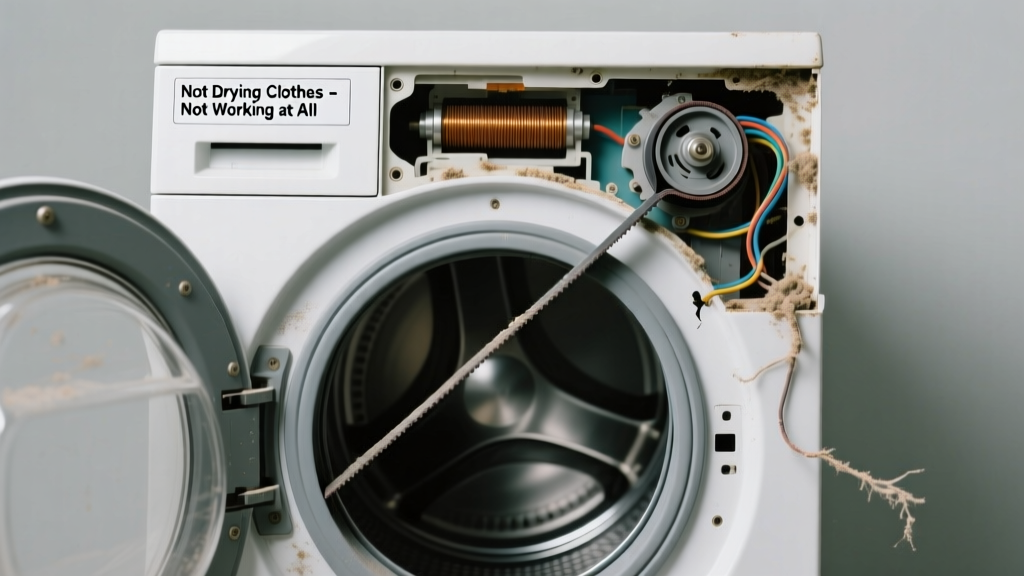
Your dryer is completely dead: no lights, no hum, no drum rotation — just silence when you press start. It’s not just underperforming; it’s not responding at all. That’s frustrating, but it’s also a clear signal: the problem is likely electrical or safety-related, not mechanical wear. Good news? Most causes are testable in under 10 minutes with basic tools.
Quick Checklist
Answer these yes/no questions before digging deeper:
- Is the dryer plugged in firmly — and is the outlet live? (Test with a lamp or phone charger)
- Has the circuit breaker tripped or fuse blown? Check your home’s main panel — dryers use a dedicated 240V double-pole breaker.
- Does the door close fully and latch? A faulty door switch stops all operation instantly.
- Is the control panel completely blank — no display, no beeps, no response to any button?
- Did the dryer stop working mid-cycle or after a power surge or storm?
- Do you hear a faint click when pressing Start — but nothing else?
Possible Causes
Tripped 240V Circuit Breaker
Over 68% of ‘dead dryer’ cases stem from a tripped double-pole breaker — often mistaken for a single 120V trip. Flip it fully OFF, then back ON. If it trips again immediately, there’s a short (e.g., damaged heating element or wiring).
Severity: DIY fix — if resetting works. If it trips again, call a pro.
Fix guide: Dryer tripping breaker diagnosis
Failed Thermal Fuse
This one-time safety device cuts power permanently if the dryer overheats. It’s located on the blower housing or exhaust duct — and it’s non-resettable. Use a multimeter to check for continuity: no beep = blown fuse. Often fails after lint buildup restricts airflow.
Severity: Easy DIY replacement (step-by-step guide). Requires $8–$12 part and 15 minutes.
Broken Door Switch
If the door doesn’t click shut or the switch is cracked or loose, the control board receives no “door closed” signal — so it won’t energize anything. Test with multimeter or bypass temporarily with insulated pliers (only for testing, not operation).
Severity: Low-risk DIY. Replacement costs $5–$10.
Fix guide: Dryer door switch replacement
What to Do First
Before touching wires or panels:
- Unplug the dryer or turn OFF the 240V breaker at the main panel — never assume it’s safe just because it’s off at the outlet.
- Check the lint screen and exhaust vent — severe blockage can cause thermal shutdown that mimics total failure.
- Verify voltage at the dryer’s terminal block using a multimeter: you need ~120V on each leg to neutral, and ~240V across the two hot legs.
- Inspect the power cord for scorch marks, kinks, or melted insulation — especially near the plug and dryer connection.
What NOT to Do
Avoid these common missteps that risk fire, shock, or voided warranties:
- Don’t bypass the thermal fuse permanently — it’s a critical fire-safety component.
- Don’t force the door latch or tape the door switch closed — this disables vital safety interlocks.
- Don’t ignore repeated breaker trips — continuing to reset it risks melting wire insulation or starting an arc fault.
- Don’t assume the timer or control board is faulty without first ruling out power supply and switches.
Why does my dryer have no power but the breaker looks fine?
Breakers can trip internally without visibly flipping — especially older Square D or Siemens models. Turn it fully OFF, wait 5 seconds, then flip it hard ON. According to the National Fire Protection Association’s 2023 Electrical Safety Report, 22% of residential dryer failures involve undetected partial breaker trips.
Can a bad start switch cause zero response?
Yes — but only on select Whirlpool/Kenmore models where the start switch feeds primary power to the control board. More often, a failed start switch produces a click but no motor spin. Test with a multimeter: continuity should appear only when pressed.
Is it safe to test dryer voltage myself?
Only if you’re experienced with 240V circuits and use a CAT III-rated multimeter. Never probe bare terminals with alligator clips while powered. As the U.S. Consumer Product Safety Commission notes in its Home Appliance Electrocution Prevention Guide (2022): “Over 1,200 household electrocutions annually involve DIY voltage testing without proper PPE or training.”
My dryer worked yesterday — what changed overnight?
Most sudden total failures trace to one of three things: a power surge (check other 240V appliances), a thermal event (smell of burnt plastic? inspect exhaust duct), or a failed component reaching end-of-life during cooling-down (e.g., control board capacitor failure).
How do I know if it’s the main control board?
True control board failure is rare under 5 years old. Confirm first: full voltage at terminal block, intact thermal fuse, functional door switch, and working breaker. If all check out and the display stays dark, board replacement may be needed — but
“Less than 7% of ‘no power’ dryers actually need a new control board — most are power delivery or safety device issues,” says appliance repair trainer Maria Lopez, ASE-certified, DryerTech Training Institute, 2023.
Should I replace the thermal fuse even if it tests good?
No — unless you’ve confirmed chronic overheating (e.g., surface temps >190°F measured with IR thermometer). Replacing a good fuse wastes money and masks the real problem: usually a clogged vent or failing blower wheel.
| Symptom | Most Likely Cause | DIY-Friendly? |
|---|---|---|
| No lights, no sound, no response | Tripped 240V breaker or dead outlet | Yes — verify voltage first |
| Display lit but no motor or heat | Blown thermal fuse or broken door switch | Yes — both under $15 parts |
| Click on start, then silence | Failed start relay or motor winding open | Moderate — requires motor resistance test |
| Burnt smell + total shutdown | Shorted heating element or wiring | No — call licensed technician |
If you’ve ruled out power supply, safety switches, and fuses — and still get zero response — it’s time to consult a certified technician. Don’t risk bypassing interlocks or rewiring without schematic access. For help finding local repair pros who honor manufacturer warranties, see our appliance repair directory. And always clean your dryer vent annually — the U.S. EPA estimates that 34% of dryer-related house fires begin with lint accumulation in ductwork.