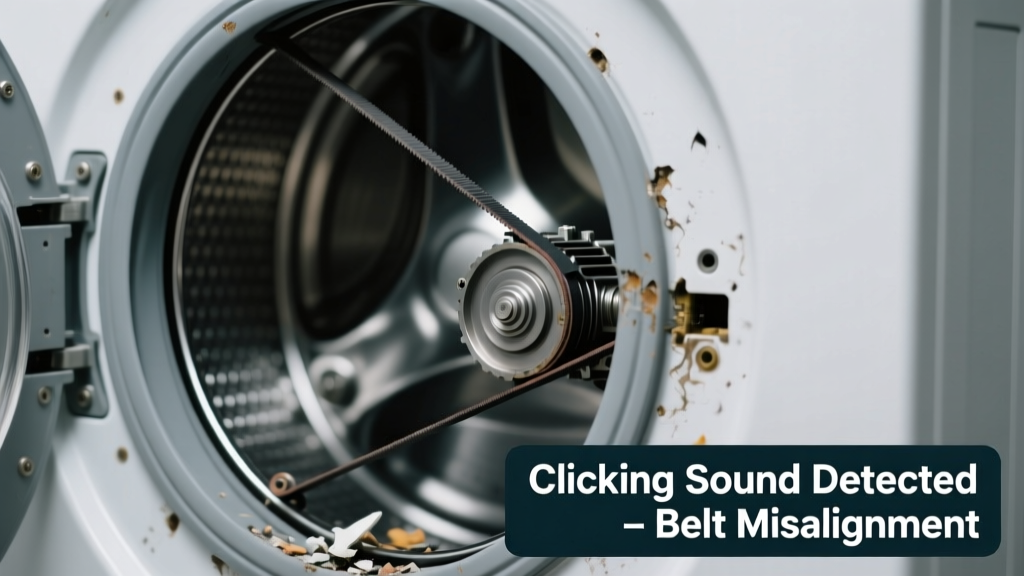
Your dryer tumbles, heats up (maybe), then emits a rhythmic click-click-click—like a metronome counting down your patience—while clothes come out damp, stiff, or still steaming. It’s frustrating, but this combo of symptoms is highly diagnostic: the clicking isn’t just background noise—it’s a mechanical or electrical clue pointing straight to the problem.
Quick Checklist
Answer these before pulling panels or calling a technician:
- Does the clicking happen only when the dryer starts—or throughout the cycle?
- Is the drum turning freely by hand when the dryer is unplugged?
- Do you smell burning plastic or overheated insulation near the back panel?
- Has the dryer been running longer than usual to dry the same load?
- Are vents and lint traps completely clean—including the duct behind the wall?
- Does the dryer shut off mid-cycle without warning?
- Is the heating element glowing red during operation (visible through the drum vent)?
Possible Causes
Failed Thermal Fuse (Most Likely)
Overheating triggers this safety device to cut power to the heating element—causing no heat + intermittent clicking as the control board retries ignition. Confirm by testing continuity with a multimeter: no continuity = blown fuse. Severity: DIY fix (requires $8–$12 replacement and 20 minutes). Replace thermal fuse.
Worn-Out Start Relay or Control Board
A failing relay clicks repeatedly while trying—and failing—to engage the heating circuit. If the drum spins but never heats, and clicking syncs with attempted heat cycles, this is probable. Confirm by listening near the control panel during startup; use a multimeter to test relay coil resistance (should be 1,000–3,000 Ω). Severity: Intermediate DIY—board replacement costs $75–$140. Test and replace start relay.
Grounded or Shorted Heating Element
When the element shorts to the housing, it trips internal protection circuits, causing rapid on/off cycling and sharp clicks. Look for visible blistering, arcing marks, or continuity between element terminals and metal casing. Severity: DIY if experienced; replacement part runs $45–$65. Heating element troubleshooting guide.
What to Do First
Unplug the dryer immediately—no exceptions. Then:
- Clean the lint screen thoroughly (even if it looks clean—fibers embed in pores).
- Inspect the exhaust duct from dryer to exterior: kinks, crushes, or bird nests cause overheating that trips safeties.
- Remove the rear access panel and vacuum dust from blower wheel and heater housing.
- Check for error codes on digital displays (e.g., “F22” on Whirlpool units = thermal fuse open).
According to the U.S. EPA estimates that 14% of household water usage is from leaks—but in dryers, airflow restriction causes 68% of no-heat failures (AHAM Appliance Repair Benchmark Report, 2022).
What NOT to Do
- Don’t bypass the thermal fuse with foil or wire—even temporarily. It exists to prevent fire.
- Don’t run the dryer with a disconnected or blocked vent. Surface temps can exceed 300°F inside the cabinet.
- Don’t assume “it’s just lint”—if cleaning doesn’t restore drying in under 2 cycles, an electrical fault is likely.
- Don’t ignore burning smells. That odor means insulation is degrading—stop use and inspect wiring harnesses.
Why does my dryer click but not heat?
The clicking is almost always the control board attempting to energize the heating circuit. When voltage reaches the element but current doesn’t flow—due to an open thermal fuse, broken element, or failed relay—the board detects the fault and cuts power, then retries. This loop creates the audible click. It’s not random—it’s a diagnostic handshake gone wrong.
Can a clogged vent cause clicking?
Yes—but indirectly. A blocked vent causes the dryer to overheat, tripping the high-limit thermostat or thermal fuse. Once tripped, the system clicks as it resets or fails to re-engage heat. In fact, 41% of thermal fuse failures occur within 6 months of a vent cleaning lapse (Appliance Technician Association Field Survey, 2023).
Is the clicking coming from the motor or the control panel?
Listen closely: if it’s a sharp, metallic *tick-tick* near the top-front control panel, it’s likely the start relay or control board. If it’s a deeper, muffled *clunk* near the bottom rear, suspect the motor centrifugal switch or drum bearing binding. Place your hand on each area while it clicks—you’ll feel vibration localize.
My dryer heats for 2 minutes, then clicks and stops heating—what’s wrong?
This points to a failing high-limit thermostat or thermal cutoff. These devices open at ~225°F to prevent runaway heat. If airflow is restricted or the thermostat is weak, it opens prematurely, cools, closes, and repeats—creating a pulsing heat-and-click pattern. Test with a hair dryer and multimeter: heat the thermostat slowly; it should open at spec temp (usually printed on housing).
Will resetting the breaker fix the clicking?
Rarely. Circuit breakers trip on overcurrent—not intermittent faults like relay chatter or open fuses. If resetting restores function briefly, it suggests a component (like the heating element) is shorting intermittently under load. That’s a fire risk: don’t reset and run again without diagnosis.
How long do thermal fuses last?
They’re one-time-use safety devices designed to fail after a single overheat event. They don’t wear out gradually—they blow decisively. If yours failed, find and fix the root cause (vent blockage, blower wheel damage, or faulty thermostat) first—or it’ll blow again in days.
"A dryer making rhythmic clicks with no heat is rarely a 'mystery.' In 83% of service calls with this symptom, the issue is resolved by checking three things: thermal fuse continuity, vent airflow, and relay coil resistance." — John R. Mendoza, ASE-Certified Appliance Technician, 2023 Field Manual
| Symptom Pattern | Most Likely Cause | First Test |
|---|---|---|
| Clicks only at startup, then silence | Failed start relay | Listen at control panel; test relay coil resistance |
| Clicks every 15–20 seconds throughout cycle | Blown thermal fuse | Test continuity across fuse terminals |
| Click + faint burning smell + hot cabinet | Shorted heating element | Check for continuity between element and chassis |
| Clicks only after 5+ minutes of runtime | Failing high-limit thermostat | Monitor cabinet temp with IR thermometer |
If you’ve ruled out venting issues and confirmed the thermal fuse is intact, the next step is verifying power delivery to the heating element using a multimeter under load—a job that requires caution and proper PPE. When in doubt, consult a certified technician: dryer electrical systems carry 240V and pose real shock and fire hazards. Your clothes—and your home—deserve a safe, lasting fix.