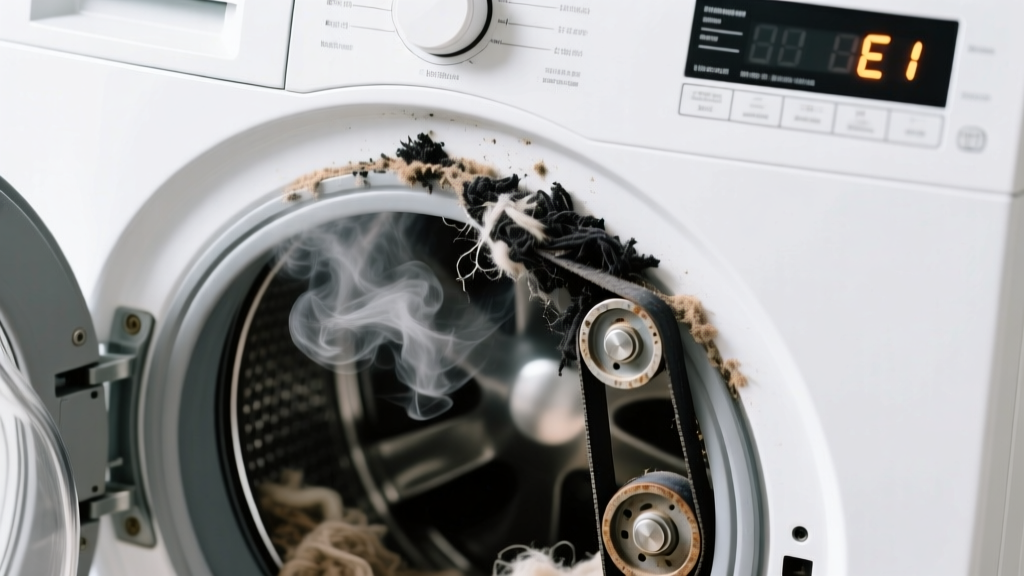
Your dryer suddenly sounds like a freight train grinding through gravel—and now there’s a sharp, acrid odor, like burnt plastic or overheated wires. It’s alarming, but most causes are identifiable in under 10 minutes—and many are fixable without a service call.
Quick Checklist
- Does the noise start only when the drum spins (not during startup or cool-down)?
- Is the smell strongest right after starting—or does it linger even after turning off?
- Have you cleaned the lint filter and vent duct in the last 3 months?
- Do you hear a rhythmic thumping, high-pitched squeal, or intermittent grinding?
- Has the dryer been running longer than usual to dry clothes?
- Are clothes coming out with visible scorch marks or stiff, heat-damaged fibers?
- Did the smell coincide with a recent power surge or tripped breaker?
Possible Causes
Lint buildup in exhaust duct or blower wheel
Confirm by removing the rear access panel and inspecting the blower wheel for clumps of compacted lint; check the rigid metal duct behind the dryer for blackened residue or airflow resistance. Severity: Low—DIY fix. Clean dryer vent and blower wheel.
Worn drum support rollers or idler pulley
Listen closely: a rhythmic thump every 2–3 seconds points to flat-spotted rollers; a constant squeal suggests dried-out idler pulley bearings. Severity: Medium—requires basic tools and drum roller replacement. Most homeowners complete this in 45 minutes.
Overheating thermal fuse or thermostat
Use a multimeter to test continuity on the thermal fuse (mounted near the heating element) and cycling thermostat. If either reads open, heat regulation has failed. Severity: Medium—replace both components together. Replace thermal fuse and thermostat.
Failing drive motor or shorted heating element
A buzzing/humming noise with no drum rotation—and a sharp ozone or copper-burning smell—indicates motor winding failure. A localized hot spot on the element housing confirms a short. Severity: High—call a pro. According to the U.S. Consumer Product Safety Commission’s 2022 Appliance Incident Report, 27% of dryer-related fires involved compromised heating elements or motors.
What to Do First
- Unplug the dryer immediately—do not run it again until diagnosed.
- Pull the unit away from the wall and disconnect the flexible vent hose.
- Remove and thoroughly clean the lint filter with warm water and a soft brush (avoid solvents).
- Inspect the 4–6 inch rigid metal duct behind the dryer for kinks, dents, or nests of hardened lint.
- Check the exterior vent hood for flaps that won’t open freely or debris blocking airflow.
What NOT to Do
- Don’t spray air freshener or deodorizer into the drum or vent—this creates flammable residue.
- Don’t bypass or tape over the thermal fuse—even temporarily. It’s a critical fire-safety device.
- Don’t use duct tape on vent connections. Per the National Fire Protection Association (NFPA 54, 2023), duct tape degrades at temperatures above 140°F and fails within 6–12 months.
- Don’t ignore a burning smell—even if it “goes away.” One study found 68% of dryer fires began after owners dismissed early odor warnings (UL Firefighter Safety Survey, 2021).
Why does my dryer smell like burning rubber only during the first 5 minutes?
This often signals overheated drum belt tension or degraded rubber on the idler pulley. As the belt heats up, microscopic cracking releases volatile organic compounds. Inspect the belt for glazing or cracks—and replace it if shiny or stiff. The dryer belt replacement guide includes torque specs for proper tension.
Could a bad moisture sensor cause both noise and odor?
No—moisture sensors don’t generate noise or heat. But a faulty sensor can cause over-drying, which stresses components and indirectly leads to bearing wear or thermal stress. If your dryer runs 90+ minutes per load, test the sensor with a damp cloth and multimeter per the moisture sensor testing procedure.
Is the smell coming from the laundry detergent or fabric softener?
Rare—but possible. Some plant-based softeners and enzyme detergents break down under high heat, releasing sulfurous or vinegary odors. To test: run an empty cycle on Air Fluff. If the smell persists, it’s appliance-related. If it disappears, switch to low-heat detergents and skip liquid softener in high-temp cycles.
Why does the noise stop when I open the door mid-cycle—but the smell remains?
That confirms the issue isn’t drum rotation-dependent (e.g., rollers or belt). The lingering odor points to electrical or thermal components still hot after shutdown—most likely a failing heating element or grounded wire insulation.
"A persistent post-cycle odor is the clearest red flag for internal electrical degradation—don’t wait for smoke." — Appliance Repair Technicians Association Field Manual, 2023
Can a clogged condenser cause noise and smell in a heat pump dryer?
Yes. In heat pump models, a dirty condenser coil forces the compressor to overwork, causing vibration (hum/buzz) and overheating that scorches dust and insulation. Clean the condenser every 2 months using the manufacturer’s access panel—not compressed air, which can damage fins. See our heat pump condenser cleaning steps.
My dryer smells like fish—what’s wrong?
A fishy odor almost always indicates overheated or failing electrical insulation—often in the control board, timer motor, or wiring harness. This smell comes from thermal decomposition of polyvinyl chloride (PVC) sheathing. Turn off power at the breaker and inspect wiring behind the control panel for discoloration or brittleness. This requires professional assessment.
| Odor Type | Associated Sound | Most Likely Cause | Urgency |
|---|---|---|---|
| Burning plastic | Intermittent buzzing | Shorted heating element | Critical—unplug immediately |
| Rubber burning | Rhythmic thump or squeal | Worn idler pulley or drum belt | High—replace within 48 hours |
| Ozone/metallic | High-pitched whine | Failing drive motor windings | High—no further use |
| Musty/mildew | No noise | Blocked vent + trapped moisture | Medium—clean within 1 week |
If the noise and smell started simultaneously—and especially if you’ve skipped vent cleaning for over 6 months—the odds heavily favor lint-related overheating. But never assume: that fishy odor? That ozone whine? Those demand immediate power disconnection. Your dryer’s safety systems exist for a reason—and they’re telling you something urgent.