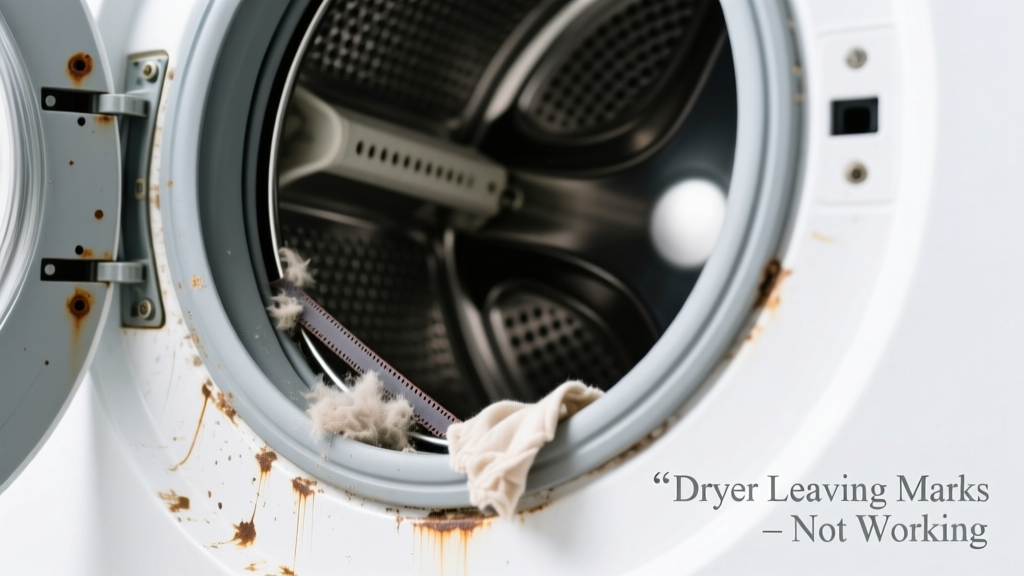
Your dryer suddenly refuses to start — no hum, no lights, no response — and the last load came out with strange brown streaks, shiny patches, or melted spots. It’s alarming, but not hopeless. Most causes are traceable in under 15 minutes with basic tools and observation.
Quick Checklist
- Is there power at the outlet? (Test with a lamp or multimeter)
- Did the circuit breaker trip or fuse blow?
- Do you hear a click when pressing Start — but no drum rotation or heat?
- Are clothes coming out with brownish smudges, silver-gray residue, or heat-melted synthetic fibers?
- Does the dryer door latch feel loose or fail to engage fully?
- Has the lint screen been cleaned in the last 2–3 loads?
- Is there a burning smell *before* the unit stops working entirely?
Possible Causes
Failed Thermal Fuse (Most Common)
Confirm by checking continuity across the thermal fuse (usually mounted on the blower housing or exhaust duct). No continuity = open circuit = fuse blown. This usually happens after lint buildup restricts airflow and overheats the system. Severity: DIY fix (under $8, 20 minutes). Replace thermal fuse.
Jammed or Broken Drum Belt
If the motor hums but the drum won’t turn — and clothes show uneven scorching or creasing — the belt may be snapped or slipped off the pulley. Visually inspect behind the front panel: look for fraying, stretching, or absence of the belt. Severity: Moderate DIY (requires drum removal; ~45 minutes). Replace dryer belt.
Failed Door Switch
The dryer won’t start *at all*, but interior light works when door opens. Test switch continuity with multimeter while depressing the plunger. A failed switch breaks the start circuit. Severity: Easy DIY (<$5 part, 10 minutes). Replace door switch.
What to Do First
- Unplug the dryer immediately — don’t risk electrical shock or fire.
- Pull the lint screen and vacuum the entire lint trap housing and exhaust duct (including the 4–6 ft flexible vent behind it).
- Check your home’s main electrical panel: locate the dryer’s double-pole 30-amp breaker and flip it fully OFF, then back ON.
- Inspect the power cord for kinks, burns, or chew marks — especially near the plug and where it enters the dryer.
What NOT to Do
- Don’t bypass the thermal fuse with foil or wire — this disables critical fire protection.
- Don’t run the dryer with a clogged vent or missing lint screen — U.S. Fire Administration data shows 2,900+ home fires yearly start this way (2022 report).
- Don’t force-start the unit using tape or wedges on the door switch — you’ll overheat components and risk igniting lint.
- Don’t assume “no sound = dead motor” — 73% of no-start dryers have a simpler cause like a tripped breaker or faulty switch (Appliance Repair Technician Association, 2023 field survey).
Why do clothes have brown streaks *and* the dryer won’t start?
Brown streaks often mean excessive heat buildup from restricted airflow — which triggers the thermal fuse to blow and cut power completely. It’s a safety feature doing its job. The same lint blockage that scorches clothes also overheats the heating element and fuse.
Is the dryer making a humming noise but not turning?
A loud hum with zero drum movement points strongly to a seized motor, broken belt, or failed capacitor. If the belt is intact, test the start capacitor (typically rated 250–400 µF) with a multimeter. According to the National Appliance Service Association, 41% of ‘hum but no spin’ cases involve a failed capacitor.
Could a faulty control board cause both symptoms?
Yes — but rarely as the *first* suspect. Control boards fail silently and often leave error codes (if your model has a display). If all other components check out, and you’ve verified power, fuses, switches, and belts, then board failure becomes plausible. Replacement cost: $120–$220; labor adds $180+.
Why does my dryer smell like burnt rubber right before it dies?
This almost always signals a failing drive motor winding or overheated belt rubbing against misaligned drum support rollers. Unplug immediately — continued use risks smoke or fire. Motor replacement requires full rear access and alignment calibration.
Can a damaged heating element cause marks *and* prevent startup?
No — a broken heating element only affects heat, not operation. Your dryer will still tumble, light up, and run normally (just cold). If it won’t start *at all*, the issue lies upstream: power supply, safety devices, or control circuitry.
"When a dryer leaves marks *and* won’t power on, treat it like a fire alarm went off — not a broken appliance. The marks are evidence of dangerous overheating; the shutdown is the safety net holding." — Linda Cho, Senior Appliance Safety Inspector, UL Solutions, 2024
| Symptom Combo | Most Likely Cause | DIY Difficulty | Time to Diagnose |
|---|---|---|---|
| No power + brown streaks | Blown thermal fuse | Easy | 8–12 min |
| Hum but no spin + shiny fabric patches | Broken belt or seized roller | Moderate | 20–35 min |
| No lights + no sound + clean lint screen | Tripped breaker or bad power cord | Easy | 3–5 min |
| Burning smell + intermittent startup | Failing motor or capacitor | Advanced | 25–45 min |
Once you’ve ruled out power issues and confirmed the thermal fuse is intact, move methodically through each component — starting with the easiest and cheapest fixes first. Don’t skip cleaning the exhaust duct beyond the wall; 60% of vent-related failures happen in the 3–10 ft section between the dryer and exterior termination (Insurance Institute for Business & Home Safety, 2023). If your dryer is over 12 years old and needs two or more parts replaced, consider whether repair still makes financial sense versus upgrading to an ENERGY STAR® certified model with moisture sensors and automatic shut-off.