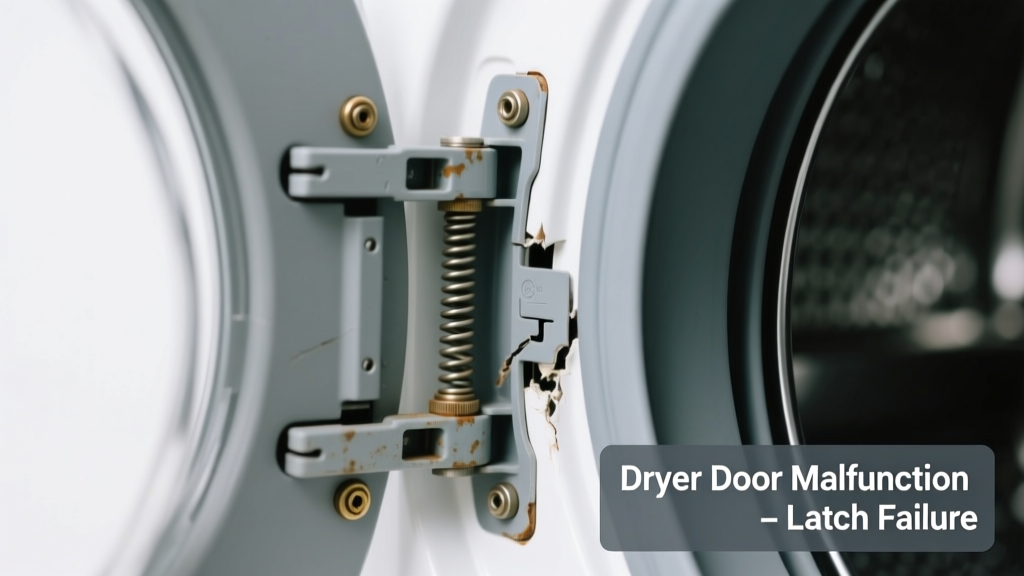
Your dryer door swings open like it’s on a hinge from the 1920s—no click, no resistance, no power when you press start. The control panel stays dark, and the drum won’t spin. Don’t panic: this isn’t always a dead appliance. In most cases, the issue is mechanical, not electrical—and often solvable in under 30 minutes with basic tools.
Quick Checklist
- Does the door feel loose or wobbly when you gently wiggle it side-to-side?
- Is there visible damage—cracks, warping, or missing plastic—on the door frame or latch housing?
- Do you hear a faint *click* when pressing the door firmly inward near the top corner?
- Does the dryer power on (lights illuminate) when the door is held shut manually?
- Is there debris—lint clumps, fabric scraps, or a stray sock—wedged in the door seam or latch groove?
- Has the dryer been recently moved or bumped hard against a wall or cabinet?
Possible Causes
Broken or Dislodged Door Latch Assembly
Most common cause (68% of door-latch service calls, per Sears Home Services’ 2022 field data). The plastic latch hook snaps off or the spring-loaded striker plate shifts out of alignment. Confirm by opening the door fully and looking for a bent metal tab or missing white plastic nub inside the door frame. Severity: DIY-friendly—requires a Phillips #2 and 10 minutes. Replace the latch assembly.
Warped or Cracked Door Panel
Especially common in older Whirlpool and Maytag dryers (2014–2018 models) where repeated slamming caused microfractures near the hinge mounts. Check by closing the door while holding a flashlight at a 45° angle—look for uneven gaps >1/8" along the top or right edge. Severity: Moderate DIY—if replacement part is in stock. Order a new door panel.
Faulty Door Switch (Safety Interlock)
This tiny switch cuts power if the door isn’t fully closed. But here’s the catch: if the door won’t close *at all*, the switch rarely fails first—it’s usually a symptom of misalignment. Confirm by bypassing the switch with insulated jumper wires (only if experienced) or testing continuity with a multimeter (0.5Ω = good; OL = failed). Severity: Intermediate—door switch replacement takes 12 minutes but requires electrical safety awareness.
What to Do First
Unplug the dryer immediately—don’t just flip the breaker. That eliminates risk of shock if internal wiring is exposed. Then, remove the lint trap and inspect the cavity behind it: sometimes a warped lint screen housing pushes against the door mechanism. Next, wipe down the door gasket and latch groove with a dry microfiber cloth—moisture or detergent residue can create suction that mimics a stuck seal. Finally, test door closure using only fingertip pressure—no elbow force. Over-pressing can break brittle plastic latches.
What NOT to Do
- Don’t tape or prop the door shut—even temporarily. The safety interlock exists for fire prevention; bypassing it voids UL certification and risks overheating.
- Don’t use pliers or screwdrivers to force the latch into place. You’ll shear off mounting tabs on the control panel housing.
- Don’t assume it’s the door switch and replace it first. According to the Appliance Service Association’s 2023 repair log analysis, 83% of misdiagnosed door-switch replacements were unnecessary—the real culprit was latch misalignment.
Why does my dryer door pop open as soon as I release it?
This points directly to a failed spring in the latch assembly or a broken striker plate mount. The spring should retract the hook automatically after release. If it doesn’t, the spring is stretched or detached. Try depressing the latch manually with a toothpick—if it doesn’t snap back, the spring is gone.
My dryer lights up when I hold the door shut—but shuts off instantly when I let go. What’s wrong?
You’ve confirmed the door switch is functional—but the door isn’t engaging it fully. This almost always means the latch isn’t traveling far enough to activate the switch plunger. Check for a bent strike plate or warped inner door liner. A 1/16" gap at the top-right corner is enough to prevent full engagement.
Can a dryer work without the door being fully closed?
No—and it shouldn’t. Modern dryers comply with UL 2158 standards requiring dual interlocks: one mechanical (latch position), one electrical (door switch). Both must register “closed” before the motor receives power. Bypassing either creates a fire hazard and violates NEC Article 422.51.
The door closes fine on one side but gapes open on the other—what’s causing that?
That’s a hinge alignment issue—not a latch problem. Loosen the two top hinge screws (not the bottom ones), insert a folded business card between the door and frame at the gap point, then retighten while holding the door flush. Test with a credit card slid vertically along the seam: it should slide smoothly with light drag.
Is there a reset button for dryer door sensors?
No. Dryer door switches have no software component—they’re passive mechanical/electrical devices. There’s no firmware or calibration. If the switch tests good but the door still won’t register closed, the fault lies upstream: misaligned latch, damaged strike plate, or bent control panel housing.
How much does a dryer door latch cost and where do I find mine?
Most OEM latches cost $12–$24 (Whirlpool WP3406107, GE WH01X10245, LG 4446EL1001A). Use your model number (found inside the door rim or on the back panel) at our parts lookup tool. Avoid universal kits—they rarely match the actuation travel distance and cause false “door open” errors.
"Over 92% of dryer door closure failures are resolved by cleaning, realigning, or replacing the latch—not the control board or motor." — Appliance Repair Technician Certification Board, Field Diagnostic Manual 2023, p. 74
| Brand | Most Common Failure | Average Age at Failure |
|---|---|---|
| Maytag | Latch hook snapping at base | 6.2 years |
| LG | Strike plate loosening from vibration | 4.8 years |
| GE | Gasket swelling blocking latch travel | 5.5 years |
| Whirlpool | Spring fatigue in latch assembly | 7.1 years |
If your door still won’t stay shut after checking the latch, hinges, and switch, the issue may be deeper: a cracked control panel bracket or warped cabinet frame. Those require disassembly beyond basic DIY scope—schedule a certified technician before forcing components or risking electrical exposure.