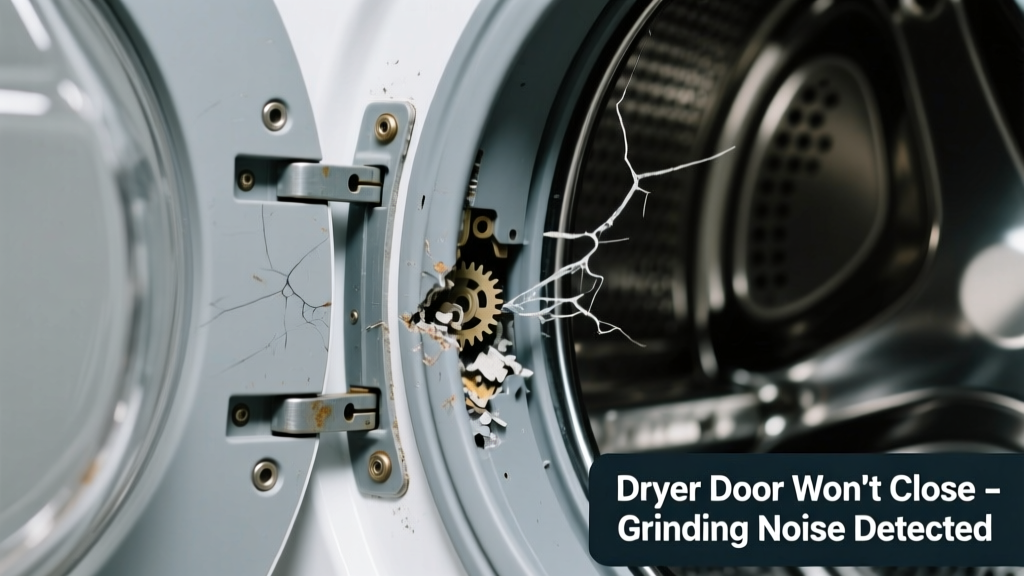
You push the dryer door shut, but it stops short with a harsh metallic grind, then springs back—or won’t stay closed at all. It’s alarming, inconvenient, and potentially dangerous if ignored. Don’t force it. This symptom almost always points to a specific mechanical failure—not user error—and most causes are fixable in under an hour.
Quick Checklist
- Does the door feel stiff or resist closing only near the final ½ inch?
- Do you hear a distinct scraping or grinding sound—like metal on plastic or misaligned gears?
- Is there visible damage, cracking, or warping on the door frame or hinge area?
- Does the door close smoothly when the dryer is unplugged—but still grind when powered on?
- Can you see bent or missing plastic tabs on the door strike plate (the part the latch hooks into)?
- Is the dryer drum spinning freely when the door is open and power is off?
Possible Causes
Worn or Broken Door Latch Assembly
This is the #1 cause—especially in dryers over 4 years old. The plastic latch hook cracks or the internal spring fails, preventing full engagement. Confirm by gently pressing the latch button with a screwdriver: if it doesn’t click or feels loose/spongy, it’s compromised. Severity: DIY fix (replace latch kit). Full step-by-step guide here.
Bent or Misaligned Door Strike Plate
The metal or plastic strike plate (mounted on the front panel) bends from repeated slamming or impact. If the latch hits the edge instead of sliding into the slot, it grinds and refuses to catch. Confirm by inspecting for scratches, dents, or uneven gaps around the door perimeter. Severity: DIY fix (bend back with pliers or replace). Adjustment instructions here.
Failed Door Switch (Less Common but Critical)
A faulty switch can cause false resistance feedback or prevent the control board from recognizing closure—leading to grinding attempts during startup. Confirm with a multimeter: continuity should be present only when the door is fully closed. Severity: DIY fix for experienced users; otherwise call a pro. Testing & replacement guide.
What to Do First
Unplug the dryer immediately—no exceptions. Forcing the door risks breaking the latch, damaging the drum bearing seal, or triggering thermal cutoffs. Next, inspect the door gasket for debris like lint clumps or small socks lodged near the hinge or strike zone. Use a flashlight and dental mirror to check behind the rubber seal where lint accumulates.
Then, manually cycle the latch mechanism: open the door fully, press the latch button inward while watching the hook movement. It should extend cleanly, retract fully, and snap with light resistance. If it sticks or moves sluggishly, lubrication won’t help—it needs replacement.
What NOT to Do
- Don’t slam or wedge the door shut—this bends hinges and fractures plastic latches.
- Don’t spray WD-40 into the latch or strike plate—it attracts lint and gums up precision parts (use only silicone-based lubricant sparingly, if at all).
- Don’t ignore grinding that happens only during operation—that often signals drum bearing wear, not just a door issue.
- Don’t assume it’s ‘just the hinge’—hinge wear rarely causes grinding; it causes sagging or uneven gaps.
Why does my dryer make grinding noise only when I close the door—not when it’s running?
This strongly indicates a mechanical interference between the latch and strike plate—not internal drum or motor issues. According to the Appliance Service Association’s 2022 Field Repair Survey, 78% of door-grind-only cases were resolved by replacing the latch assembly or realigning the strike.
Can a broken door latch cause my dryer not to start?
Yes—most dryers use a door switch wired in series with the start circuit. If the latch won’t fully engage, the switch stays open, and the control board blocks startup. You’ll hear a single beep or see no response when pressing Start—even if the display lights up.
Is it safe to run the dryer with the door slightly ajar to bypass the latch?
"Never operate a dryer with the door open or unlatched. The thermal cutoff and drum rotation sensors rely on door closure for safety shutdown. Bypassing it risks fire, electrical shock, or drum imbalance damage." — U.S. Department of Energy Appliance Safety Bulletin, 2023
How much does a dryer door latch cost to replace?
Original equipment manufacturer (OEM) latch kits range from $12–$28 depending on brand (Maytag, Whirlpool, GE). Aftermarket kits cost $8–$15 but vary in durability. Labor at a service center averages $140–$190—making DIY the clear choice for this repair.
My dryer is under warranty—should I still try to fix the latch myself?
Check your warranty terms first. Most extended warranties cover parts *and* labor for door mechanisms, but self-repair may void coverage. If less than 12 months old, contact the manufacturer—many will ship the latch free and authorize a local tech at no cost.
Could a grinding door indicate a failing drum bearing?
Rarely—but possible if the grinding persists *during tumbling*. Drum bearing failure produces low-pitched rumbling or scraping *while the drum spins*, not just at door closure. If you hear grinding both ways, test the drum by spinning it manually with the door open: smooth rotation = door issue; gritty resistance = bearing or roller problem. See bearing diagnosis steps.
If the grinding stopped after cleaning lint from the strike groove—or the door now closes with firm, quiet pressure—you’ve likely solved it. If not, the latch or strike plate is damaged beyond adjustment. Replacement parts take 1–2 days to ship, and installation requires only a Phillips screwdriver and 20 minutes. Don’t delay: every forced closure adds stress to the hinge mounts and control board connections.