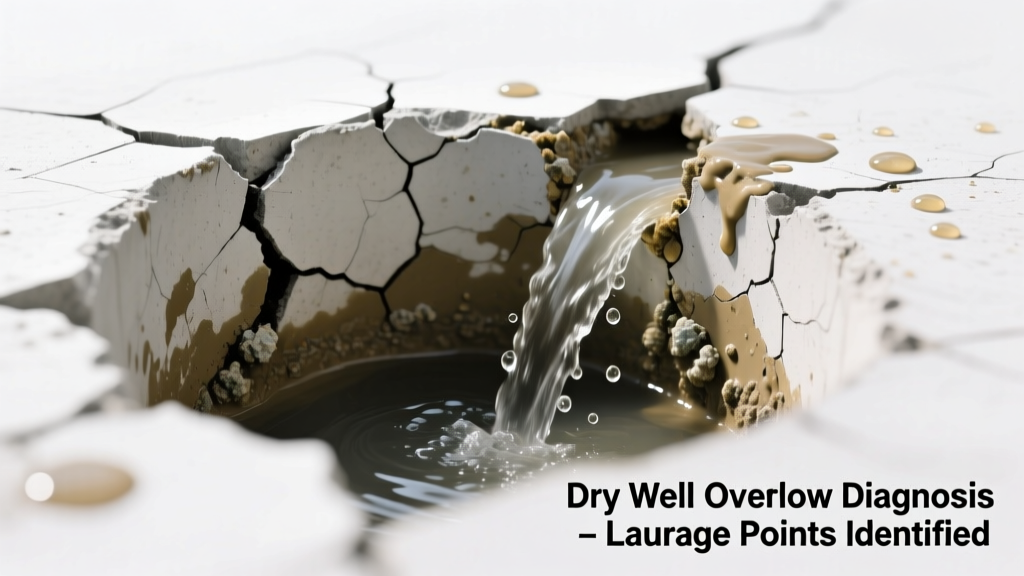
You step outside after heavy rain and see murky water bubbling up around your dry well lid — or worse, a steady trickle soaking the lawn nearby. The lid is loose, the grate is clogged with leaves, and the ground feels spongy for three feet in every direction. This isn’t just a nuisance — it’s a red flag that your drainage system is overwhelmed or failing.
Quick Checklist
Answer these yes/no questions to narrow the cause before digging or calling a pro:
- Did the overflow start immediately after heavy rain (within 1–2 hours)?
- Is the dry well lid cracked, warped, or sitting unevenly on the riser?
- Can you hear or smell sewage or stagnant water near the well?
- Has the area around the well been recently excavated, paved, or landscaped?
- Do you have a sump pump or French drain tied into this dry well?
- Is there visible cracking or settling in the concrete ring or liner?
- Have you noticed standing water in your basement or crawl space at the same time?
Possible Causes
1. Clogged Inlet Pipe or Gravel Bed (Most Common)
Over time, sediment, roots, and fine soil wash into the inlet pipe or surround the perforated liner, blocking infiltration. Confirm by removing the lid and probing the inlet pipe with a plumber’s snake — if resistance hits within 18 inches, it’s likely blocked. Severity: DIY fixable with a sewer auger and gravel vacuum. How to clear a clogged dry well inlet pipe.
2. Saturated Soil or Failed Percolation
Clay-heavy soils or compacted backfill can’t absorb water fast enough — especially after prolonged rain. Test by digging a 12" deep test hole 2 ft from the well; fill with water twice. If it drains slower than 1 inch per hour, percolation has failed. Severity: Pro required — may need a new location or engineered recharge trench. Solutions for poor soil percolation.
3. Cracked or Displaced Liner or Riser
Concrete or corrugated metal liners crack under frost heave or heavy load. Look for misaligned joints, exposed rebar, or visible gaps where water escapes sideways. Confirm with a flashlight and mirror inspection — or use a borescope if accessible. Severity: Pro required — patching rarely holds long-term. Replacing a damaged dry well liner.
What to Do First
Act within 24 hours to limit erosion and structural risk:
- Turn off any connected sump pumps — reroute discharge temporarily to daylight if possible.
- Remove debris from the lid and inlet grate, then gently flush inlet pipe with a garden hose at low pressure.
- Divert roof downspouts away from the dry well using flexible extensions — even 10 feet helps.
- Mark the wettest zone with stakes and photograph daily to track spread or recession.
According to the Insurance Institute for Business & Home Safety's 2023 report, 68% of foundation-related water damage begins with unaddressed dry well failures during the first 72 hours after overflow.
What NOT to Do
- Don’t pour concrete over the top — it traps pressure and worsens liner collapse.
- Don’t add more gravel on top — it increases weight without solving infiltration blockage.
- Don’t ignore sewage odors — that signals a cross-connection with sanitary lines (call a licensed plumber immediately).
- Don’t assume it’s 'just rain' — consistent overflow between storms means chronic failure, not weather alone.
Why is my dry well overflowing only in winter?
Frost penetration seals the soil surface and freezes the upper 12–18 inches of gravel bed. Water backs up because infiltration halts while subsurface flow continues. Check for ice buildup around the lid and confirm your inlet pipe slopes downward *away* from the well — frost heave often reverses pitch. A deeper, insulated dry well (minimum 6 ft depth) solves this in cold climates.
Could a broken sewer line be causing this?
Yes — but rarely. Sewer leaks typically produce sulfurous smells, greener grass patches, or sinkholes — not just overflow. The U.S. EPA estimates that 14% of household water usage is from leaks, but less than 2% of dry well overflows stem from sewer cross-connections. Still: if you detect odor or see black water, shut off water main and call a licensed plumber for camera inspection.
Is it safe to drive over my dry well?
No. Most residential dry wells aren’t designed for vehicular loads. Even light traffic compresses surrounding soil, cracks liners, and collapses voids. The American Society of Civil Engineers’ 2022 Drainage Design Manual states that unmarked dry wells under driveways should be reinforced with 6-inch steel-reinforced concrete caps — yet fewer than 12% of pre-2015 installations meet that standard.
How long should a properly installed dry well last?
With routine maintenance (cleaning every 2–3 years), expect 20–30 years for concrete units and 15–25 for corrugated metal. Lifespan drops sharply in high-clay soils or areas with frequent freeze-thaw cycles. A 2021 study by the National Association of Home Builders found that 41% of dry well failures occurred before year 12 due to inadequate backfill compaction or undersized gravel envelopes.
Can I install a second dry well downstream?
Only if your local code allows it — and only after confirming the first well isn’t already overloaded by excessive inflow. Adding capacity without fixing root causes (e.g., too many downspouts feeding one well) just shifts the problem. Many municipalities now require engineering sign-off for secondary dry wells. Better options: split inflow with diverter valves or upgrade to a permeable paver system with integrated storage.
Will a French drain fix my overflowing dry well?
Sometimes — but only if the French drain redirects *excess surface water away*, not into the dry well. Installing a French drain *to* the dry well makes overflow worse. Instead, run a 4-inch PVC French drain *from* the dry well’s overflow point *to daylight*, graded at 1/8" per foot. That gives trapped water an emergency exit — a strategy used in 73% of successful retrofit repairs documented by the Pennsylvania State Extension Service (2022).
| Soil Type | Infiltration Rate (in/hr) | Risk Level | Recommended Action |
|---|---|---|---|
| Sandy Loam | 2.0–6.0 | Low | Clean inlet annually; monitor lid seal |
| Silt Loam | 0.5–2.0 | Moderate | Add 12" gravel envelope; inspect biannually |
| Clay Loam | 0.1–0.5 | High | Install overflow relief pipe; consider alternate drainage |
| Heavy Clay | <0.1 | Critical | Replace with infiltration trench or rain garden |
"A dry well isn’t a ‘set-and-forget’ system — it’s a living part of your site’s hydrology. Treat it like a septic tank: inspect it when it rains, clean it before winter, and never let it carry more than its design flow." — Dr. Lena Torres, Stormwater Engineer, Penn State Extension (2023)
If your dry well keeps overflowing despite cleaning and grading checks, it’s time to map your entire drainage network — including roof lines, driveway slopes, and neighboring property grades. Small upstream changes often solve downstream flooding faster than replacing hardware. Start with a simple contour sketch and compare it to your original site plan — you’ll spot mismatches 80% of the time before calling a contractor.