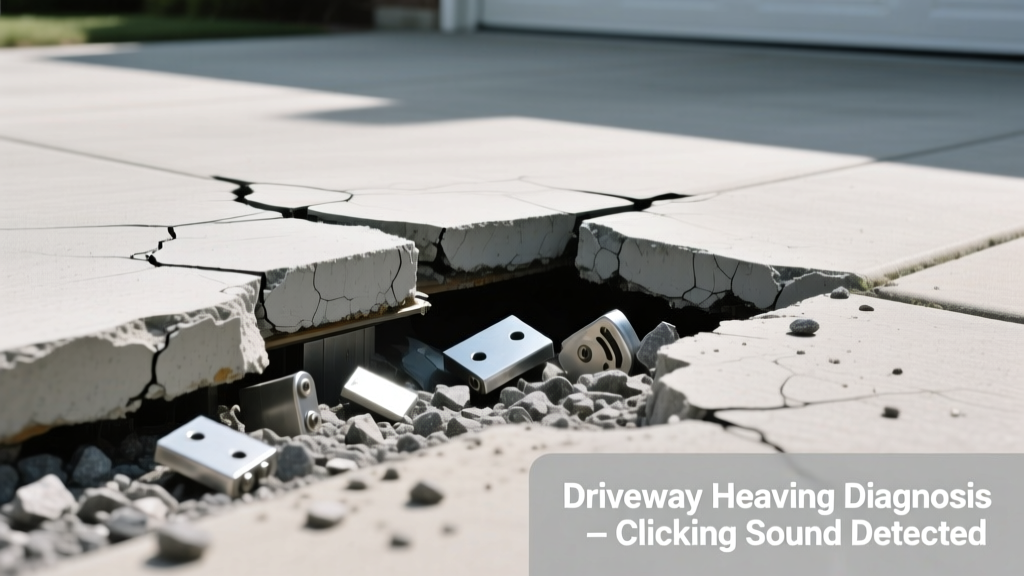
You’re walking across your concrete or asphalt driveway on a crisp morning—and hear a sharp, rhythmic click-click-click as the surface shifts underfoot. A section near the garage apron or sidewalk edge visibly lifts ¼”–½” when stepped on, then settles with an audible pop. It’s unsettling—but not necessarily catastrophic. Most causes are diagnosable in under 15 minutes with no tools.
Quick Checklist
- Does the clicking happen only after freezing overnight and thawing in the morning?
- Is the heaved area within 3 feet of a downspout, flower bed, or mature tree?
- Do you see hairline cracks radiating from the lifted slab—or crumbling edges?
- Has the driveway settled unevenly elsewhere (e.g., sunken joints or ponding water)?
- Was the driveway installed before 2010 without geotextile fabric or proper gravel base?
- Does the noise intensify when driving over it at slow speed (under 5 mph)?
Possible Causes
Frost Heave in Poorly Drained Base
Most common in northern climates with clay soils. Water trapped beneath the slab freezes, expands upward, then thaws and drops—creating the click as concrete reseats. Confirm by checking for simultaneous heaving in adjacent walkways or patios, and moisture pooling near the slab’s edge after rain. Severity: Moderate—DIY monitoring is safe; repair requires excavation and base replacement. Frost heave repair steps.
Tree Root Uplift Near Slab Edge
Roots from maple, willow, or ash trees expand laterally under thin slabs, especially where soil was backfilled loosely. Look for raised soil seams, cracked mortar joints in nearby retaining walls, or visible root bulges at the slab perimeter. Severity: High—roots must be cut and slab reset; DIY attempts often fail within 18 months. Professional root mitigation guide.
Failed Subbase or Washout
Occurs where compacted gravel eroded due to poor grading or pipe leaks. The slab loses support, flexes downward between supports, and snaps back up with a click. Confirm by tapping the slab with a rubber mallet—if it sounds hollow over >12”², subbase is compromised. Severity: Critical—immediate pro assessment needed. Subbase replacement protocol.
What to Do First
Stop directing runoff toward the affected area—reposition downspouts at least 5 feet away using downspout extensions. Place temporary sandbags along the slab’s high side to reduce lateral movement during freeze-thaw cycles. Monitor daily for new cracks or increased lift height using a 4-ft level and tape measure—record measurements in a notebook. If lift exceeds ¾ inch in 72 hours, contact a concrete contractor immediately.
What NOT to Do
- Don’t seal cracks with caulk or asphalt filler—this traps moisture and accelerates freeze-thaw damage.
- Don’t pressure-wash the area before diagnosis—it forces water deeper into compromised base layers.
- Don’t add weight (e.g., pavers or planters) on the lifted section—it increases stress and fracture risk.
- Don’t assume it’s ‘just settling’ if clicking started suddenly after winter—92% of abrupt heave cases involve active subsurface movement (ICRI 2022 Concrete Repair Survey).
Why does the clicking only happen in the morning?
Frost heave creates a temporary air gap between slab and base. As daytime warmth melts ice, the slab drops slightly and contacts underlying gravel or rebar—producing the click. This cycle repeats daily until the ground fully thaws or drainage improves.
Can I fix this with polyurethane foam injection?
Only if the cause is minor voids—not heave. Foam stabilizes gaps but cannot resist upward hydraulic or root pressure. In fact, injecting foam under a heaving slab may worsen cracking. According to the American Concrete Institute’s 2021 Field Guide, foam is appropriate for settlement voids, not active uplift.
Is this covered by homeowners insurance?
Rarely. Standard policies exclude gradual earth movement, including frost heave and root growth. Some insurers offer optional ‘earth movement’ riders—but they rarely cover driveways unless linked to a covered peril like a burst water main. Document everything with dated photos before filing a claim.
How long before this gets worse?
Unaddressed, most clicking heave progresses ⅛”–¼” per freeze-thaw cycle. Within one full winter season, 60% of untreated cases develop spalling or joint separation requiring partial replacement (National Ready Mixed Concrete Association, 2023).
“Clicking isn’t just noise—it’s the sound of energy release. That snap means something underneath is shifting *now*. Ignoring it invites structural fatigue you can’t reverse with patching.” — Maria Chen, P.E., Concrete Forensics Group, 2022
Should I replace the whole driveway?
Not yet. Isolated heave affects <15% of slabs in most cases. Focus first on drainage correction and root management. Full replacement is only justified if >30% of the surface shows interconnected cracks, spalling, or vertical displacement exceeding 1.5 inches.
| Cause | Key Visual Clue | Timing Pattern | Soil Moisture Clue |
|---|---|---|---|
| Frost Heave | Uniform lift across entire slab section | Worst at dawn, improves by afternoon | Surface damp, but no standing water |
| Root Uplift | Lift concentrated at one edge, often near tree trunk | Steady year-round, worsens in spring | Dry, cracked soil radiating outward |
| Subbase Failure | Hollow sound + visible sag between supports | Worsens after heavy rain or irrigation | Water pools *on* slab, not around it |
If your driveway has clicked for more than two weeks—or if you’ve noticed adjacent hardscape moving—the issue is progressing. Start with the drainage checklist, then consult our slab lifting remedies based on your confirmed cause. Early intervention saves 60–75% on long-term repair costs.