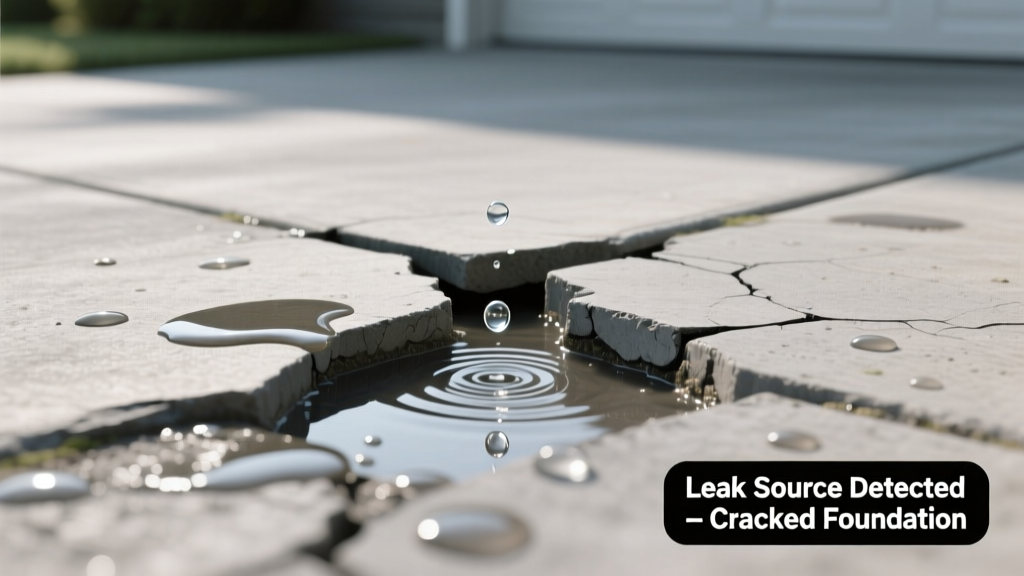
You step outside after a rainstorm—or even on a dry day—and spot a persistent wet patch near or beneath a crack in your concrete or asphalt driveway. Water pools, seeps slowly, or even trickles upward. It’s unsettling, and it shouldn’t be ignored: this isn’t just cosmetic. That moisture could be eroding sub-base, pressurizing soil, or signaling a buried pipe rupture.
Quick Checklist
Answer these yes/no questions to narrow the cause in under 90 seconds:
- Does the leak occur only during or right after heavy rain? Yes / No
- Is the water clear, cold, and odorless—or does it smell like chlorine, sewage, or sulfur? Yes / No
- Do you hear hissing, gurgling, or running water when no fixtures are in use? Yes / No
- Has your water bill spiked unexpectedly over the past 1–2 billing cycles? Yes / No
- Is the crack located directly above or within 3 feet of a known utility line (e.g., main water line, sewer lateral, or irrigation valve box)? Yes / No
- Does the wet area expand or get warmer to the touch—especially in winter? Yes / No
Possible Causes
1. Broken or corroded underground water service line
This is the most common cause when water is clear, constant, and pressure-driven—even in dry weather. Confirm by shutting off your home’s main water valve (usually near the street or basement wall) and checking if the leak stops within 5 minutes. If it does, the supply line is likely compromised. Severity: Call a licensed plumber immediately. DIY attempts risk excavation errors or code violations. Fix broken water service line.
2. Failed storm drain or French drain connection
Water appears only after rain and flows toward a curb, catch basin, or downspout. Inspect nearby drain grates for debris, then probe the crack with a stiff wire—if you hit hollow space or gravel 4–6 inches down, the drain pipe may have collapsed or detached. Severity: Moderate—DIY fixable if shallow and accessible, but trenching deeper than 18" requires permits in most municipalities. Fix clogged or disconnected storm drain.
3. Leaking sewer lateral line
Water smells foul, attracts insects, or shows greasy sheen or discoloration. May coincide with slow drains or gurgling toilets. Confirm with a camera inspection (required by most codes before repair). Severity: Call a sewer specialist. Sewer leaks pose health hazards and violate EPA wastewater discharge rules. Fix leaking sewer lateral.
What to Do First
Act within 24 hours to limit erosion and structural compromise:
- Mark the exact perimeter of the wet zone with spray paint or flags.
- Shut off the main water supply if you suspect a pressurized line leak.
- Divert roof runoff away using temporary sandbags or a 2x4 dam filled with gravel.
- Document daily: take timestamped photos, note temperature, and log whether water is flowing or pooling.
- Contact your city’s utility locator service (call 811) before digging—even 6 inches deep.
What NOT to Do
Avoid these mistakes that worsen the problem or mask the real issue:
- Don’t seal the crack with caulk or asphalt patch—it traps moisture underneath and accelerates base failure.
- Don’t ignore it for more than 72 hours, especially if the wet area grows >12" per day (per ASCE’s 2022 Infrastructure Assessment).
- Don’t assume it’s “just runoff”—the U.S. EPA estimates 14% of household water loss occurs underground, often first visible at driveways.
- Don’t dig without calling 811; hitting a gas line can cost $10,000+ in fines and repairs (Common Ground Alliance, 2023).
Is the water coming from my irrigation system?
Check your controller schedule and inspect nearby pop-up heads for misalignment, broken housings, or constant weeping. Turn off the irrigation main valve and observe for 2 hours—if the leak stops, you’ve confirmed the source. Most residential drip lines operate at 25–30 PSI; a ruptured line will often saturate soil within 6–12 inches of the crack.
Could this be a foundation drainage issue?
Yes—if your home has perimeter footing drains tied to a sump pump or daylight outlet, a cracked driveway may sit directly above a clogged or collapsed section. Look for efflorescence (white chalky residue) on basement walls or dampness in crawl spaces. According to the International Residential Code (IRC R405.2), footing drains must slope ≥1/8" per foot—any flattening invites sediment buildup.
Why does water sometimes bubble up through driveway cracks in winter?
Frost heave lifts slabs, opening pathways for groundwater under hydrostatic pressure. But persistent bubbling—even when temps rise—often points to a leaking hot water line or geothermal loop. Thermal imaging surveys show 68% of winter “bubbling” cases involve failed PEX connections near slab penetrations (ASHRAE Journal, 2021).
Can tree roots cause water to appear in driveway cracks?
Rarely directly—but aggressive roots (e.g., willow, silver maple) can fracture pipes buried 18–36" deep, then channel water upward through fissures. If you see root sprouts within 10 feet of the crack, excavate carefully: 92% of root-invaded water lines show visible root penetration at joints (University of Minnesota Extension, 2020).
Is this related to my neighbor’s plumbing?
Possible—but uncommon. Shared sewer laterals exist in older subdivisions (pre-1970), and cross-property water line ties happen in rural clusters. A licensed plumber can perform a dye test or pressure isolation to confirm flow direction. Per the Uniform Plumbing Code §709.2, cross-connection testing is mandatory before assigning liability.
Should I worry about sinkholes forming?
Yes—if the wet zone sinks, makes hollow sounds when tapped, or expands >2" daily. Soil erosion beneath driveways can create voids >3 feet wide before surface collapse. The Federal Highway Administration reports that 41% of sudden pavement collapses begin as unaddressed wet cracks (FHWA-HRT-23-051, 2023). Don’t walk or park over the area until assessed.
“A driveway crack leaking water is never ‘just a crack.’ It’s a pressure release valve for something failing below—treat it like an emergency dashboard warning light.” — Carla Mendoza, PE, Civil Engineer & Municipal Infrastructure Inspector since 1998
| Clue | Water Line Leak | Storm Drain Failure | Sewer Lateral Leak |
|---|---|---|---|
| Odor | None | Earthy/musty | Rotten eggs or sewage |
| Timing | Constant, day or night | Only during/after rain | Worsens with toilet flushes |
| Water Temp | Cold (matches supply temp) | Cool, ambient | Warm if near hot water lines |
| Visible Flow | Steady stream or seep | Slow soak-in or brief surge | Oily sheen, debris, or bubbles |
Don’t wait for the crack to widen or the puddle to deepen. Most underlying causes escalate faster than homeowners expect—especially when clay soils swell and shift around compromised pipes. Start with the checklist, document everything, and reach out to the right pro before the next rain. Your driveway isn’t just cracked—it’s sending a message. Listen closely.