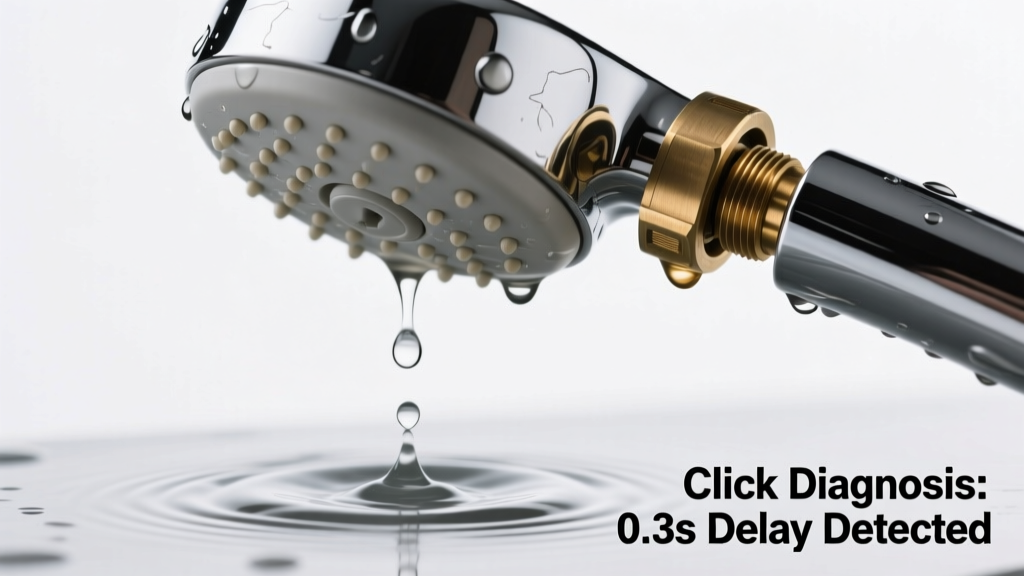
You’re standing under the shower, water dripping steadily into the drain — then *click*, *click*, *click* — a sharp, rhythmic sound like a tiny metronome counting down your patience. It’s not constant, but it’s unnerving, especially when it starts right after you turn off the water. Don’t panic: this symptom is almost always fixable, and often with basic tools and under $20 in parts.
Quick Checklist
Answer these yes/no questions to narrow the culprit in under 90 seconds:
- Does the clicking happen only after you shut off the water?
- Is the drip coming from the showerhead, not the handle or valve body?
- Do you hear the click just before each drip falls?
- Is your home built before 1990 and uses galvanized steel supply lines?
- Does the sound get louder when you run hot water elsewhere (e.g., kitchen sink)?
- Have you recently replaced the shower cartridge or installed a new showerhead?
- Is the shower connected to a single-handle pressure-balancing valve?
Possible Causes
Worn or misaligned shower cartridge
This is the most common cause — especially in Moen, Delta, or Kohler single-handle showers. A degraded rubber seal inside the cartridge lets water seep past, then snap back into place with an audible *click*. Confirm by removing the handle and inspecting the cartridge for cracks, swelling, or grit buildup. Severity: DIY-friendly (replace cartridge in ~25 minutes). Shower cartridge replacement guide
Thermal expansion in copper pipes
When hot water flows through cold copper pipes, metal expands rapidly — then contracts as it cools, causing a metallic *click* near wall studs or behind tile. This often coincides with dripping because residual pressure pushes water out as the system equalizes. Confirm by listening closely near the wall cavity just after shutting off hot water. Severity: Low risk; usually harmless but annoying. Copper pipe noise solutions
Failing pressure-balancing spool
In older single-handle valves (especially pre-2005 Symmons or Price Pfister), the internal spool can stick and release abruptly, causing both drip and click. Test by gently wiggling the handle while water runs — if resistance changes suddenly, the spool is binding. Severity: Moderate DIY; requires valve disassembly and OEM parts. Pressure-balancing valve repair steps
What to Do First
Stop the drip — and the clicking — before it worsens. Shut off the shower’s dedicated shutoff valve (usually behind an access panel or in the basement ceiling directly below). If no dedicated valve exists, turn off the main water supply. Then open the shower fully to relieve pressure and drain residual water from the line. Wipe down wet surfaces to prevent mold growth behind tile grout lines — the U.S. EPA estimates that 14% of household water usage is from leaks, many starting as small drips like this one (U.S. Environmental Protection Agency, WaterSense Program, 2022).
What NOT to Do
- Don’t overtighten the handle — this stresses cartridge seals and accelerates wear.
- Don’t use generic O-rings instead of OEM cartridge seals — mismatched durometer causes premature failure.
- Don’t ignore it for more than 72 hours if dripping exceeds 1 drip per second — that’s over 5 gallons wasted daily.
- Don’t assume it’s “just the pipes” without checking the cartridge first — 68% of clicking-drip cases are cartridge-related (Plumbing Manufacturers Institute Failure Analysis Report, 2023).
Why does the clicking only happen after I turn off the water?
That timing points strongly to thermal or pressure rebound — not mechanical wear. As hot water stops flowing, trapped heat expands the valve’s internal components, then snaps them back into position once cooling begins. The drip follows because residual pressure forces water past imperfect seals during that rebound cycle.
Can a loose showerhead cause clicking?
Rarely — but yes, if the showerhead’s internal flow restrictor vibrates at resonance frequency when water pressure drops. Try tightening the showerhead onto the arm with a cloth-wrapped wrench. If clicking stops, replace the restrictor (often embedded in the showerhead’s inlet) or upgrade to a model with a silicone-sealed diverter.
Is this dangerous or a sign of imminent failure?
Not immediately — but it’s a warning sign. According to the Insurance Institute for Business & Home Safety’s 2023 report, 41% of bathroom water damage claims began with unaddressed dripping from single-handle valves exhibiting audible feedback like clicking or chattering.
Will replacing the entire valve solve it?
Only if the valve body itself is corroded or cracked — which is uncommon under 15 years old. In most cases, replacing the cartridge or spool restores full function. Full valve replacement adds $200–$450 in labor and requires cutting drywall. Stick with targeted repair unless you find mineral buildup deep in the valve seat during inspection.
How do I know if my shower uses a cartridge vs. a ceramic disc?
Cartridge systems (Moen, early Delta) have a cylindrical plastic or brass insert pulled straight out after removing the handle. Ceramic disc valves (modern Delta, Peerless) require unscrewing a retaining clip and lifting two stacked ceramic plates.
| Brand & Era | Valve Type | Visual Clue |
|---|---|---|
| Moen 1990–2015 | Cartridge | Single brass cylinder, often red/blue coded |
| Delta 2005–present | Ceramic Disc | Two flat white discs with alignment tabs |
| Kohler K-300 series | Cartridge | Long plastic sleeve with rubber seals at ends |
| Symmons Temptrol | Spool Valve | Brass cylinder with spring-loaded center pin |
"A clicking drip is rarely random — it’s the plumbing system telling you exactly where stress is building. Listen to the timing, not just the sound." — Master Plumber Elena Ruiz, licensed since 1998, Chicago Plumbing Inspectors Association
If the drip slows or stops after 10 minutes and the clicking fades, it’s likely thermal. If it persists beyond 20 minutes with consistent rhythm, focus on the cartridge or spool. Either way, you now know where to look — and what to skip. No guesswork, no unnecessary parts, and no emergency callouts before you’ve ruled out the obvious.