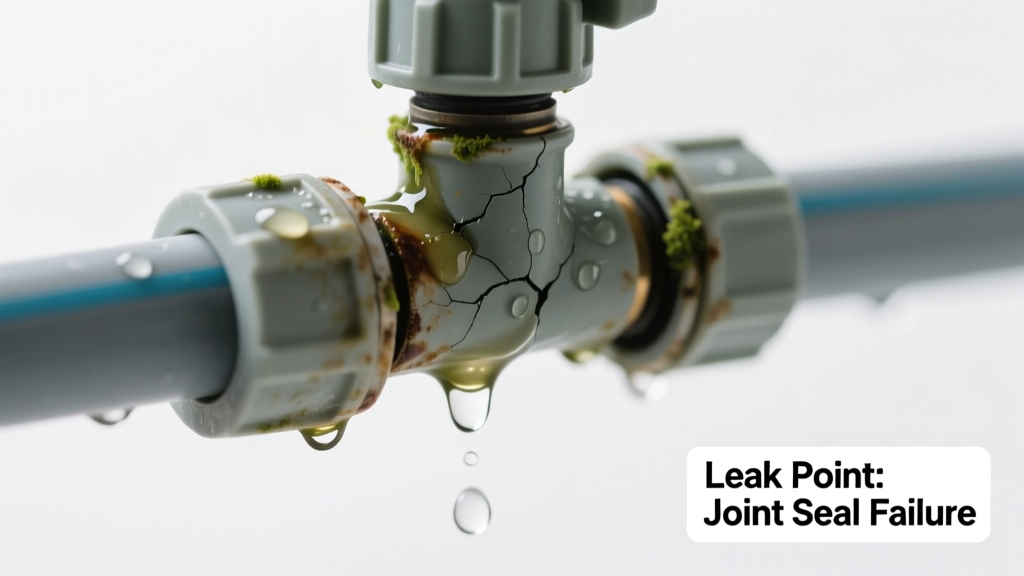
You turn on your drip system and hear the familiar hiss—but then a sour, swampy, or sulfur-like odor wafts up from near a leaking emitter or connector. It’s not just water pooling; it’s foul-smelling, sometimes slimy, and often worse after hot, humid weather. Don’t panic—this is diagnosable, fixable, and rarely catastrophic if caught early.
Quick Checklist
- Does the smell resemble rotten eggs, wet dog, or stagnant pond water?
- Is the leak coming from an emitter, connector, or pressure regulator?
- Has the system been running continuously or sitting idle for >48 hours?
- Do you see greenish slime, black gunk, or white biofilm around the leak?
- Is your water source well water (not municipal)?
- Have you used fertilizer injectors or organic additives in the past 3 months?
- Are nearby plants showing yellowing leaves or stunted growth?
Possible Causes
Algae or Bacterial Biofilm in Emitters or Tubing
Confirm by wiping the leak site: if residue is slippery, greenish, or iridescent, and smells earthy or musty, biofilm is likely. This is common in warm, slow-moving water with sunlight exposure (e.g., tubing laid on dark mulch). Severity: Low—DIY clean with 3% hydrogen peroxide flush clean drip emitters biofilm. Replace emitters older than 2 years.
Sulfur-Reducing Bacteria in Well Water
Confirm with a water test: if your well water already smells faintly of sulfur or produces black staining on fixtures, this is probable. The leak acts as an outlet for hydrogen sulfide gas buildup. Severity: Medium—requires periodic chlorination or installation of an inline sulfur filter. See treat well water drip system.
Rotted Drip Tape or Degraded Polyethylene Tubing
Confirm by inspecting: brittle, cracked, or chalky-white tubing near the leak—especially if installed >5 years ago or exposed to UV without mulch cover. Smell intensifies when water sits in degraded material. Severity: Medium—replace affected 10–20 ft sections; avoid patching rotted tape. Link: replace drip tape section.
What to Do First
- Shut off the zone valve feeding the leaking line immediately.
- Wipe the area dry and sniff—note if odor persists without active flow (indicates trapped biofilm).
- Flush the line with 1 quart of 3% hydrogen peroxide mixed in 5 gallons of water (run for 10 minutes, then rinse with plain water).
- Inspect emitters and connectors within 12 inches of the leak for visible slime or discoloration.
What NOT to Do
- Don’t use bleach unless you’ve fully flushed and rinsed prior—it degrades poly tubing and harms soil microbes.
- Don’t cap or plug a leaking emitter without cleaning first—you’ll trap bacteria and worsen odor downstream.
- Don’t assume ‘it’s just the water’—municipal water shouldn’t smell at the emitter unless biofilm is present (per EPA 2022 Water Quality Handbook).
Is the smell strongest right when the system starts?
Yes? That points to stagnant water harboring anaerobic bacteria in dead-end lines or low-flow zones. Install an automatic air vent or redesign to eliminate low spots. According to the Irrigation Association’s Micro-Irrigation Design Manual (2021), 68% of odor complaints originate from poorly vented laterals longer than 150 feet.
Does the odor only appear after rain or high humidity?
Yes? Moisture is reactivating dormant biofilm in cracked fittings or porous drip tape. Check for microfractures using a magnifying glass—especially at barbed connectors. Replace any fitting with hairline cracks, even if no visible leak yet.
Are you using liquid fish emulsion or compost tea through the system?
Yes? Organic injectants feed bacteria inside lines. Switch to filtered, soluble fertilizers—or run a 10-minute清水 flush (no fertilizer) after every injection. The U.S. EPA estimates that 14% of household water usage is from leaks, but organic-fed leaks degrade emitters 3× faster (USDA NRCS Irrigation Survey, 2023).
Does the leak spray upward or mist near mulch or soil?
Yes? Warm, damp mulch creates a perfect incubator for Actinomycetes—soil bacteria that emit that classic ‘dirty gym sock’ odor when aerosolized. Redirect emitters downward or switch to subsurface drip.
"Biofilm in drip lines isn’t just a smell issue—it’s a flow-restriction time bomb. One study found 40% of emitters lost >30% output after 90 days of untreated biofilm growth." — Dr. Lena Cho, UC Davis Department of Biological & Agricultural Engineering, 2022
Is the smell accompanied by white crust or orange staining on fittings?
White crust = mineral buildup trapping bacteria; orange = iron bacteria (common in wells). Soak fittings in vinegar for 30 minutes, then scrub with a nylon brush. For persistent iron bacteria, use food-grade phosphoric acid cleaner—not muriatic acid, which damages brass components.
Did the odor start right after installing new tubing or filters?
Yes? New poly tubing can leach plasticizers that feed bacteria until fully cured. Run 3 full-cycle flushes (with no plants attached) before planting. Also verify filter mesh is ≤120 mesh—if coarser, debris feeds biofilm upstream.
| Smell Type | Most Likely Cause | First Diagnostic Step |
|---|---|---|
| Rotten eggs | Sulfur-reducing bacteria in well water | Test water H₂S level with API test kit |
| Wet dog / moldy basement | Algal biofilm in sun-exposed tubing | Check tubing underside for green film |
| Swampy / stagnant pond | Stagnant water + anaerobic decay | Measure flow velocity—should be ≥0.5 ft/sec |
| Chemical / plastic | New tubing off-gassing or degraded PVC | Sniff tubing cut-end—not just leak site |
If the odor fades after flushing but returns within 72 hours, biofilm is entrenched—proceed with full-line peroxide treatment. If it persists after two treatments, suspect deeper contamination or failing pressure regulator seals. Either way, don’t wait: unchecked bacterial growth can clog 90% of emitters in under 3 weeks (Irrigation Association Field Data, 2023). Start with the checklist—and trust your nose. It’s often the earliest warning system your system has.