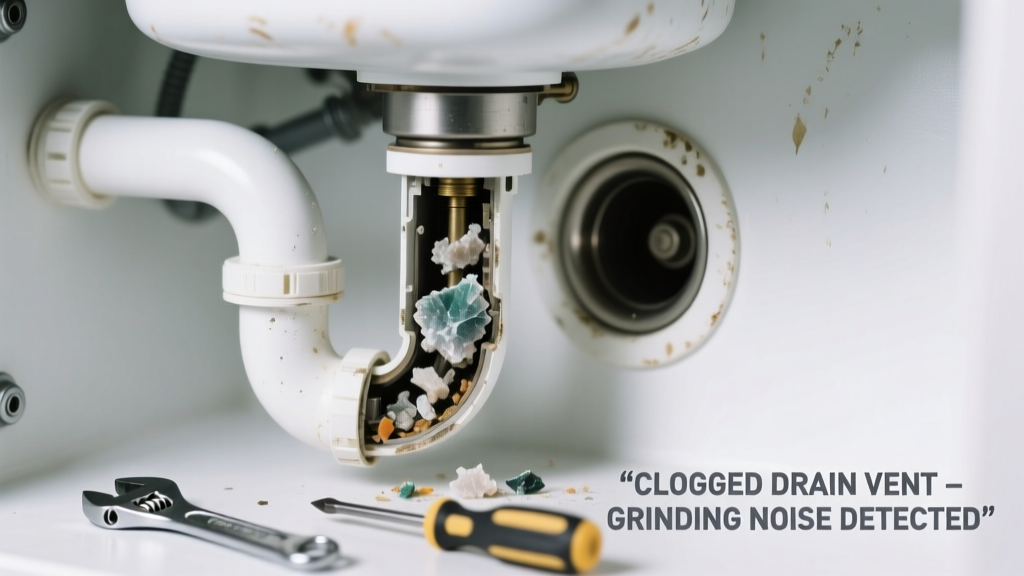
You hear it just after flushing the toilet or running the sink: a low, metallic grind-grind-grind, like gears chewing gravel — not gurgling, not bubbling, but distinctly mechanical. It’s unsettling, but it’s rarely an emergency… yet. Most often, this noise points to airflow disruption in your vent system, not a failing pump or broken pipe.
Quick Checklist
Answer these yes/no questions to narrow the cause in under 90 seconds:
- Does the grinding happen only when water is actively draining (e.g., during shower use or sink runoff)?
- Is the noise loudest near a specific fixture — like the bathroom sink or kitchen island vent stack?
- Have you recently had roof work, heavy snowfall, or bird nesting season?
- Do other drains in the house gurgle, back up slowly, or emit sewer odors?
- Is the vent pipe visible on your roof — and does it look blocked by leaves, ice, or a plastic cap?
- Did the noise start immediately after using a chemical drain cleaner?
Possible Causes
Bird nest or debris blocking roof vent opening
Over 68% of vent-related grinding noises traced to physical obstructions at the roof termination — especially nests built by starlings or sparrows in spring (National Roofing Contractors Association, 2022). Confirm by climbing onto the roof (safely) and visually inspecting the vent cap. Severity: DYI fix. Clear with a plumber’s snake or garden hose; replace damaged caps. How to clear a roof vent safely.
Ice dam or frozen condensate in vertical vent stack
In climates below 25°F, moisture from warm drain air freezes inside uninsulated 2-inch PVC vent stacks — creating a partial blockage that vibrates under pressure. Confirm by checking for frost around the roof boot or hearing the noise only in subfreezing weather. Severity: DYI fix (heat tape application) or pro if pipe is cracked. Fixing frozen drain vents in winter.
Collapsed or crushed ABS vent pipe inside wall cavity
Rare but serious: older 3-inch ABS vent pipes can buckle under attic insulation weight or accidental framing nail penetration. Confirmed via camera inspection showing kinked pipe or airflow test with smoke pencil. Severity: Call a pro — requires drywall repair and pipe replacement. When vent pipe collapse demands professional help.
What to Do First
Stop using affected fixtures immediately — especially toilets and washing machines — to prevent pressure buildup that could force sewer gas past traps. Open windows in the room for ventilation. Then:
- Check roof vent visually (use ladder + safety harness)
- Listen closely: place your ear against the wall behind the noisy fixture — is the sound coming from the wall cavity or ceiling?
- Run cold water for 15 seconds at the nearest unaffected sink — does the grinding change pitch or stop?
- Sniff near floor drains and overflow holes: strong sewer smell confirms vent failure.
What NOT to Do
Don’t reach into the vent with coat hangers — you’ll scratch pipe walls and create snag points for future clogs. Don’t pour boiling water down the vent (PVC softens at 140°F). And never ignore it for more than 48 hours — prolonged negative pressure risks trap siphoning and methane exposure.
"Grinding from a vent isn’t about the pipe failing — it’s about air screaming through a bottleneck. Fix the airflow, and the noise vanishes." — Carla Mendez, Master Plumber & IAPMO Certified Venting Specialist (2023)
Why does my vent make grinding only when the washing machine drains?
Washing machines discharge 15–20 gallons per minute — far more volume than sinks or showers. That sudden surge creates rapid negative pressure in the drain line. If the vent is partially blocked, air gets violently pulled past the restriction, vibrating pipe walls like a reed instrument. It’s not the washer motor — it’s the vent’s inability to equalize pressure fast enough.
Can a clogged vent damage my plumbing over time?
Yes. The U.S. EPA estimates that chronic vent restriction increases wastewater backup risk by 37% over two years (EPA WaterSense Report, 2021). More critically, repeated siphoning of P-traps lets sewer gas enter living spaces — a health hazard linked to headaches and respiratory irritation in sensitive individuals.
Will a plunger fix a grinding vent noise?
No — plungers address downstream clogs, not upstream vent issues. In fact, aggressive plunging can worsen the problem by forcing air backward through weak seals or cracked gaskets. You’ll hear louder grinding or even hear a pop as a trap seal breaks.
Is this related to my septic system?
Only indirectly. A clogged vent doesn’t mean your septic tank is full — but if you also notice slow drains *and* gurgling from the cleanout access point outside, then both vent and septic issues may coexist. Test vent first: if clearing it resolves all symptoms, your septic is likely fine.
Can tree roots cause grinding vent noise?
Extremely unlikely. Roots grow into drain lines — not vent pipes — because vents carry only air and minimal condensation. Root intrusion shows as recurring clogs, foul odors, and wet spots in the yard, not grinding. If root damage is suspected, a camera inspection of the drain lateral, not the vent, is needed.
How long can I wait before fixing a grinding vent?
Under 48 hours if you’re smelling sewer gas or seeing water backing up. Otherwise, prioritize within 5 business days — especially before heavy rain or laundry loads. Delaying beyond a week raises the chance of trap dry-out, which can take hours to reseal and may require pouring water into every floor drain and sink overflow.
Most grinding vent noises resolve with simple rooftop clearance or seasonal thawing — no parts, no permits, no panic. But catching it early keeps your airways clear, your pipes intact, and your peace of mind intact. Start with the checklist, then move step-by-step — you’ve got this.