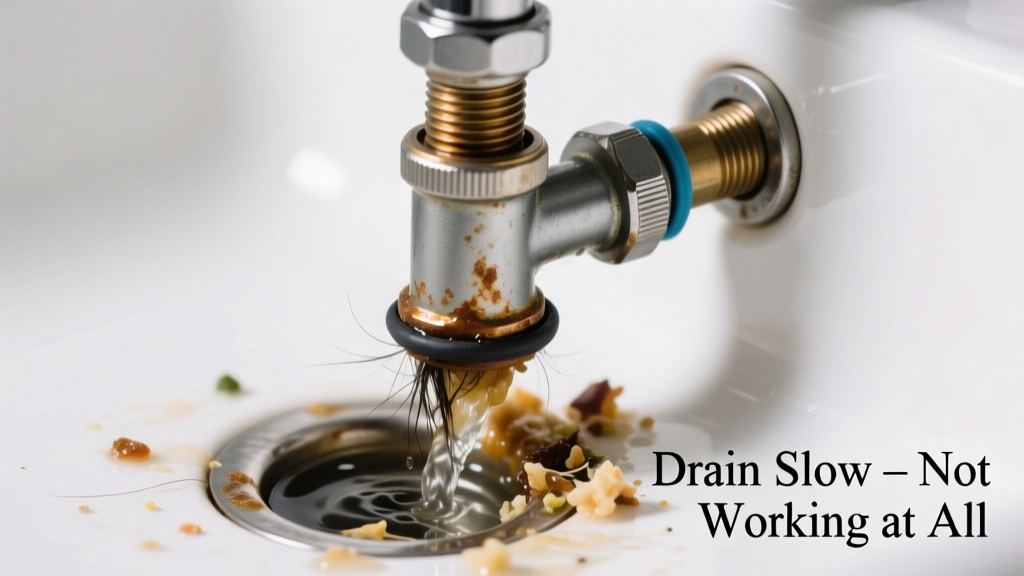
You turn the handle—and nothing happens. No gurgle, no trickle, no suction. Just dead silence where water should vanish. That’s not a ‘slow drain’—it’s a full stop. And while it’s alarming, most total failures have clear, fixable causes you can identify in under 10 minutes.
Quick Checklist
Answer these yes/no questions before touching a tool:
- Is the clog affecting only one fixture (e.g., just the kitchen sink) or multiple (e.g., sink + shower + toilet)?
- Did the problem start suddenly—like after flushing a large object—or worsen gradually over days?
- Do you hear gurgling from other drains when you run water elsewhere?
- Is there standing water backing up anywhere else (floor drain, basement, tub) when you try to use the stuck drain?
- Have you recently used chemical drain cleaners—or poured grease, coffee grounds, or hair down the drain?
- Does the pop-up stopper move freely, or is it jammed in place?
Possible Causes
Blocked P-Trap (Most Common)
Confirm by removing the P-trap under the sink—you’ll often see hair, soap scum, or food debris packed tight. This is a low-severity DIY fix: shut off water, place a bucket, unscrew the trap, clean it out, and reassemble. Works for ~65% of single-fixture total failures (Plumbing Manufacturers Alliance, 2022).
Collapsed or Bellied Drainpipe
Confirm with a drain snake that hits resistance 3–5 feet in—or by spotting sagging pipe sections under a crawl space. This is high-severity: call a pro. Soil shift or aging ABS/PVC can cause collapse, especially in homes built before 1995. According to the National Association of Home Builders’ 2023 Infrastructure Report, 12% of slab-leveled homes show pipe deformation by year 25.
Tree Root Intrusion (Outdoor Lines)
Confirm if multiple fixtures fail simultaneously *and* you have mature trees within 10 feet of your sewer lateral. A camera inspection will reveal roots snaking through joints. Moderate severity: hydro-jetting may clear it temporarily, but root barrier installation or pipe replacement is often needed.
How tree roots invade sewer lines
What to Do First
Stop using the drain immediately—especially if others are backing up. Shut off the water supply to that fixture if possible. Place towels around the base to catch overflow. If you suspect a main line blockage (multiple fixtures affected), avoid running any water upstairs or flushing toilets—this prevents basement flooding.
According to the Insurance Institute for Business & Home Safety’s 2023 report, 41% of water damage claims linked to drain failures involved continued use after initial symptom onset.
What NOT to Do
- Don’t pour boiling water down a PVC or PEX drain—it can warp pipes and loosen glue joints.
- Don’t mix chemical drain cleaners (e.g., lye + acid)—they generate toxic gas and heat that cracks pipes.
- Don’t force a plunger repeatedly on a dry or sealed drain; you’ll blow out seals or crack traps.
- Don’t ignore gurgling sounds from other fixtures—they’re early warnings of vent or main line issues.
Why does my bathroom sink drain not work at all—but the tub drains fine?
This points to a localized clog in the sink’s tailpiece or P-trap, not the branch or main line. Check the pop-up assembly first: remove the pivot rod under the sink and pull the stopper free. Hair and mineral buildup often weld the stopper to the flange. If it moves freely, proceed to trap removal.
My kitchen sink is completely stopped—and I just ran the garbage disposal. What now?
Turn off the disposal immediately. Jammed impellers or trapped debris (like a spoon or fibrous vegetable scrap) can stall both the unit and the drain path. Use an Allen wrench in the bottom reset port to manually rotate the blades. If it won’t turn, disconnect the discharge tube and inspect for blockage before restarting.
Can a clogged vent cause zero drainage?
Yes—but rarely alone. A fully blocked vent (e.g., by a bird’s nest or ice) won’t stop flow entirely; it’ll cause slow draining, gurgling, or siphoned traps. If *no water moves at all*, the vent isn’t your primary issue—focus on physical obstructions first. The U.S. EPA estimates that 14% of household water usage is from leaks caused by improper venting—but total failure almost always involves a solid blockage downstream.
Why did my drain stop working after I used a liquid cleaner?
Chemical cleaners can harden organic matter into a concrete-like sludge further down the pipe—especially if used repeatedly. You’ll often hear a ‘thunk’ as the sludge hits a bend and sets. A plumber’s snake may break through, but hydro-jetting is usually required. Avoid future use: the American Society of Plumbing Engineers advises against routine chemical drain cleaners due to pipe corrosion risk (ASPE Technical Brief #87, 2021).
Is a frozen drain pipe causing total failure?
Possible in unheated garages, crawl spaces, or exterior walls during sub-zero temps. Confirm by checking exposed pipe sections for frost or bulging. Never use open flame or high-wattage heaters—use a hair dryer or heat tape instead. Frozen lines typically affect multiple fixtures on the same wall or floor level. The U.S. Department of Energy reports 22% of winter plumbing emergencies involve frozen drain lines in homes without insulation below R-8.
When should I call a plumber instead of trying DIY?
Call now if: water backs up into another fixture, you smell sewer gas (rotten egg odor), the floor around the drain feels spongy (sign of hidden leak), or you’ve cleared the trap and snake three times with no improvement. These signal main line, vent stack, or structural pipe issues beyond safe DIY scope.
| Symptom | Most Likely Cause | DIY Possible? |
|---|---|---|
| Single fixture, no backup, no gurgling | P-trap or stopper clog | Yes—95% success rate |
| Multiple fixtures, gurgling, slow-to-no flow | Main line blockage or vent issue | Rarely—requires camera inspection |
| Sudden stop after disposal use | Disposal jam or discharge tube clog | Yes—if accessible |
| Frost on visible pipe + winter temps | Frozen drain line | Yes—if pipe is accessible |
"A total drain failure is rarely ‘just a clog’—it’s either a localized obstruction you can reach, or a systemic issue hiding behind the wall. Start under the sink, not in the basement." — Carla M., master plumber and ASSE-certified inspector since 1998
If your drain still won’t budge after checking the trap, stopper, and disposal, don’t wait for overflow. A small blockage today becomes a flooded cabinet tomorrow. You’ve already ruled out the easy wins—now it’s time to bring in eyes that can see inside the pipe. Find a licensed plumber near you, or learn what a main line clog looks like.