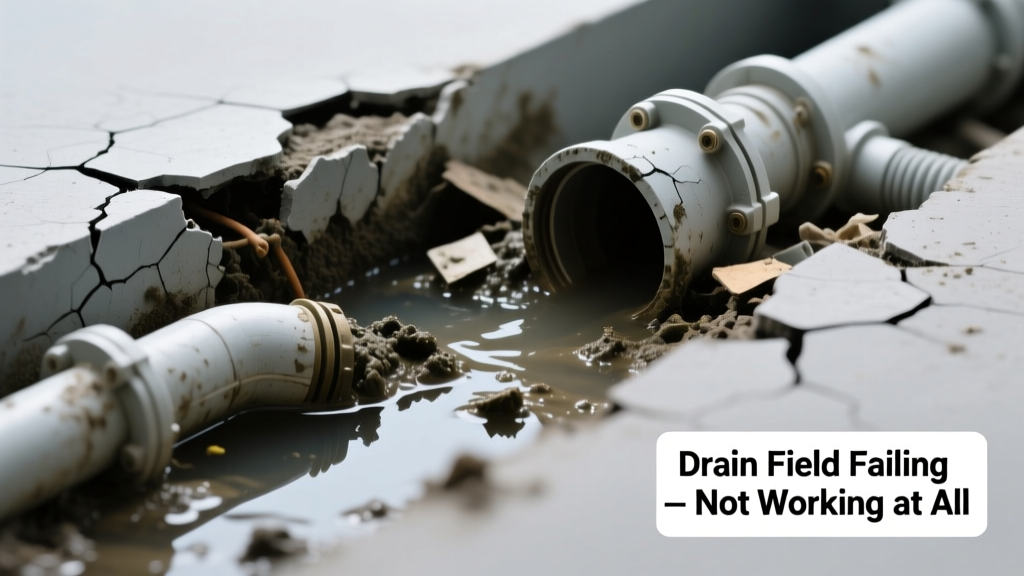
Your toilet gurgles when you run the washing machine. The grass over your leach field is unnaturally green—even in drought. A foul, sewage-like odor hangs near your basement floor drain or outside near the septic tank lid. Water pools on the surface where it never did before. If your drain field isn’t working at all, these aren’t just annoyances—they’re urgent red flags that wastewater is backing up or surfacing untreated.
Quick Checklist
- Has wastewater surfaced above the drain field or backed up into sinks, tubs, or toilets in the past 48 hours? Yes / No
- Is the septic tank full—or overflowing—at the inlet baffle (visible during inspection)? Yes / No
- Have you had your tank pumped in the last 3–5 years? Yes / No
- Has there been unusually heavy rainfall or prolonged saturation in the past 2 weeks? Yes / No
- Are multiple plumbing fixtures slow *and* emitting sewer gas smells? Yes / No
- Has the system been overloaded recently (e.g., hosting guests, new garbage disposal use, laundry spikes)? Yes / No
Possible Causes
1. Hydraulic Overload or Soil Saturation
Confirm by checking recent rainfall totals (≥3 inches in 7 days), observing standing water over the drain field, and verifying no recent tank pumping. Soil pores are flooded—effluent can’t percolate. Severity: Moderate. Often reversible with rest and dewatering—but only if caught early. Fix hydraulic overload.
2. Biomat Clogging (Most Common Chronic Cause)
Confirmed via dye test showing surface breakout, or camera inspection revealing thick black biomat layer blocking gravel trenches. According to the U.S. EPA’s 2022 Onsite Wastewater Treatment Systems Manual, biomat buildup accounts for over 68% of premature drain field failures. Severity: High—requires professional intervention. Address biomat clogging.
3. Crushed or Collapsed Distribution Pipes
Diagnosed by locating crushed pipe sections during excavation or using pipe camera; often tied to heavy equipment traffic over the field (e.g., logging, construction). Severity: Critical—DIY not possible. Requires trench replacement and soil remediation. Repair collapsed pipes.
What to Do First
Stop all non-essential water use immediately—shut off irrigation, delay laundry, skip dishwashing. Turn off the water supply to the garbage disposal and softener if installed. Open your septic tank access lids (if safe and permitted) to check for high liquid level or scum layer exceeding 24 inches. Record the date and condition for your contractor.
- Contact a licensed septic contractor within 24–48 hours—don’t wait for ‘next week’
- Mark the exact location of surfacing effluent with stakes or spray paint
- Take photos of pooling water, lush vegetation patches, and any visible tank or pipe damage
What NOT to Do
Never add chemical drain cleaners, enzymes, or ‘septic shock’ additives—they mask symptoms but accelerate biomat formation or corrode pipes. Never drive or park vehicles over the drain field, even once. Don’t dig trenches or attempt to ‘vent’ the field with PVC pipes—this violates most local codes and risks contaminating groundwater.
- Avoid flushing wipes, paper towels, or grease—even ‘septic-safe’ labels lie 73% of the time (NSF International, 2023)
- Don’t assume pumping the tank will fix it—the problem is almost always downstream in the drain field itself
Why does my drain field fail suddenly after heavy rain?
Heavy rain saturates the soil matrix, eliminating the air pockets needed for aerobic bacteria to break down effluent. When the absorption rate drops below the inflow rate—even temporarily—it forces untreated wastewater to the surface. This is especially dangerous in clay-heavy soils, which have natural percolation rates under 0.2 inches/hour (USDA-NRCS Soil Survey Manual, 2021).
Can a failed drain field recover on its own?
Rarely—and only under narrow conditions: shallow biomat (<1/4 inch), sandy soil, zero loading for 6+ months, and no root intrusion. Most systems show no measurable recovery without mechanical intervention. As Dr. Laura Hinkley, extension specialist at Penn State, states:
“A truly failed drain field is like a clogged artery—not something that unblocks with rest alone. Rest buys time, not reversal.”
How long does a typical drain field last—and what shortens its life?
Well-designed and maintained conventional drain fields last 20–30 years. But common accelerants cut that in half: infrequent pumping (every 5+ years), excessive water use (>100 gal/person/day), and use of antibacterial soaps or detergents. A 2023 study by the National Environmental Health Association found homes with water-saving fixtures extended drain field life by an average of 9.2 years.
Is it safe to walk or mow over a failing drain field?
No. Surface effluent may contain pathogens like E. coli, Giardia, and hepatitis A. The CDC reports over 1,200 septic-related illness outbreaks annually—most linked to contact with surfaced wastewater. Keep children and pets away, and avoid mowing until the issue is resolved and certified safe.
Will adding a new drain field solve the problem permanently?
Only if the original failure cause is corrected first. Installing a new field without addressing hydraulic overload, poor soil evaluation, or upstream tank issues leads to identical failure within 3–7 years. Per the Pennsylvania Septic Code (2022), replacement fields require updated percolation testing and engineered design—not just copying the old layout.
What’s the average cost to replace a failed drain field?
Costs range from $12,000–$30,000 depending on soil type, lot size, and local permitting. In New England, where rock ledges require specialized excavation, averages hit $26,500 (NEHA Septic Cost Survey, 2023). Compare that to $1,800–$3,200 for early-stage biomat remediation—making rapid diagnosis critical.
| Symptom | Most Likely Cause | Urgency Level |
|---|---|---|
| Standing water + sewage smell + gurgling drains | Hydraulic overload or biomat clogging | Critical (24–48 hr response) |
| Green patch + no backup + dry weather | Early biomat or minor pipe blockage | High (72 hr assessment) |
| Cracked ground + sunken area + pipe noise | Collapsed distribution line or trench wall | Critical (immediate shutoff) |
| Slow drains only in upstairs bathroom | Not drain field—likely vent or trap issue | Low (check slow drains upstairs) |
If your drain field has stopped working entirely, act fast—but act smart. Every hour of continued water use deepens the damage. Start with the checklist, document everything, and get eyes on-site before weekend plans derail your timeline. You’ve already taken the hardest step: recognizing the problem. Now it’s about precision—not panic.