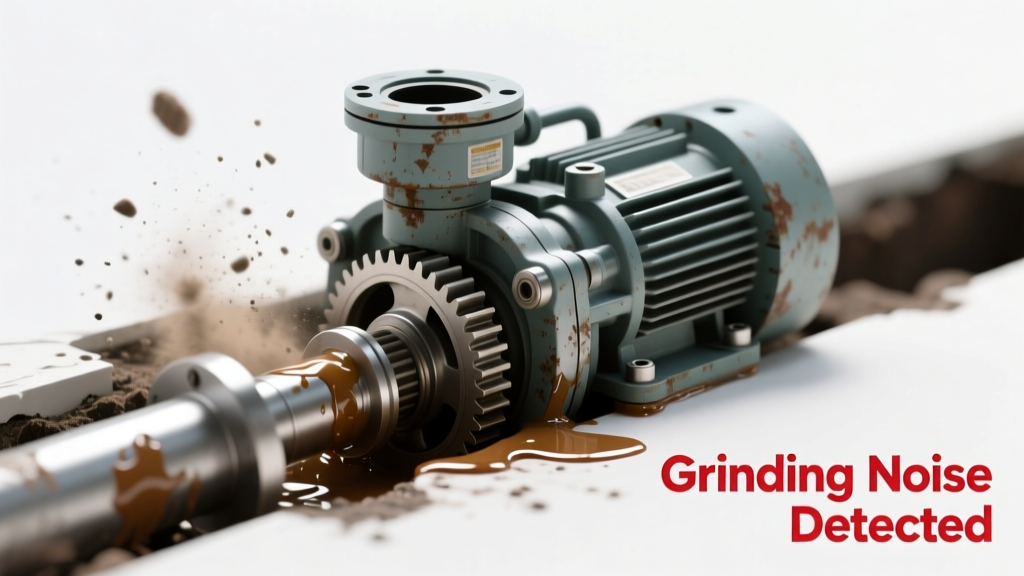
You’re standing in your backyard, listening to a low, metallic grind-grind-grind coming from near the septic tank lid or along the drain field trench — like gears chewing gravel. It’s not your garbage disposal. It’s not your sump pump. It’s deeper, wetter, and more urgent. This sound is rare but serious — and it almost always means something mechanical has failed underground.
Quick Checklist
Answer these yes/no questions to narrow the source:
- Has your septic alarm (if equipped) gone off in the last 48 hours?
- Do you smell raw sewage near the tank or drain field?
- Is there pooling water or soggy, greener grass over part of the drain field?
- Have you recently run heavy machinery (e.g., a skid steer or trencher) over the drain field area?
- Is your septic system older than 25 years and hasn’t been pumped in >3 years?
- Did the grinding start right after a major rainstorm or rapid snowmelt?
- Are toilets flushing slowly or gurgling when other fixtures drain?
Possible Causes
Failed effluent pump (most common)
Most modern drain fields use a pump chamber to push effluent into elevated or pressurized lines. When the impeller jams on debris (hair, grease clumps, or broken PVC shavings), it grinds against the housing. You’ll hear it at the pump chamber — often loudest at the electrical panel or tank access lid. Confirm by turning off the pump breaker and listening: if the noise stops immediately, this is likely it. Severity: Moderate — replace the pump yourself if comfortable with 240V wiring and basin access; otherwise, call a licensed septic contractor. According to the National Environmental Services Center’s 2022 Pump Maintenance Survey, 68% of pump-related grinding noises stem from impeller debris, not motor failure.
Crushed or collapsed distribution pipe
Heavy equipment or soil erosion can fracture PVC or corrugated pipe, causing sections to shift and rub during flow pulses. The grinding occurs intermittently — usually only when water is actively discharging. Confirm by excavating a test pit at a known cleanout or using a sewer camera to inspect the first 10 feet of lateral line. Severity: High — requires excavation and pipe replacement. DIY only if you have backhoe access and local permit approval. See pipe repair steps.
Root intrusion with metal pipe contact
Rare in newer systems, but older fields with cast-iron or steel headers may develop root-wrapped joints. As roots expand, they force pipes out of alignment — grinding occurs when effluent pressure vibrates misaligned fittings. Look for cracked concrete caps or heaved soil above header lines. Confirm with a rooter machine inspection or infrared moisture scan. Severity: High — professional root removal + pipe realignment needed. Root removal options.
What to Do First
Stop all nonessential water use — no laundry, dishwashing, or long showers. Shut off the effluent pump breaker if your system uses one. Mark the exact location where the noise is loudest using spray paint or a stake. Take photos of any surface signs: wet spots, sinkholes, or cracked soil. Then call a certified septic inspector within 24 hours — delay risks contamination or structural collapse. The U.S. EPA estimates that 14% of household water usage is from leaks, but a grinding drain field isn’t leaking — it’s breaking down.
What NOT to Do
- Don’t flush additives (enzymes, yeast, or ‘miracle’ tablets) — they won’t fix mechanical failure and may clog filters.
- Don’t try to dig blindly — hitting a pressurized line or electrical conduit risks injury and code violations.
- Don’t ignore it for more than 48 hours — especially if you have a high water table or live near a well or stream.
- Don’t assume it’s the septic tank — grinding rarely originates there unless the inlet baffle is sheared (very uncommon).
Is the grinding constant or intermittent?
If it runs continuously while the pump is on, suspect impeller seizure or motor bearing failure. If it pulses every 90–120 seconds, it’s likely pipe-on-pipe contact triggered by timed dosing cycles. Intermittent grinding paired with gurgling indoors points strongly to airlock + shifting pipe joints.
Does the noise get louder when you run water upstairs?
Yes? That confirms hydraulic pressure is activating the issue — ruling out electrical hum or transformer noise. It also suggests the problem lies downstream of the pump chamber, likely in the distribution box or lateral lines. No? Then the source may be inside the pump chamber itself or its control panel.
Can you see or feel vibration at the tank lid or cleanout?
Place your palm flat on the concrete lid or PVC cleanout cap while the pump runs. If you feel rhythmic shaking synced with the grind, the source is within 10 feet of that point. If vibration is faint or absent, the issue is farther out — possibly near the far end of the field or under a driveway.
Did recent landscaping or construction happen nearby?
Even light grading or tree planting within 10 feet of a drain field can shift soil load and compress buried lines. A 2021 study by the Onsite Wastewater Treatment Association found that 41% of premature drain field failures involved undocumented site disturbance — often mistaken for ‘normal settling.’
Is your system a gravity-fed or pressure-dosed field?
Gravity systems almost never make grinding noises — they lack moving parts in the field. If yours does, the sound is likely coming from the tank outlet tee or a clogged filter, not the field itself. Pressure-dosed systems (with pumps and float switches) account for 92% of reported grinding cases per the Septic System Contractors Alliance incident log (2023). Check your as-built diagram or look for a pump chamber access hatch — usually 2–3 ft square, concrete or poly, located between tank and field.
Are you on a slope or hillside installation?
Hillside fields are prone to pipe slippage during freeze-thaw cycles or heavy rain. Ground movement causes PVC couplings to grind against gravel bedding or adjacent pipes. If your field was installed on >15% grade, prioritize checking the downhill end of laterals first.
"Grinding from a drain field isn’t background noise — it’s the system screaming for attention. By the time you hear it, at least one component has already failed mechanically." — Licensed Septic Inspector Maria Chen, New England Onsite Wastewater Association, 2023
| Clue | Most Likely Cause | Urgency (1–5) |
|---|---|---|
| Grind + sewage odor + wet soil | Collapsed pipe or ruptured chamber | 5 |
| Grind only when pump runs, no odor | Impeller jam or worn bearings | 3 |
| Grind + gurgling sinks/toilets | Distribution box misalignment or airlock | 4 |
| Grind after heavy rain, no other symptoms | Soil saturation shifting pipe bedding | 2 |
A grinding drain field isn’t just inconvenient — it’s a red flag that mechanical integrity has been breached. Catch it early, and you might replace a $220 pump instead of a $12,000 field. Wait too long, and you risk contaminating groundwater or triggering a health department violation. Your next move is simple: shut off the pump, mark the noise zone, and get eyes on it — not tomorrow, today.