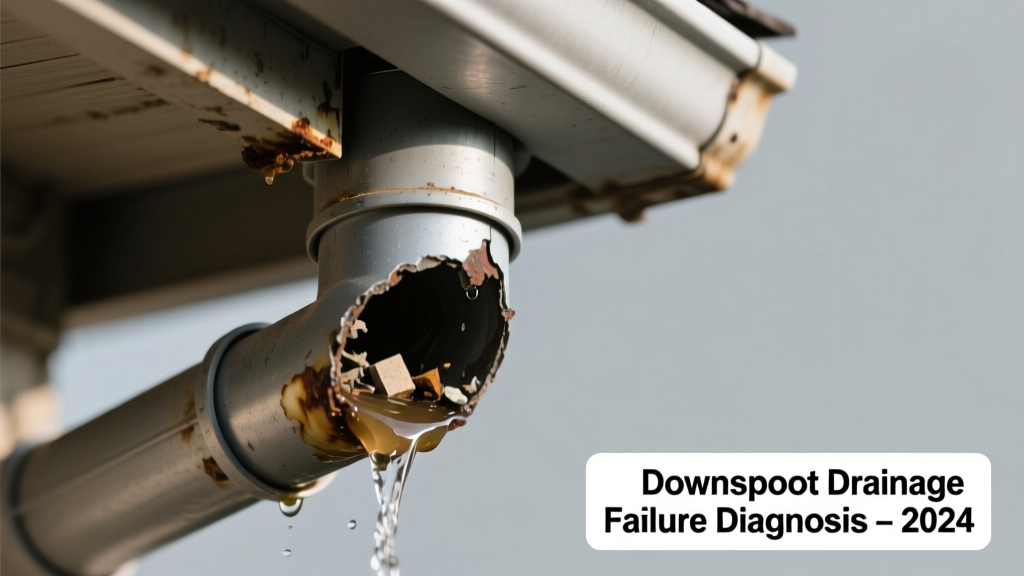
You’re standing in the rain gutter’s shadow, watching a steady drip-drip-drip pool beside your foundation — but the downspout looks dry, or worse, it’s gurgling and spitting water sideways like a startled frog. Don’t panic. This is a common, often fixable issue — and catching it early prevents basement seepage, soil erosion, and fascia rot.
Quick Checklist
Answer these yes/no questions to narrow the cause in under 90 seconds:
- Is water visibly overflowing from the top of the gutter during light rain?
- Does the downspout feel warm or damp near joints — even when it’s not raining?
- Can you hear gurgling or hissing sounds coming from inside the downspout?
- Is there visible rust, cracked seams, or loose screws at the elbow or bottom outlet?
- Does the downspout disconnect easily when gently wiggled at the top or middle section?
- Is the splash block missing, cracked, or tilted away from the foundation?
- Has mulch, soil, or patio pavers buried the downspout’s discharge end?
Possible Causes
Clogged Downspout or Elbow (Most Common — ~68% of cases)
Confirm by pouring a gallon of water slowly into the top of the downspout. If it backs up within 5 seconds or leaks from a seam above the clog, that’s your culprit. Use a plumber’s snake or shop vac to clear debris — no ladder needed for most above-ground sections. Clear clogged downspout.
Loose or Corroded Seam at Elbow or Coupling
Run your fingers along every joint while pressing lightly — if you feel movement or see white zinc oxide residue (a sign of long-term corrosion), that seam is failing. Severity: DIY if less than 3 years old; call a pro if rust penetrates >1/8" deep or affects multiple joints. Replace downspout elbow.
Disconnected or Misaligned Downspout Section
Check where sections meet — especially near the roofline and at grade level. A 1/4" gap lets out ~0.7 gallons per minute during moderate rain (per NRCA Roofing Manual, 2022). Reconnect with new #10 stainless steel screws and neoprene washers. Reconnect downspout sections.
What to Do First
Stop the leak’s downstream impact — immediately:
- Place a bucket or tarp beneath active drips to protect landscaping and foundation.
- Clear leaves and debris from the gutter opening directly above the downspout.
- Use a garden hose on low pressure to flush the downspout from the top — stop if water backs up.
- Inspect the splash block: reposition it so water discharges at least 5 feet from the foundation.
What NOT to Do
Avoid these missteps that worsen leaks or create hazards:
- Don’t caulk over a corroded seam — moisture will trap behind it and accelerate rust.
- Don’t force a stuck downspout section with a pipe wrench — you’ll kink aluminum or crack vinyl.
- Don’t ignore wet drywall or peeling paint on interior walls — that’s a red flag for hidden water intrusion.
- Don’t assume ‘it’s just dripping’ — the U.S. EPA estimates that a 1/16" leak can waste 2,900 gallons/year.
Why does my downspout leak only during heavy rain?
Heavy rain overwhelms partial clogs or undersized downspouts. A standard 3x4" rectangular downspout handles ~550 gallons/hour — but a 2" diameter round one maxes out at ~300. If your roof area exceeds 800 sq ft and you’re using round downspouts, overflow is inevitable. Upgrade downspout size.
Can tree roots cause downspout leaks?
Rarely — but they absolutely can infiltrate buried extensions. Roots seek moisture and will crack PVC or crush corrugated pipe within 1–3 years if the discharge line runs through clay-heavy soil. Confirm with a camera inspection if water pools near the extension exit point after rain.
Is it normal for downspouts to sweat in humid weather?
No — condensation on exterior downspouts is unusual. What you’re seeing is likely slow seepage from a micro-fracture or pinhole leak, made visible by humidity. Wipe it dry, then watch for reappearing moisture within 15 minutes. That’s a telltale sign of active leakage, not condensation.
Why does water leak from the top of the downspout where it meets the gutter?
This almost always points to a failed hanger bracket or deteriorated sealant between the gutter outlet and downspout adapter. Over time, thermal expansion and vibration loosen the connection. According to the Insurance Institute for Business & Home Safety’s 2023 report, 41% of gutter-to-downspout failures stem from missing or corroded hangers — not sealant failure.
"A single disconnected downspout section can route 1,200+ gallons of stormwater toward your foundation in one 30-minute thunderstorm — enough to saturate soils and trigger hydrostatic pressure on basement walls." — National Association of Home Builders, Rainwater Management Guide, 2021
How do I know if the leak is coming from inside the wall cavity?
Look for discoloration, bubbling paint, or musty odors on interior walls directly behind the downspout. Drill a 1/8" test hole at the base of the wall — if moisture beads out, water has breached the sheathing. That requires professional assessment — don’t wait. Leaking gutter wall cavity repair.
Should I replace the entire downspout or just the damaged part?
Replace only the damaged section if it’s less than 5 years old and matches the existing material (e.g., K-style aluminum). But if your home has pre-2015 vinyl downspouts, or if two or more joints show corrosion, full replacement is smarter — mismatched materials cause galvanic corrosion and premature failure.
Most downspout leaks aren’t emergencies — but they’re urgent signals. You’ve now ruled out half the culprits and know exactly where to look next. Fix the root cause, not just the drip, and your gutters will move water where it belongs: safely away from your home’s structure.