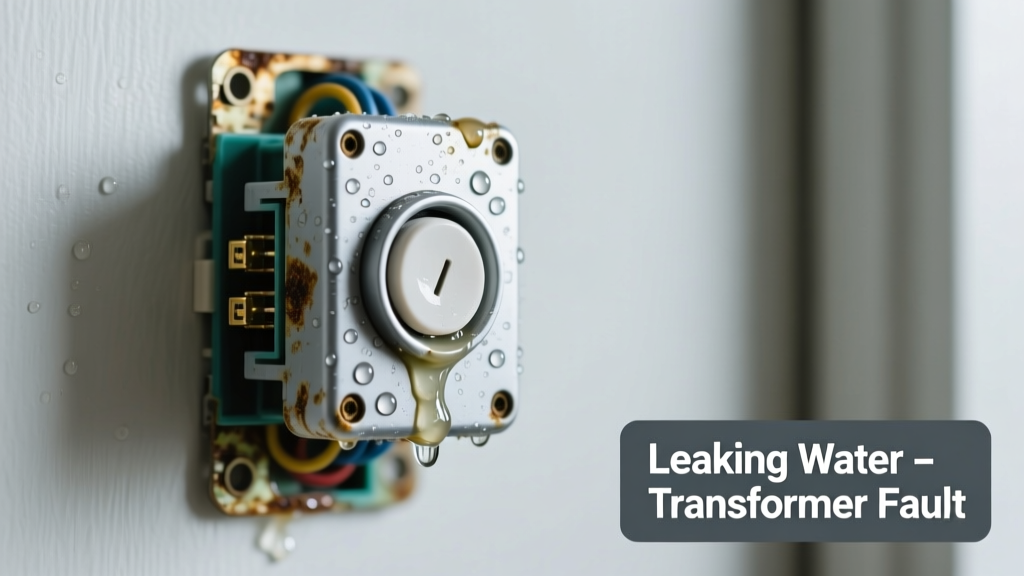
You hear a faint hiss near your doorbell chime, spot damp drywall behind the transformer box, or see pooled water on the basement floor beneath the HVAC closet—yes, that’s alarming. But take a breath: the transformer itself doesn’t leak water. What you’re seeing is a symptom of another failure nearby, and catching it early prevents mold, electrical hazards, and costly drywall replacement.
Quick Checklist
- Is water pooling directly beneath the doorbell transformer mounting location?
- Does the leak appear only during or shortly after rain or snowmelt?
- Is the transformer mounted inside an exterior wall cavity, attic, or HVAC closet?
- Can you feel moisture on the back of the drywall or insulation behind the transformer box?
- Is there visible rust or white mineral residue on the transformer’s metal housing or wiring terminals?
- Does your home have a humidifier attached to the furnace—and is it running?
Possible Causes
Roof or Soffit Leak Tracking Down Wall Cavity
Water from a compromised roof shingle, damaged drip edge, or clogged soffit vent travels down framing members and pools where the transformer is mounted—often in a stud bay shared with wiring. Confirm by inspecting attic framing above the transformer location for wet insulation or water staining. Severity: Moderate—requires roofing or carpentry repair. Fix roof leak tracking down wall.
Condensation From HVAC Duct or Humidifier
The U.S. EPA estimates that 14% of household water usage is from leaks—but condensation accounts for far more unmeasured moisture intrusion. If the transformer sits near a cold supply duct or humidifier drain line, condensation can drip onto wiring boxes. Confirm with a hygrometer (readings >60% RH in the space) and visual frost on ductwork. Severity: Low—DIY fixable with duct insulation and drain line inspection. Fix humidifier condensation drip.
Frozen & Burst Drain Line (Winter Only)
In homes with whole-house humidifiers, the PVC drain line can freeze in unheated attics or exterior walls. When it thaws, water surges into adjacent cavities—including where transformers are mounted. Confirm by checking for ice crystals in the drain line or a cracked fitting near the furnace. Severity: High—immediate shut-off required; call an HVAC pro. Fix frozen humidifier drain line.
What to Do First
Turn off power to the doorbell circuit at the breaker—even if the transformer appears dry. Then, use a non-contact voltage tester to confirm no live current reaches the transformer terminals. Next, gently remove the cover plate and inspect for wet insulation behind it. Place absorbent towels underneath and log the time, weather, and whether the leak recurs within 2 hours of HVAC cycling.
- Label and photograph all wiring before disconnecting anything
- Check your furnace humidifier’s drain pan for overflow
- Inspect attic access points above the transformer for missing baffles or wet insulation
What NOT to Do
Never wrap a wet transformer in tape or silicone—it traps moisture and accelerates corrosion. Don’t assume ‘no voltage = safe’; water + low-voltage wiring can still cause short circuits and fire risk in junction boxes. And don’t ignore it because ‘it’s just the doorbell’—the National Fire Protection Association reports 7% of residential electrical fires originate in low-voltage systems compromised by moisture intrusion (NFPA Electrical Fire Report, 2022).
"Transformers don’t sweat, drip, or leak—they’re sealed units. If you see water near one, you’re looking at a symptom of a larger building envelope or mechanical system failure." — Licensed Home Inspector, Building Science Institute, 2023
Is the water clear and odorless—or does it smell like mildew or antifreeze?
Clear, odorless water points to rain infiltration or condensation. A musty smell suggests long-term mold growth behind drywall. Antifreeze odor indicates a failed furnace heat exchanger or coolant line breach—immediately shut off the furnace and call an HVAC technician.
Does the leak stop when you turn off the furnace humidifier?
If yes, the humidifier’s drain line or pan is likely the source. Check for algae buildup in the drain tube and verify the float switch isn’t stuck open. Replace the drain line if it’s rigid PVC older than 5 years—per ASHRAE Guideline 36-2021, PVC degrades under constant moisture exposure.
Is the transformer mounted on an exterior wall with no vapor barrier?
This is common in older Cape Cod or ranch homes built before 1980. Without a proper vapor barrier, warm indoor air meets cold sheathing, causing interstitial condensation. You’ll find black mold on paper-faced insulation and rust on nail heads. Fix requires removing drywall, installing smart vapor retarder, and sealing all penetrations. Fix exterior wall condensation.
Did the leak start after recent roof work or gutter replacement?
Gutter misalignment or missing drip edge redirects runoff behind fascia boards—water then migrates down sheathing and into wall cavities. Inspect fascia for staining and test gutter slope with a level. A 1/4″ per 10′ pitch is minimum; steeper is better.
Are there copper pipes or refrigerant lines running through the same stud bay?
Copper sweating due to temperature differential can drip onto transformer boxes. Look for green patina or water rings around pipe clamps. Wrap pipes with closed-cell foam insulation rated for sub-zero temps—R-3.7 minimum per inch (International Mechanical Code, 2021).
Water near your doorbell transformer isn’t about the transformer—it’s your home telling you something upstream is failing. Pinpointing the real source stops recurring leaks, protects your electrical system, and avoids $2,000+ in hidden mold remediation. Start with the checklist, then follow the trail—not the drip.