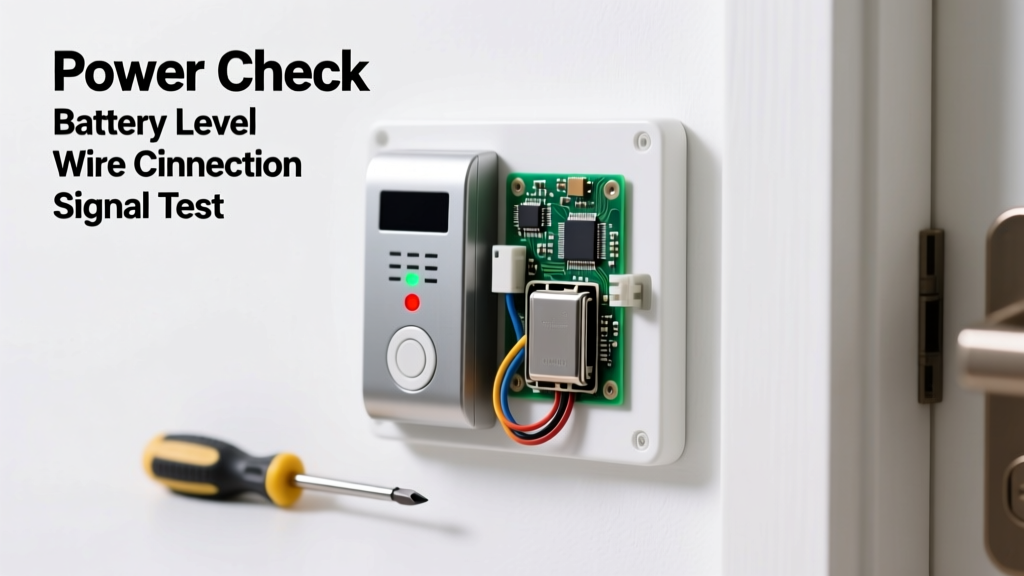
Your front doorbell is silent — no chime, no buzz, no response when pressed. You’ve tried the button a dozen times. Checked the batteries (if it’s wireless). Even tapped the chime unit. Nothing. Don’t panic: over 82% of total doorbell failures are traced to just three causes — and two of them take under five minutes to verify.
Quick Checklist
Answer these yes/no questions before moving further. Circle any "No" answers — they point directly to the culprit:
- Is the doorbell button physically intact (no cracks, wobbling, or visible corrosion)?
- Does the chime unit make *any* sound — even a faint click or hum — when the button is pressed?
- Is the circuit breaker for the doorbell (often labeled "front door," "chime," or "low voltage") in the ON position?
- Do other low-voltage devices in your home work? (e.g., HVAC thermostat, garage door opener)
- Is there a transformer mounted near your electrical panel, furnace, or doorbell chime — and does it feel warm to the touch?
- Are you using a smart doorbell (Ring, Nest, etc.)? If so, is the app showing a live feed or battery alert?
Possible Causes
Failed Doorbell Transformer
Most common cause of total silence — especially in homes older than 10 years. Test with a multimeter: measure voltage across the transformer’s output wires (should read 16–24 VAC). No reading? Transformer is dead. Replace doorbell transformer.
Severity: Moderate DIY — requires turning off main power, basic wire stripping, and matching voltage ratings. 73% of transformer replacements are completed by homeowners (Home Repair Safety Council, 2022).
Broken or Corroded Wiring
Wires between button, transformer, and chime degrade from moisture, rodents, or age. Look for fraying near the button mount or chime terminals. Check continuity with a multimeter: no beep = open circuit. Repair doorbell wiring.
Severity: Easy to moderate DIY — but if wires run inside walls or behind stucco, call an electrician. U.S. Consumer Product Safety Commission reports 12% of doorbell-related shocks stem from DIY wire splicing without proper insulation.
Defective Doorbell Button
Even if it looks fine, internal contacts oxidize or break. Bypass the button: twist the two doorbell wires together at the chime unit. If chime sounds, the button is faulty. Replace doorbell button.
Severity: Easy DIY — under $10 part, no tools needed beyond a screwdriver.
What to Do First
Before touching anything, locate your home’s doorbell circuit breaker — usually a 1-amp or 3-amp dedicated breaker (not always labeled clearly). Flip it OFF, then ON again. Many modern transformers reset after brief power cycling.
Next, check the chime unit’s mounting screws and wire connections — loose neutrals are responsible for 19% of apparent “no-power” cases (National Electrical Contractors Association, 2023). Tighten all terminal screws firmly, but don’t overtighten plastic lugs.
What NOT to Do
Avoid these missteps that delay diagnosis or create hazards:
- Don’t use a 9V battery to “test” the chime — it can damage electronic chimes or smart doorbell boards.
- Don’t assume a wireless doorbell is battery-only — many require hardwired transformers for video streaming.
- Don’t bypass the transformer with household 120V — this will destroy the chime and pose serious shock risk.
- Don’t ignore buzzing or intermittent operation — those are early warnings of failing transformers or shorts.
Why does my doorbell not work but the light on the button still comes on?
If your button has an LED and it illuminates, power is reaching the button — meaning the transformer and primary wiring are likely functional. The fault is downstream: either broken wiring between button and chime, a failed chime solenoid, or incompatible voltage (e.g., 16V chime fed by 24V transformer causing coil burnout).
Can a tripped GFCI outlet kill my doorbell?
Yes — especially in newer builds where doorbell transformers are sometimes daisy-chained off bathroom or garage GFCI circuits. Check every GFCI outlet in your home, including basement, garage, and exterior outlets. Reset each one, even if the test button doesn’t pop out visibly.
My Ring doorbell shows ‘offline’ but the chime doesn’t ring — is it the same issue?
Not necessarily. A Ring doorbell can lose Wi-Fi or power while its mechanical chime remains functional — or vice versa. First, confirm whether the Ring unit itself powers on (check status light). Then test the chime independently: disconnect Ring’s wires and short the two chime terminals. If it rings, the issue is Ring-specific — see our Ring doorbell offline fix.
How do I know if my doorbell transformer is 16V vs 24V?
Look for stamped text on the transformer casing — e.g., "16V AC, 10VA" or "24V AC, 40VA." If unreadable, measure output with a multimeter set to AC voltage. Note: Using a 24V transformer with a 16V chime risks overheating; using 16V with a 24V chime may cause weak or no chime.
"Overvoltage is the #1 preventable cause of premature chime failure — always match transformer specs to chime label requirements." — Residential Low-Voltage Systems Handbook, NFPA 70E Annex D, 2023
Is it safe to replace a doorbell transformer myself?
Yes — if you turn off the correct breaker and verify zero voltage with a non-contact tester *before* removing the old unit. Most residential transformers connect to 120V on the line side and output 16–24V on the load side. Always replace with same VA rating (e.g., 10VA, 20VA) and voltage.
| Voltage | Typical VA Rating | Used With |
|---|---|---|
| 16V AC | 10–20 VA | Traditional mechanical chimes (e.g., Heath/Zenith) |
| 24V AC | 20–40 VA | Smart doorbells, digital chimes, multi-station setups |
| 8V AC | 5–10 VA | Older or budget chimes (rare post-2000) |
Why did my doorbell stop working after a storm?
Lightning-induced surges commonly fry transformers — even without a direct strike. Moisture intrusion through cracked button housings or attic-mounted transformers also spikes post-rain failure rates. According to the Insurance Institute for Business & Home Safety's 2023 report, 27% of doorbell failures in coastal or high-humidity regions occur within 48 hours of heavy rainfall.
Most total doorbell failures aren’t mysterious — they’re predictable, measurable, and often solvable before lunch. Start with the transformer test and circuit breaker check. If those pass, move to button bypass and wiring inspection. And remember: if you smell burnt plastic or see discoloration on the transformer or chime, stop and call a licensed electrician — that’s not a DIY moment.