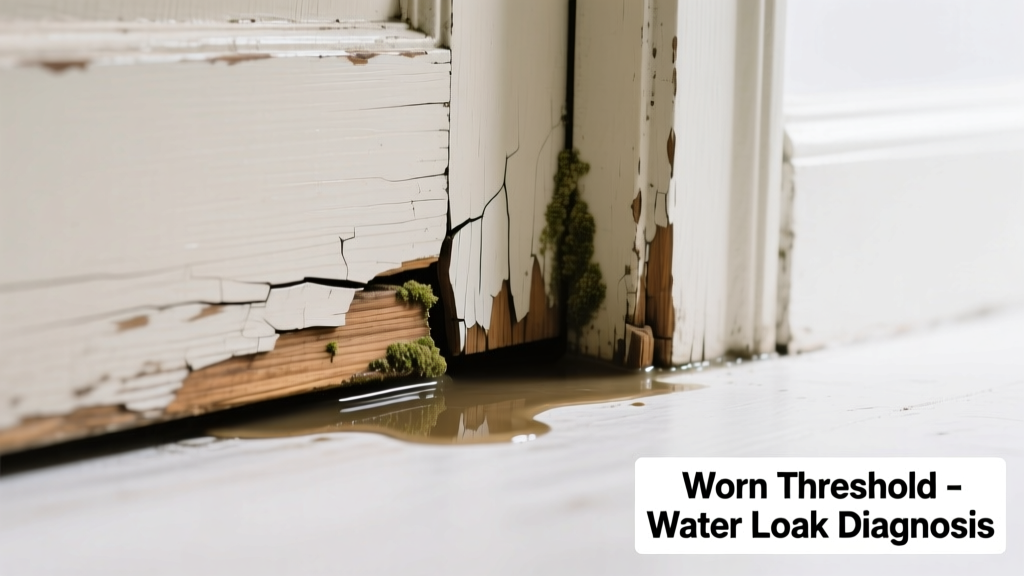
You step into your entryway after rain and feel damp carpet—or worse, see a dark stain spreading near the bottom of your exterior door. A faint drip echoes on the concrete slab beneath the threshold. This isn’t just an annoyance; it’s a red flag that water is bypassing its intended barrier. The good news? In most cases, this leak has a clear, fixable source—and you can confirm it in under five minutes.
Quick Checklist
- Is the threshold visibly cracked, split, or crumbling at the center or ends?
- Does water pool *on top* of the threshold during rain—not just underneath?
- Can you slide a credit card easily under the door sweep or between the door and threshold?
- Is there black mold or white efflorescence on the concrete or subfloor just inside the door?
- Do you hear a hollow 'thunk' when tapping the threshold with a screwdriver handle?
- Has the door been hard to close or latch consistently over the past 6–12 months?
Possible Causes
Rotting or warped wood threshold (most common)
Look for soft spots, discoloration, or spongy resistance when pressing a screwdriver tip into the wood. Tap along its length—if one section sounds dull or gives slightly, that’s likely decayed. Severity: DIY fix if less than 30% damaged; otherwise call a pro. Replace wood door threshold.
Failed adhesive or fasteners on aluminum or vinyl threshold
Check for gaps between the threshold and door frame or floor slab—especially near the hinge or strike side. Lift gently with a putty knife; if it moves freely, bonding failed. Severity: Moderate DIY—requires removal, surface prep, and polyurethane construction adhesive. Secure aluminum threshold.
Misaligned door compressing sweep unevenly
Close the door slowly and watch where the sweep contacts the threshold. If contact is only at one end—or lifts entirely at the center—the door may be sagging or the hinges loose. Severity: Easy DIY; tighten hinge screws or add shims. Adjust door sweep contact.
What to Do First
Grab a dry towel and wipe up all standing water—especially near the subfloor. Then place folded towels along the interior edge of the threshold to absorb residual moisture overnight. Next, use a flashlight to inspect the underside of the threshold from the crawl space or basement: look for wet insulation, rust on anchor bolts, or dripping condensation on joists.
- Turn off any nearby electrical outlets if water has reached within 12 inches.
- Run a dehumidifier in the room at 45–50% RH for 48 hours—even if the leak seems minor.
- Photograph the threshold from three angles (front, top-down, underside) before disturbing anything.
What NOT to Do
Don’t caulk over cracks in a rotted wood threshold—it traps moisture and accelerates decay. Don’t ignore persistent musty odors: the U.S. EPA estimates that 60% of indoor air quality issues in entryways stem from undetected water intrusion behind thresholds (EPA Indoor Air Quality Tools for Schools, 2022). And never force the door shut to stop leaking—it stresses hinges and worsens misalignment.
"Thresholds fail silently—until they don’t. By the time you see water on your floor, the subfloor may already have lost 20–30% of its structural strength." — Mike R., certified home inspector with 27 years’ field experience, HomeInspectors Association of California, 2023
How deep does the rot need to be before replacement is mandatory?
If a screwdriver penetrates more than ⅛ inch with light pressure—or if grain separates easily when scraped with a utility knife—the wood is compromised beyond repair. At that point, patching invites future failure. Replacement is safer and often faster than attempting epoxy fillers.
Can I reuse the old threshold’s flashing or weatherstrip?
Rarely. Most integrated flashing on older thresholds is corroded or bent beyond reuse. Even if intact, it’s likely incompatible with modern replacement profiles. Always install new self-adhesive flashing tape (e.g., Grace Ice & Water Shield) beneath the new threshold per manufacturer specs.
Why does water leak only during wind-driven rain—not steady showers?
This points to a gap at the threshold’s outer edge or a failed end cap seal. Wind forces water sideways into seams that gravity alone wouldn’t breach. Check for missing or cracked end dams—especially on left- or right-hand swing doors exposed to prevailing winds.
Is silicone caulk ever appropriate for threshold repairs?
Only as a temporary dam—never as a structural seal. Use 100% silicone *only* to bridge a hairline gap while waiting for parts (max 72-hour hold). Never apply it between threshold and slab: it prevents drainage and hides ongoing moisture migration. Instead, use a flexible, paintable acrylic-latex sealant rated for exterior expansion joints.
How long should a properly installed threshold last?
Aluminum thresholds last 25–35 years with annual inspection; hardwood thresholds last 12–18 years in dry climates but as little as 5–7 years in humid, coastal, or shaded entries (National Association of Home Builders, 2021 Remodeling Impact Report). Vinyl thresholds fall in between—but degrade faster if exposed to UV without cover.
| Material | Avg. Lifespan | Top Leak Cause | DIY-Friendly? |
|---|---|---|---|
| Pressure-treated pine | 8–15 years | End-grain rot | Yes, with proper flashing |
| Hardwood (mahogany, ipe) | 12–20 years | Fastener corrosion | Moderate—requires pre-drilling |
| Extruded aluminum | 25–35 years | Adhesive failure | Yes, with urethane adhesive |
| Composite PVC | 20–30 years | Thermal expansion gap | Yes, but requires expansion joints |
If you’ve confirmed threshold wear—and especially if you found soft wood or visible gaps—you’re already halfway to solving it. Start with the wood threshold replacement guide or aluminum threshold resealing steps, depending on your material. Catch it early, and you’ll avoid subfloor replacement, mold remediation, or even structural framing repairs down the line.