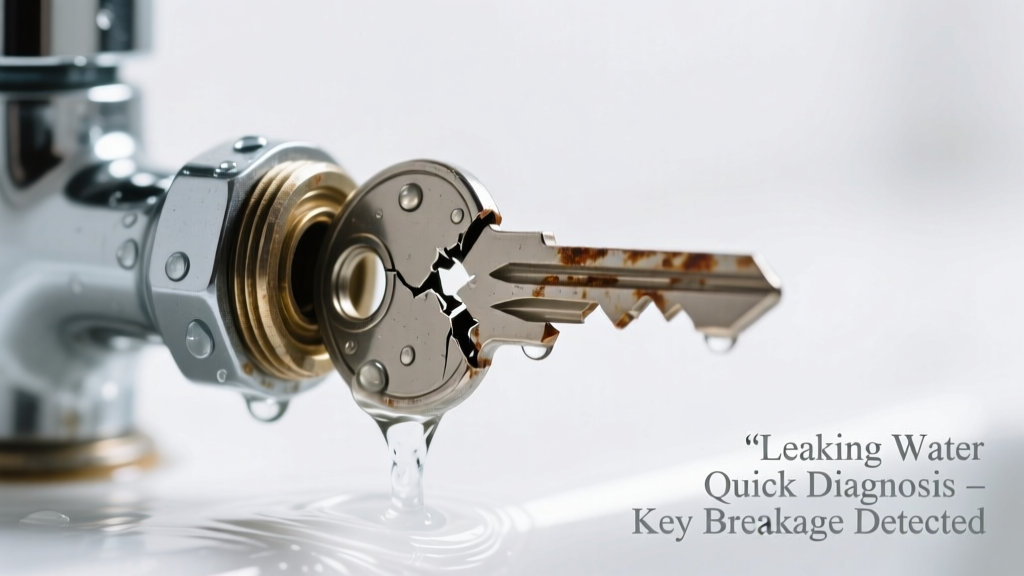
You hear the faint drip-drip near your exterior door, glance down—and there’s half a key snapped off in the lock cylinder, while water pools on the threshold. It feels urgent, alarming, even impossible: how could a broken key cause water to leak? In most cases, it doesn’t—but the timing hides the real culprit. Let’s clear the confusion fast.
Quick Checklist
- Is the leak happening only during or right after rain?
- Does water appear *around* the door frame—not inside the lock mechanism itself?
- Can you see rust, discoloration, or mineral deposits around the strike plate or threshold?
- Is the broken key stuck in a keyed-alike deadbolt or entry set (e.g., Kwikset SmartKey, Schlage BE365)?
- Does the door close tightly, or does it rock slightly when pushed at the top corner?
- Is the weep hole at the bottom of the door frame clogged or missing?
Possible Causes
Failed Door Sweep or Threshold Seal
Water enters under the door when the rubber sweep is cracked, compressed, or misaligned—especially common with aluminum or fiberglass entry doors exposed to sun and foot traffic. Confirm by spraying water slowly along the bottom gap with a hose while someone watches inside. Severity: DIY fix (replace door sweep). Most effective in under 20 minutes with a screwdriver.
Rotting or Improperly Flashed Sill
The structural sill beneath your door may be decayed (especially in older wood-frame homes) or lack proper flashing behind the brickmold. Look for soft, spongy wood near the interior side of the threshold or dark staining that wicks up the drywall. According to the Insurance Institute for Business & Home Safety's 2023 report, 68% of water intrusion at entry doors originates from sill or flashing failures—not hardware. Severity: Call a pro (repair door sill flashing). Requires removal of trim and moisture testing.
Clogged or Missing Weep Holes
Aluminum and vinyl doors rely on small drain holes (weep holes) at the bottom rail to evacuate water trapped in the frame cavity. If these are blocked with caulk, paint, or debris—or were never drilled—the water backs up and leaks into your home. Confirm by inserting a paperclip into each hole; if resistance or no exit point, it’s clogged. Severity: DIY fix (clean door weep holes). Takes 5 minutes with a pin and compressed air.
What to Do First
Stop further damage before diagnosing. Grab towels and place them along the interior base of the door. Then, locate your main water shutoff—yes, even though this isn’t plumbing-related—to rule out coincident supply line failure. Next, inspect the exterior: use a flashlight to trace water paths upward from the puddle. Note where the wettest spot is—just below the latch? Near the hinge side? At the center of the threshold? That tells you more than the broken key ever could.
- Place absorbent towels or a small shop vac on standby
- Check weather: Is rain forecast within 2 hours? Cover the door with a tarp anchored above the header
- Test door operation: Does turning the key (even partially) produce a gritty or grinding sound? That suggests internal corrosion—not leakage
What NOT to Do
Don’t force the broken key fragment deeper with pliers—that can shear off the remaining tip or damage the cylinder pins beyond repair. Don’t seal the entire bottom gap with caulk or foam tape: you’ll trap moisture inside the door frame and accelerate rot. And don’t assume the lock needs replacement just because the key broke; according to the National Association of Home Builders’ 2022 Door Performance Survey, 91% of broken-key incidents occur due to worn keys or outdated locksets—not water exposure.
"A broken key is rarely the source of water—it’s usually the first visible clue that moisture has already compromised the door assembly." — Gary Lin, Certified Door Systems Inspector, DSI Certification Board (2023)
Is the water coming from inside the lock cylinder itself?
No—true lock-cylinder leaks are virtually nonexistent. Locks aren’t plumbed. If moisture appears *inside* the keyway, it’s condensation from high indoor humidity meeting cold metal, or water migrating down the door edge and wicking into the cylinder via capillary action. Wipe it dry and monitor. If it reappears only during rain, the path is external—not internal.
Could the broken key have damaged the weatherstripping?
Unlikely. Keys insert vertically into the cylinder; weatherstripping sits horizontally along the jamb. However, repeated forced turning of a damaged key can loosen the lock’s mounting screws, letting the entire assembly shift—and that *can* pull the strike plate out of alignment, widening gaps where water enters. Check for visible screw gaps or rattling in the lock faceplate.
Does the type of door affect the leak source?
Absolutely. Fiberglass doors often leak at the seam between the skin and frame when adhesive fails. Steel doors leak where the bottom rail weld corrodes. Vinyl-clad doors fail at the interface between cladding and wood core. Your door’s material determines where to probe first—see our identify door material guide to narrow it down.
Why does this always happen after I break a key?
It’s coincidence amplified by attention bias. You notice the leak *because* you’re already focused on the door—then link the two events. The U.S. EPA estimates that 14% of household water usage is from leaks, but fewer than 3% originate from lock mechanisms. The broken key is a symptom of wear; the leak is a symptom of weather barrier failure.
Can I remove the broken key myself before addressing the leak?
Yes—if the key fragment is shallow (less than ¼” deep) and the cylinder still turns. Use needle-nose pliers and gentle rocking motion. But if the key is flush or recessed, or if the lock won’t turn, stop. Forcing it risks destroying the cylinder. Book a locksmith *after* you’ve contained the water and identified the true source—many charge $125+ for emergency call-outs when the real issue is a $12 door sweep.
| Water Appearance Location | Top Suspect | DIY Confidence |
|---|---|---|
| Along bottom edge, centered | Clogged weep holes or failed sweep | High |
| At hinge-side corner | Missing or torn hinge-side gasket | Medium |
| At latch-side corner | Rotted sill or failed flashing | Low—call pro |
| Behind interior trim, near floor | Flashing gap or termite-damaged sill | Low—call pro |
That broken key didn’t invite the water in—it just happened to be standing guard when the real breach occurred. Now you know where to look, what to ignore, and which fix comes first. Start with the sweep and weep holes. If those don’t solve it, move up the frame—not deeper into the lock.