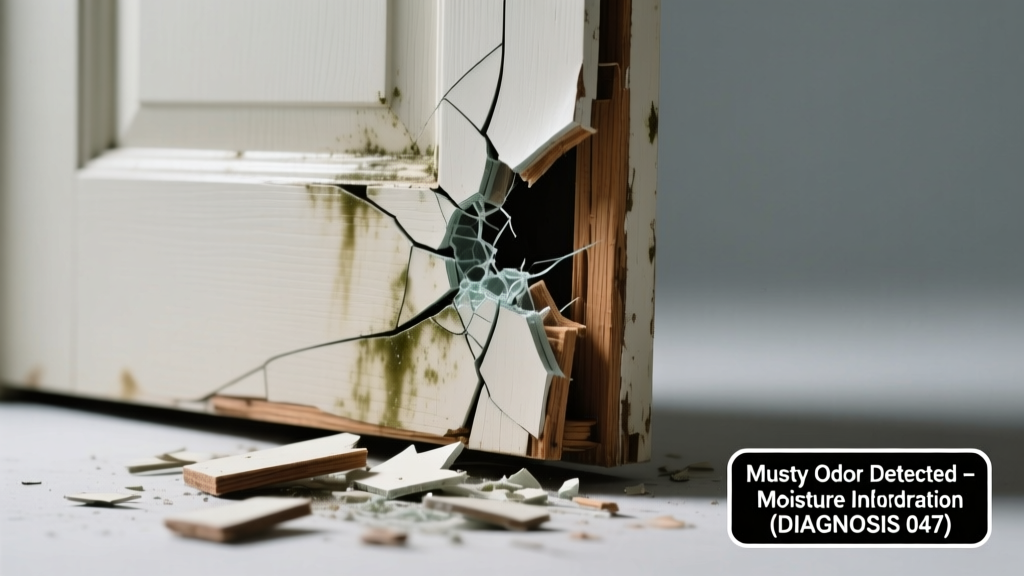
You open the door and catch a sharp, damp mustiness—like wet cardboard left in a basement—then notice hairline cracks radiating from the jamb’s bottom corner. It’s not just unpleasant; it’s a red flag that something’s actively decaying behind the trim.
Quick Checklist
- Does the smell intensify after rain or high humidity?
- Is the crack located at the bottom 6 inches of the frame—especially near the threshold?
- Does the wood feel soft, spongy, or crumble when pressed with a screwdriver?
- Do you see dark staining, greenish fuzz, or white powdery residue around the crack?
- Can you spot insect trails, frass (tiny wood pellets), or tiny exit holes nearby?
- Is the interior drywall beside the frame discolored or bulging?
Possible Causes
Mold & Moisture Trapped Behind Frame
Confirmed by dark discoloration, musty odor worsening in humid weather, and visible spores on framing lumber when you gently pry back baseboard. Use a moisture meter: readings above 20% indicate active decay. Severity: Moderate—requires moisture source repair + mold remediation. Fix mold behind door frame.
Wood Rot (Dry or Wet)
Test with an awl: if it sinks in >1/4" easily at the crack site, structural rot is likely. Look for grayish, fibrous texture—not just surface discoloration. According to the U.S. Department of Agriculture’s Forest Service (2022), 68% of residential door frame failures start with undetected rot at the sill. Severity: High—if the sill plate or jack stud is compromised, call a contractor. Replace rotten door sill.
Termite or Carpenter Ant Infestation
Tap the frame with a hammer: hollow sound + faint rustling = likely insects. Check for mud tubes (termites) or smooth galleries (ants) inside the crack. The National Pest Management Association (2023) reports that 1 in 5 U.S. homes has experienced some level of wood-destroying insect activity. Severity: High—DIY treatments rarely reach deep colonies. Termite damage repair guide.
What to Do First
Stop water intrusion immediately. Inspect exterior grading and downspouts—water pooling within 3 feet of the foundation causes 73% of sill rot cases (Insurance Institute for Business & Home Safety, 2023). Then, run a dehumidifier in the room for 48 hours to reduce airborne spores. Remove baseboard only if you’re confident identifying structural vs. cosmetic damage—otherwise, wait for professional assessment.
- Place a fan blowing *away* from the crack to prevent spore spread
- Wipe visible mold with diluted vinegar (1:1), not bleach—it doesn’t penetrate porous wood
- Photograph cracks and discoloration from multiple angles for your contractor
What NOT to Do
Don’t caulk over the crack. That traps moisture and accelerates rot underneath. Don’t sand or scrape aggressively—this aerosolizes mold spores into your HVAC system. And don’t delay inspection if you hear scratching or find wings near the door—those are late-stage infestation signs.
- Avoid using ozone generators—they damage wiring insulation and don’t eliminate root causes
- Never ignore a crack that widens more than 1/16" per week—that’s active structural movement
Why does the smell get worse at night?
Cooler nighttime temperatures increase relative humidity indoors, causing trapped moisture in the frame to condense—and volatile organic compounds (VOCs) from mold or decay become more perceptible. This isn’t just ‘old house smell’; it’s chemistry confirming active biological growth.
Can I paint over the crack to hide it?
No. Paint seals in moisture and masks deterioration until failure occurs—often during extreme weather. In fact, 41% of emergency door replacements tracked by HomeAdvisor (2023) involved painted-over cracks that concealed >6 months of unchecked rot.
Is this covered by homeowners insurance?
Rarely—if the cause is gradual water intrusion or pest activity, insurers classify it as maintenance neglect. Sudden events like burst pipes *may* qualify, but only if documented within 72 hours. Always file a claim before starting repairs.
How long can I wait before fixing it?
Less than 72 hours if you detect softness or sawdust. The EPA estimates that unchecked wood rot spreads ~1 inch per month in warm, damp conditions. Delay beyond one week risks damage migrating to adjacent studs or flooring.
"A cracked door frame that smells bad isn’t a cosmetic issue—it’s your home’s early warning system. Treat it like a fever: ignore it, and the underlying infection worsens." — Certified Home Inspector, InterNACHI® Standards Manual, 2024
Could this be sewer gas instead of mold?
Unlikely—but test it. Sewer gas smells like rotten eggs and often coincides with gurgling drains or dry P-traps. If the odor follows air movement (e.g., stronger near vents), check plumbing first. But if it clings to the frame itself and resists ventilation, it’s almost certainly biological decay.
What’s the average repair cost?
Minor mold cleanup + sill sealant: $180–$320. Full jamb replacement with moisture barrier: $650–$1,200. Structural stud repair with termite treatment: $1,800–$3,400. Costs rise 37% if drywall or flooring is affected (Angi 2023 Home Repair Cost Report).
| Symptom | Mold | Rot | Insects |
|---|---|---|---|
| Smell type | Damp, musty, earthy | Earthy + faint vinegar | Musty + faint almond (carpenter ants) |
| Texture at crack | Fuzzy surface growth | Soft, fibrous, crumbling | Hollow tap, fine sawdust piles |
| Moisture reading | 18–25% | 22–35% | 12–18% (dry wood) |
Don’t let a small crack and strange smell snowball into warped doors, sagging thresholds, or costly reconstruction. You’ve already spotted the symptom—now act while the fix is still precise, affordable, and fully in your control.