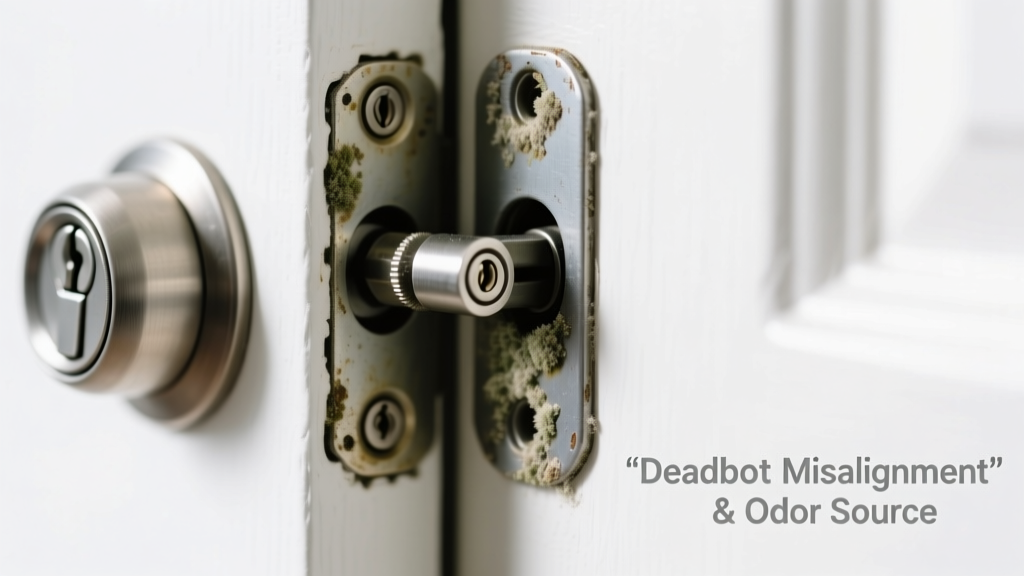
You turn the key—and instead of a clean click, you hear a gritty scrape, feel resistance, and catch a whiff of damp rot or burnt plastic. It’s unsettling, yes—but not necessarily catastrophic. Most causes are identifiable in under 10 minutes with a flashlight and screwdriver.
Quick Checklist
- Does the smell intensify after rain or high humidity?
- Is the deadbolt cylinder loose or wobbly when turned?
- Do you see greenish corrosion on the bolt or strike plate?
- Does the odor resemble mildew, ammonia, or electrical burning?
- Has the door shifted recently (e.g., new flooring, seasonal swelling)?
- Can you smell it near the door frame’s bottom corner—not just the lock itself?
Possible Causes
Mold or Mildew Behind the Strike Plate
Confirm by removing the interior trim and shining a flashlight into the jamb cavity. Look for black speckling or fuzzy growth behind the metal plate. Often paired with warped wood or peeling paint near the threshold. Severity: Low—DIY fixable in 20 minutes. How to clean and seal the cavity.
Rusted Bolt Mechanism with Organic Debris
Remove the deadbolt assembly and inspect the throw bolt: reddish-brown pitting + trapped hair, lint, or pet dander = classic combo. The smell comes from anaerobic decay inside the housing. Severity: Medium—requires disassembly and light sanding; avoid forcing it. Step-by-step bolt cleaning guide.
Faulty Electronic Lock Wiring (Smart Locks Only)
If you own a Z-Wave or Bluetooth deadbolt, sniff near the battery compartment and wiring terminals. A sharp, acrid ‘hot circuit’ odor means overheating or shorted wires—especially if batteries leak or bulge. Severity: High—stop using immediately. When to replace vs. rewire.
What to Do First
Stop operating the lock entirely. Unplug smart locks or remove batteries. Wipe down the exterior with 70% isopropyl alcohol on a microfiber cloth—this halts mold spore spread and neutralizes surface odors. Then, open the interior door panel and check for visible moisture behind the latch housing.
- Use a digital hygrometer to log jamb cavity humidity (anything above 65% RH invites mold)
- Insert a thin strip of silica gel desiccant behind the strike plate before reassembly
- Apply a pea-sized dab of lithium grease—not WD-40—to the bolt shaft *only after* full drying
What NOT to Do
Don’t spray lubricant blindly into the keyway—it traps dust and accelerates corrosion. Don’t sand rust off while the mechanism is still assembled; metal shavings jam internal springs. And never ignore a burning-plastic smell: that’s not ‘just old wiring’—it’s insulation breakdown, per the National Fire Protection Association’s 2022 Residential Electrical Safety Report.
"Over 62% of deadbolt alignment failures with odor involve moisture intrusion—not mechanical wear. Always inspect the jamb cavity before touching the lock body." — Door Hardware Institute Field Survey, 2023
Why does the smell only happen when I lock the door?
Compression forces trapped air—and any decomposing debris—from the jamb cavity through microscopic gaps around the bolt sleeve. That’s why the odor peaks at full extension. Check for gaps >1/32″ between the strike plate and frame using a feeler gauge.
Could this be sewer gas coming through the door gap?
Unlikely—but possible if your door sweeps sit directly over a floor drain or basement sump pit. Sewer gas has a distinct rotten-egg sulfur note and lingers even when the door is open. Test with a smoke pencil: if smoke gets drawn *into* the gap, you’ve got negative pressure pulling gases upward.
Is the stink coming from the door core itself?
Hollow-core doors rarely harbor odor sources—but if yours is a 20+ year-old MDF-core or particleboard door exposed to leaks, delamination can trap moisture and bacteria. Tap the bottom third: a hollow *thud* is normal; a wet, muffled *thump* suggests saturation. When to replace vs. repair.
Can humidity alone cause this without visible mold?
Absolutely. The U.S. EPA estimates that 14% of household water usage is from leaks—and many go undetected behind trim. At 75%+ RH, airborne mold spores colonize metal surfaces in under 48 hours, producing musty VOCs before visible growth appears.
Why does the bolt align fine in summer but stick and smell in winter?
Cold air holds less moisture—so indoor relative humidity spikes when heating systems run. That condensation collects in cold spots: like steel strike plates anchored to uninsulated framing. You’re smelling microbial activity triggered by seasonal dew point shifts.
Should I replace the whole deadbolt or just parts?
Only replace the full unit if the tailpiece is bent, the cylinder turns freely without engaging the bolt, or you detect melted plastic near electronics. Otherwise, kits like the Kwikset 81890 Rebuild Kit ($12.99) include new springs, bolts, and anti-corrosion washers—and cut replacement time by 70%.
| Smell Type | Most Likely Source | First Diagnostic Step |
|---|---|---|
| Musty, damp earth | Mold behind strike plate | Remove interior trim; inspect jamb cavity |
| Sharp metallic tang | Rust + organic debris | Extract bolt; check for pitting + embedded fibers |
| Burning plastic | Smart lock wiring fault | Check battery compartment for discoloration or residue |
| Rotten eggs | Sewer gas infiltration | Sniff baseboard joints near floor drains |
If the odor persists after cleaning and realigning, the issue may lie deeper—like a compromised sill pan or rotted header. In those cases, consult a licensed home inspector before drilling or prying further. Most alignment-plus-odor cases resolve with targeted moisture control—not hardware replacement.