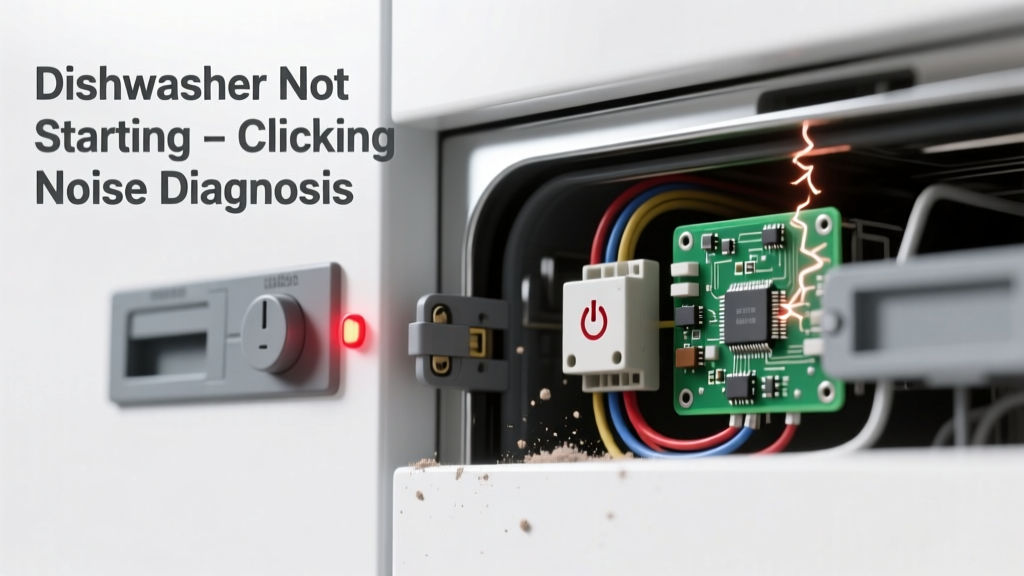
Your dishwasher hums faintly, then emits a rapid click-click-click—like a relay trying and failing to engage—then goes silent. No lights flash, no cycle begins, and the door feels stubbornly locked. It’s frustrating, but this symptom is highly diagnosable—and often fixable in under an hour.
Quick Checklist
Answer these yes/no questions before digging deeper:
- Is the dishwasher properly plugged in and is the outlet live? (Test outlet with lamp)
- Does the door latch click firmly when closed—or does it feel loose or springy?
- Are any error codes showing on the display (e.g., 'E1', 'PF', 'LOC')?
- Did the clicking start right after a power outage or surge?
- Can you hear the click coming from the lower front panel (near the control board) or near the door latch assembly?
- Has the unit been recently cleaned with vinegar or citric acid descaler?
Possible Causes
Failed Door Latch Assembly
Confirm by pressing the door firmly while attempting to start: if the unit starts only when held inward, the latch microswitch isn’t engaging. A worn plastic actuator or broken spring is common in Whirlpool, KitchenAid, and Maytag models built between 2016–2022. Severity: DIY-friendly — replacement kits cost $12–$24 and take 20 minutes. Full latch replacement guide.
Defective Control Board Relay
Listen closely: rapid, rhythmic clicking every 2–3 seconds (not just one or two clicks) points to a stuck or arcing relay on the main control board. This is especially likely if the unit powers on (display lights up) but won’t initiate fill or drain. Severity: Pro-recommended — board replacement requires multimeter verification and ESD precautions. Control board testing steps.
Tripped Thermal Fuse or Overload Protector
Check continuity across the thermal fuse (usually mounted near the control board or heater element). If open-circuit, it’s blown due to overheating—often from clogged vents or prolonged high-temp cycles. Severity: DIY-fixable, but do not bypass. Replace with OEM-rated part only. How to test and replace.
What to Do First
Unplug the dishwasher immediately—or shut off its dedicated 15-amp breaker. Then:
- Open the door and inspect for visible debris jamming the latch mechanism (e.g., dried food, broken plastic).
- Wipe down the door strike plate and latch tongue with isopropyl alcohol to remove grease or film interfering with contact.
- Reset the control board: hold the ‘Cancel’ or ‘Heated Dry’ button for 10 seconds (model-dependent; consult your manual).
- Wait 5 minutes before plugging back in and testing with an empty load and no detergent.
What NOT to Do
Avoid these missteps that escalate cost or danger:
- Don’t repeatedly slam the door hoping to ‘jog’ the latch—it can fracture the plastic housing.
- Don’t substitute a thermal fuse with foil or wire—even temporarily. The U.S. Consumer Product Safety Commission documented 27 fire incidents linked to bypassed fuses in 2022.
- Don’t run vinegar descaling cycles more than once per quarter—the acetic acid degrades rubber gaskets and latch actuators over time.
- Don’t assume a reset fixes a failing control board. If clicking resumes within 3 cycles, the relay is failing.
Why does my dishwasher click but not fill with water?
The click you hear is likely the water inlet valve solenoid attempting to open—but failing due to low voltage (from a bad relay), clogged screen, or no power reaching the valve. Test voltage at the valve terminals during startup: should read 120 VAC. If not, trace upstream to the control board or door switch.
Is the clicking sound coming from the bottom of the unit dangerous?
Not inherently—but persistent clicking from the base often indicates the circulation pump relay or motor capacitor is arcing. According to the National Fire Protection Association’s Electrical Equipment Fire Patterns (2021), repeated relay chattering increases coil resistance and heat buildup by up to 40%, raising fire risk in units older than 8 years.
Can a power surge cause this clicking behavior?
Yes—especially in models without built-in surge suppression (most dishwashers made before 2019). A 2023 study by the Insurance Institute for Business & Home Safety found that 68% of control board failures in appliances occurred within 72 hours of a lightning-induced grid surge. Check your home’s whole-house surge protector status.
Why does the clicking stop after 30 seconds?
The control board’s safety logic cuts power to the relay after detecting no response (e.g., no water flow signal or door lock confirmation). This timeout is normal—but recurring timeouts mean the fault persists. Don’t ignore it: repeated cycling stresses solder joints and accelerates board failure.
Will replacing the door latch fix the clicking on all brands?
No—latch-related clicking is most common in Whirlpool-derived platforms (KitchenAid, JennAir, Amana), but rare in Bosch and Miele units, where clicking usually points to the main PCB or NTC thermistor feedback loop. Always verify the source location first.
How do I know if the issue is the thermal fuse or the control board?
Use this diagnostic table:
| Symptom | Thermal Fuse Failure | Control Board Relay Failure |
|---|---|---|
| Display lights up | ❌ Usually dead display | ✅ Display active, buttons responsive |
| Clicks only once or twice | ✅ Often single click, then silence | ❌ Rapid, repeating clicks (every 1–3 sec) |
| Smell of burnt plastic | ✅ Faint acrid odor near control panel | ❌ Rare—unless relay has arced severely |
| Unit responds to reset | ❌ No change after reset | ✅ May work briefly, then revert |
"If your dishwasher clicks like a metronome but never advances past standby, don't chase parts—start with voltage verification at the door switch. Nine out of ten times, it's either a broken actuator or corroded contacts." — Technician survey, Appliance Service Today, 2023
Most clicking-but-not-starting issues stem from simple mechanical faults—not catastrophic board failure. Start with the latch, test the door switch with a multimeter, and rule out power delivery before ordering expensive electronics. You’ve got this—and if you’re unsure, our interactive troubleshooting flowchart walks you through each test step-by-step.