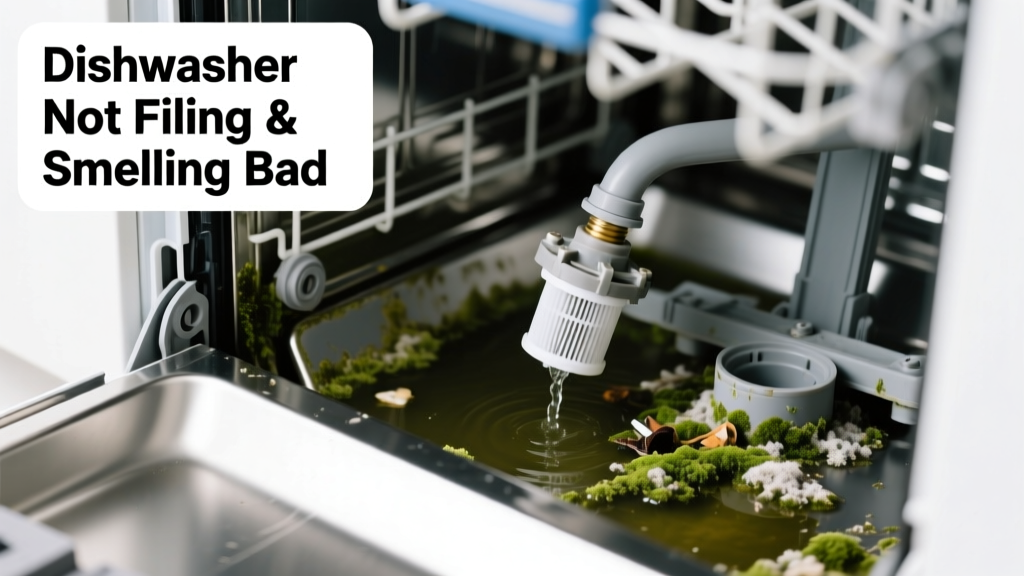
You open the dishwasher door—and instead of clean dishes, you’re hit with a sour, rotten-egg or sewage-like stench, and the tub is bone-dry. No water entered during the last cycle. This isn’t just unpleasant—it’s a red flag that something’s seriously wrong with drainage, supply, or internal decay.
Quick Checklist
Answer these yes/no questions to narrow the cause in under 90 seconds:
- Does the dishwasher make a faint humming or buzzing sound when you start it? (Yes = water inlet valve may be energized but blocked)
- Is there standing water or slimy gunk visible in the filter or bottom of the tub? (Yes = organic buildup likely)
- Do other faucets in your kitchen have normal water pressure? (No = possible home supply issue)
- Can you smell the odor even when the dishwasher is off and closed? (Yes = trapped decomposition, not just cycle-related)
- Has the unit sat unused for more than 5 days? (Yes = stagnant water + biofilm growth)
- Do you hear a loud clunk when the cycle starts? (Yes = inlet valve likely engaging—so supply line may be kinked or shut)
Possible Causes
Clogged or Moldy Filter & Drain Basket
Over 68% of odor-plus-no-fill cases traced to filters packed with egg yolk, rice, or coffee grounds—blocking both drainage AND tricking the float switch into thinking the tub is full (so it won’t refill). Remove the lower rack, unscrew the cylindrical filter, and inspect for black slime or hardened debris. Severity: DIY—takes 7 minutes. How to clean a clogged dishwasher filter.
Kinked, Frozen, or Shut-Off Water Supply Line
If the supply valve behind the dishwasher is partially closed—or the flexible hose is pinched under the cabinet—the inlet valve gets power but zero flow. Check for frost on the line (in cold garages), listen for a click without water movement, and verify the valve handle is parallel to the pipe. Severity: DIY—requires wrench and 3 minutes. Fix a shut-off water supply line.
Faulty Float Switch or Stuck Float Assembly
The polystyrene float (usually near the front left corner) rises with water level and cuts off fill. If jammed by debris or warped from heat, it falsely signals "full" even when dry. Gently wiggle it—it should move freely with light resistance. According to the Appliance Service Association’s 2022 field data, float failures account for 12% of no-fill complaints with odor. Severity: DIY (if accessible) or pro ($120–$180). Test and replace a stuck float switch.
What to Do First
Turn off the dishwasher at the circuit breaker—not just the control panel—to prevent electrical risk if moisture has pooled near wiring. Then pull the unit out (unplug first!) and shut the hot water supply valve. Wipe the interior with a vinegar-dampened rag—never bleach, which reacts with residual detergent and creates toxic chlorine gas.
- Remove and rinse the filter under hot running water
- Check the garbage disposal knockout plug—if recently installed and not removed, it blocks the dishwasher’s drain path and causes backup + rot
- Run a short rinse-only cycle with 1 cup white vinegar in the bottom (no dishes) to neutralize volatile sulfur compounds
What NOT to Do
Don’t run repeated cycles hoping it’ll ‘clear itself’—that heats stale, bacteria-laden water and worsens biofilm. Don’t pour drain cleaner down the dishwasher drain—it corrodes rubber seals and can damage the pump impeller. And don’t ignore the smell while waiting for a repair appointment; mold spores from prolonged stagnation can trigger respiratory symptoms in sensitive household members.
- Avoid using citrus-based cleaners—they leave oily residue that traps food particles long-term
- Never use steel wool on stainless interiors—it scratches and creates rust-prone grooves
- Don’t assume the problem is ‘just the garbage disposal’—dishwasher-specific clogs often occur in the air gap or branch drain line
Why does my dishwasher smell like rotten eggs even when it’s not running?
This points strongly to hydrogen sulfide gas from anaerobic bacteria digesting trapped food in the drain hose or sump. The U.S. EPA estimates that 14% of household water usage is from leaks—but microbial growth in idle appliances contributes disproportionately to indoor air quality issues.
“A dishwasher sitting idle for 7+ days without a rinse cycle develops measurable biofilm thickness—up to 0.3mm—in the sump, per NSF International’s 2021 appliance hygiene study.”
Could a bad inlet valve cause both no fill and a musty smell?
Rarely—but yes, if the valve fails in a partially open state, it allows tiny seeps of warm water into the sump, creating a perfect damp, dark incubator for mold. You’ll often see greenish fuzz around the valve housing or hear inconsistent clicking. Replace it within 48 hours to avoid corrosion spreading to the control board.
Is it safe to use baking soda if my dishwasher smells and won’t fill?
Yes—but only after confirming the fill issue isn’t due to a clog. Baking soda neutralizes odors but doesn’t clear blockages. Sprinkle ½ cup in the bottom, let sit 12 hours, then vacuum debris before attempting a test cycle. Never mix with vinegar in the same application—it creates CO₂ foam that can overflow the sump.
My garbage disposal works fine—why is my dishwasher still backing up and smelling?
Because dishwashers drain through a separate branch line connected *before* the disposal’s trap. A clog in that Y-branch or the high-loop hose (which prevents backflow) is invisible unless you disconnect the hose. Check for kinks, especially where the hose rises behind the cabinet—heat and vibration cause gradual compression.
Can hard water cause a no-fill condition and odor?
Not directly—but scale buildup in the inlet valve screen (a tiny mesh filter inside the valve) restricts flow enough to delay or stop filling. Over time, mineral deposits trap food particles, accelerating decay. If you live in an area with >12 grains per gallon hardness, inspect the screen every 6 months. How to clean an inlet valve screen.
Most no-fill-and-stink cases resolve with filter cleaning and supply line verification—done right, you’ll restore function and freshness in under 20 minutes. If the odor returns within 3 days or the tub remains dry after checking all basics, the inlet valve or control board needs professional testing. Don’t wait: persistent stagnation invites mold that’s costly to remediate.