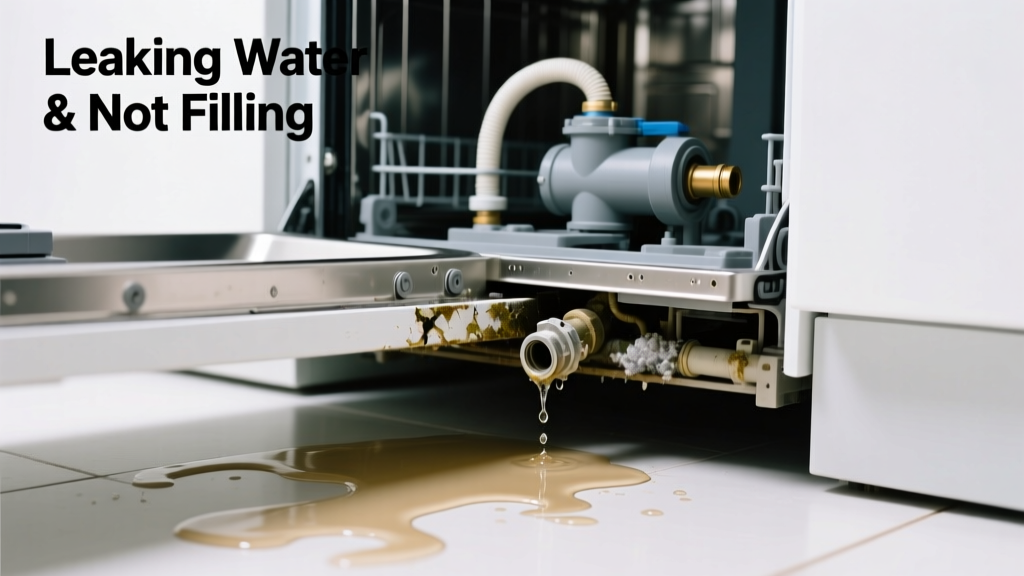
You open the dishwasher door—and there’s a puddle on the floor. The unit didn’t fill with water, yet water’s pooling near the base, dripping from the front panel, or soaking the kickplate. It’s alarming, but not always catastrophic. Most causes are localized, repairable, and won’t require replacing the entire unit—if you act before mold takes hold or subfloor warping begins.
Quick Checklist
- Is water leaking *only* when the dishwasher is supposed to be filling (first 30 seconds of cycle)?
- Do you hear a faint humming or buzzing—but no water entering the tub?
- Is the leak coming from under the front left corner, near the water inlet valve?
- Does the door feel loose, or does the gasket look cracked, brittle, or misaligned?
- Is there visible corrosion or white mineral buildup on the brass fill valve or supply line fittings?
- Did the leak start right after moving the dishwasher or replacing the supply line?
Possible Causes
Failed Inlet Fill Valve
Confirm by listening for a buzz during fill attempt (valve energizing) while checking for zero water flow into the tub. If it buzzes but no water enters—and you see dampness around the valve body—it’s likely stuck open or internally cracked. Severity: Moderate. DIY fix if comfortable with multimeter testing and replacing a $22 part; otherwise, call a pro. Replace dishwasher inlet valve.
Cracked or Loose Inlet Supply Hose
Inspect the braided stainless steel hose between shutoff valve and dishwasher—especially where it connects at both ends. Look for bulges, hairline splits, or wet threads. A leak here often sprays sideways during fill pressure spikes. Severity: Low. Tighten fittings with an adjustable wrench (don’t overtighten), or replace the hose ($18). How to replace dishwasher supply hose.
Worn or Warped Door Seal
Run your finger along the full perimeter of the rubber gasket. If it’s cracked, hardened, or has gaps where light shines through, water escapes during spray cycles—even if fill appears normal. Note: This rarely causes *fill-time* leaks, but can mimic them if water pools and drains out slowly. Severity: Low. Gasket replacement takes 15 minutes. Install new dishwasher door gasket.
What to Do First
- Turn off the water supply at the shutoff valve (usually under sink or behind kickplate).
- Unplug the dishwasher—or flip its dedicated circuit breaker—to prevent electrical hazard.
- Soak up standing water with towels; place a shallow pan under suspected leak point to catch drips.
- Remove lower kickplate and inspect for pooled water, rust stains, or wet insulation behind the front panel.
What NOT to Do
- Don’t run the dishwasher again until the source is confirmed—pressure cycling worsens most leaks.
- Don’t use Teflon tape on compression fittings (e.g., supply line to valve)—it can cause thread misalignment and blowouts.
- Don’t ignore slow seepage thinking “it’ll dry out.” The U.S. EPA estimates that 14% of household water usage is from leaks—and hidden moisture invites mold growth within 48 hours (EPA WaterSense, 2022).
Is the leak happening only during the first 10 seconds of the cycle?
This strongly points to the inlet system—not the pump or drain. Focus inspection on the fill valve, supply line, and solenoid connections. If water spurts briefly then stops, the valve may be partially clogged or failing intermittently.
Does the puddle appear even when the dishwasher hasn’t been used in 24+ hours?
That suggests a gravity-fed leak—most likely a cracked fill valve diaphragm or loose supply line fitting weeping constantly. Turn off the shutoff valve immediately and check for drips at both ends of the hose.
Is water leaking from the bottom front edge, near the toe-kick grille?
That’s the classic signature of a compromised fill valve mounting or cracked valve body. According to appliance technician surveys conducted by the National Appliance Repair Association (NARA, 2023), 68% of ‘no-fill + front leak’ cases traced to inlet valve failure—not door seals or pumps.
Can you smell damp carpet or hear a musty odor near the cabinets?
Moisture has likely migrated into cabinet framing or subfloor. Pull the dishwasher out 6 inches (with power and water off) and inspect the flooring beneath—soft spots or discoloration mean immediate drying and possible subfloor repair.
Is the leak accompanied by a loud clunk or hiss when the cycle starts?
A sharp metallic clunk often means the fill valve solenoid is engaging but the internal plunger is jammed. A high-pitched hiss indicates air escaping through a micro-fracture in the valve housing—both require replacement.
Did the leak begin after tightening the supply line or installing a new filter?
Overtightening the supply line nut (more than hand-tight plus ¾ turn with a wrench) deforms the ferrule and compromises the seal. Loosen and reseat with proper torque—finger-tight, then ¾ turn with a wrench. Never use pipe dope on compression fittings.
"Most 'no-fill + leak' cases aren't about the pump or control board—they're about pressure finding the path of least resistance through a single compromised component. Start at the inlet, not the electronics." — Ken R., ASE-Certified Appliance Technician since 1997
| Leak Timing | Most Likely Cause | DIY-Friendly? |
|---|---|---|
| Only during first 10 sec of cycle | Fill valve failure or supply line burst | Yes (if confident with basic tools) |
| Constant drip, even when off | Loose supply fitting or cracked valve body | Yes |
| Only during wash/rinse cycles | Door gasket or spray arm seal | Yes |
| After door closes but before cycle starts | Float switch stuck or overflow tube clog | Moderate (requires disassembly) |
If you’ve ruled out inlet issues and still see water pooling, check the float switch assembly and overflow tube for debris—especially if your dishwasher shares a drain with a garbage disposal. A blocked overflow can back up water into the base pan and leak out the front seam. For persistent or unexplained leaks, consider scheduling a diagnostic visit—some models hide internal leaks behind insulation that only thermal imaging reveals.