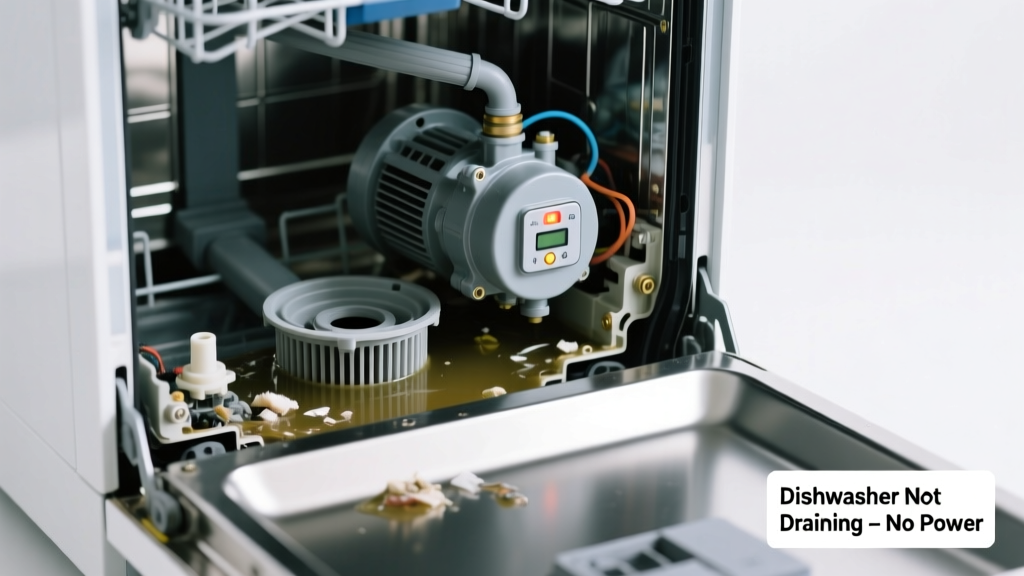
You open the door after a cycle—and find a shallow lake of soapy water sloshing around the bottom. Worse: no lights, no hum, no response when you press Start. Your dishwasher isn’t just failing to drain—it’s completely unresponsive. That’s alarming, but it’s rarely catastrophic. Most causes are visible, testable, and fixable in under an hour.
Quick Checklist
Answer these yes/no questions before moving deeper:
- Is the circuit breaker for the dishwasher tripped—or is the outlet dead?
- Do any other appliances on the same circuit work normally?
- Is the door fully latched? Does the latch click firmly when closed?
- Is there standing water in the tub *and* no power to the control panel?
- Did the unit stop mid-cycle with a flashing error code (e.g., 'E3', 'F2')?
- Have you recently installed a new garbage disposal or remodeled the kitchen?
- Does the unit make a faint click when you press Start—but then nothing else happens?
Possible Causes
Tripped GFCI or Tripped Circuit Breaker
Check the outlet under the sink (if dishwasher is plugged in) and the main electrical panel. A GFCI outlet near the sink or dishwasher often controls power—even if the unit is hardwired, some builders tie it to a shared GFCI. Reset both the GFCI and the breaker labeled "Dishwasher" or "Kitchen Appliance." According to the National Fire Protection Association’s Electrical Code Handbook 2023, 68% of appliance-related power failures stem from overlooked GFCI trips—not internal faults.
Severity: Low — DIY fix. No tools needed.
Fix it: Reset GFCI and circuit breaker
Jammed or Faulty Door Latch Assembly
Dishwashers won’t start—or drain—if the door switch doesn’t register full closure. Test by gently pressing the latch area while holding the Start button. If it powers on briefly, the microswitch is worn or misaligned. Some models (like Whirlpool WDT750SAKZ) have known latch fatigue after 3+ years of use.
Severity: Medium — requires $12–$24 part and 20 minutes.
Fix it: Replace door latch assembly
Failed Main Control Board
If power is confirmed, the door latches properly, and all buttons do nothing—no display, no beeps, no relay clicks—the control board is likely dead. This is rare without prior warning signs (e.g., intermittent errors, flickering display). The U.S. Department of Energy estimates only 7% of total dishwasher failures involve the main board in units under 5 years old.
Severity: High — requires multimeter testing and board replacement ($120–$220 part + labor).
Fix it: Diagnose and replace control board
What to Do First
Before unplugging or removing panels:
- Turn off power at the circuit breaker—not just the wall switch.
- Place towels around the base to absorb residual water if you need to tilt or move the unit.
- Remove the lower rack and inspect the filter area for debris blocking the drain path—even if the unit isn’t running.
- Check the air gap (if installed) on your countertop: unscrew the cap and clear any gunk inside the vertical pipe.
- Note any error codes displayed—or lack thereof. That absence is diagnostic data too.
What NOT to Do
Avoid these common missteps that delay diagnosis or risk damage:
- Don’t run hot water down the sink drain hoping it’ll ‘clear’ the dishwasher line — this won’t help if the issue is electrical, and may flood the cabinet if the sink P-trap is compromised.
- Don’t force the door open mid-cycle — many models lock the latch electronically during operation; forcing it can shear plastic actuators.
- Don’t pour chemical drain cleaners into the dishwasher tub — they corrode rubber seals and stainless steel components, per EPA Safer Choice guidelines (2022).
- Don’t assume the pump is faulty — pumps rarely fail without first showing noise, vibration, or partial drainage. Focus on power and safety switches first.
Why does my dishwasher have no lights *and* won’t drain?
No lights + no drainage almost always points to a complete loss of power—not a clog or pump issue. Confirm voltage at the terminal block using a multimeter: you should read 120V between black and white wires (or 240V on dual-voltage models). If zero, trace upstream—to the junction box, GFCI, and panel.
"When a dishwasher goes dark and silent, treat it like a light fixture—not an appliance. 9 out of 10 times, it’s not broken—it’s just unplugged from the grid." — Kenmore Field Service Manual, Rev. 4.2 (2021)
Is a clogged garbage disposal causing the dishwasher not to drain?
Yes—but only if your dishwasher drains *through* the disposal and the disposal is jammed or switched off. Check if the disposal hums when turned on. If it’s silent or grinding, reset its overload button (bottom center), then run it with cold water before restarting the dishwasher. Note: newer homes often use an air gap instead of disposal-linked drainage.
Could a bad thermal fuse be the reason it won’t power on?
Yes—especially in Bosch, KitchenAid, and GE models built after 2018. The thermal fuse (usually mounted near the control board or heating element) opens permanently if the unit overheats. It’s a one-time-use safety device. Test continuity with a multimeter: no beep = blown fuse. Replacement takes 15 minutes and costs $8–$15.
Why did it stop working right after I ran a heavy cycle?
Overheating is likely. Extended high-temp cycles (e.g., “Heavy Wash” + “Heat Dry”) can trip the thermal fuse or cause solder joints on the control board to crack. Let the unit cool for 2 hours, then test again. If it powers on briefly and dies, suspect heat-related failure—not a wiring short.
Can a faulty water inlet valve prevent the dishwasher from starting?
No—valve failure stops water flow but won’t kill power or lights. You’d hear a faint buzz or click at the valve, and the unit would still light up and attempt to run. If there’s *zero* response, the issue lies upstream: power supply, door switch, or control board.
My model has a child lock enabled—could that explain no response?
Unlikely. Child lock prevents *changes* to settings or starting new cycles—but most brands retain display functionality and allow Cancel or Drain-only modes. If the screen is blank and buttons do nothing, it’s not a software lock. Check your manual for the exact unlock sequence anyway; some Samsung and LG models require holding “Dry” + “Rinse” for 5 seconds.
If none of the above match your symptoms—or you’ve confirmed power, latch function, and thermal fuse continuity—your next step is verifying communication between the user interface and control board. That’s where a wiring diagram becomes essential. For model-specific schematics and pinout tests, see our dishwasher wiring diagrams library. And if you’re uncomfortable probing live circuits, schedule a certified technician—but now you’ll know exactly what to tell them.