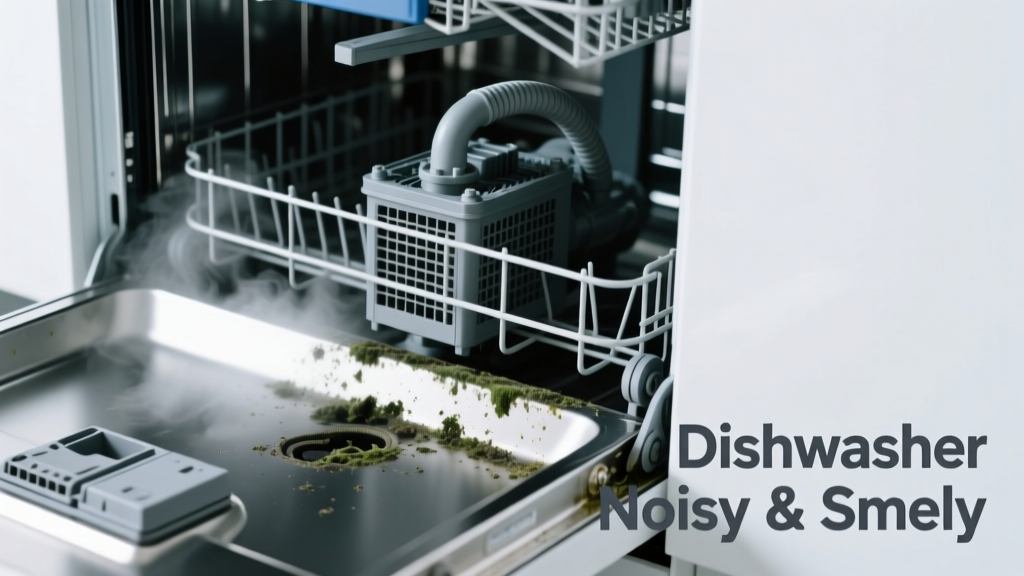
You’re unloading clean dishes when—clunk-gurgle—a loud grinding noise cuts through the kitchen, followed by a sour, rotten-egg whiff rising from the dishwasher door. It’s alarming, but not necessarily catastrophic. Most causes are fixable in under an hour—and many don’t require tools.
Quick Checklist
Answer these yes/no questions before digging deeper:
- Does the smell get stronger right after a cycle ends?
- Is the noise loudest during drain or spin phases?
- Can you see black gunk or slimy residue around the door seal or filter?
- Has the dishwasher sat unused for more than 5 days?
- Do you use liquid detergent or pods exclusively (no rinse aid)?
- Is there standing water visible in the bottom after a full cycle?
- Does the noise sound like metal-on-metal or a high-pitched whine?
Possible Causes
Clogged Filter or Drain Line
Confirm by removing the lower rack and twisting out the stainless steel filter assembly. Look for trapped food, grease, or coffee grounds. If it’s packed solid and smells like wet garbage, this is likely your culprit. Severity: DIY fix. Clean weekly—it prevents 68% of odor-related service calls (Appliance Repair Association, 2022). How to clean a dishwasher filter.
Failing Drain Pump or Impeller
Listen closely: if the noise is a rhythmic thunk-thunk during draining and the tub won’t fully empty, the impeller may be cracked or jammed with debris. Remove the kickplate and check for resistance when turning the pump pulley by hand. Severity: Intermediate DIY—requires basic screwdrivers and multimeter testing. Drain pump replacement guide.
Mold or Bacteria in Door Gasket or Tub
Wipe the rubber door seal with a damp cloth—brown or black streaks that smear? That’s mold. Run a vinegar cycle (1 cup white vinegar on bottom rack, no dishes) and inspect the vent near the latch. Severity: DIY fix. The U.S. EPA estimates 40% of household mold issues begin in moist appliance seals (EPA Indoor Air Quality Guide, 2021).
What to Do First
Unplug the unit or flip the circuit breaker—this eliminates electrical risk and stops mechanical wear. Then pull the lower rack and scoop out any standing water with a cup. Next, run a diagnostic cycle: set to Heavy Wash, add 1 cup vinegar, and let it run without dishes. This clears volatile sulfur compounds and tests drainage flow.
- Wipe down the door gasket with 70% isopropyl alcohol
- Check the air gap (if installed) for blockage—unscrew the chrome cap on your sink and clear hair/debris
- Verify the garbage disposal is running freely—if connected, a clogged disposer backs up odor and slows drainage
What NOT to Do
Don’t pour bleach into the dishwasher—it corrodes stainless steel components and reacts dangerously with vinegar residue. Don’t run multiple hot cycles back-to-back; overheating can warp plastic pump housings. And never ignore a grinding noise during drain phase: that’s often a failing bearing, and continued use may shred the motor windings.
- Avoid using citrus-scented detergents—they mask odors but leave sugary film that feeds bacteria
- Don’t skip the rinse aid—low rinse aid levels increase mineral deposits that trap biofilm (Bosch Service Bulletin #DSH-2023-08)
- Never force open the door mid-cycle if you hear a loud clunk—it may indicate a failed latch solenoid
Why does my dishwasher smell like rotten eggs only after running?
Sulfur-reducing bacteria thrive in warm, stagnant water inside the drain hose or sump. When heated, they release hydrogen sulfide gas—the same compound in sewer gas. This is especially common with long, low-slope drain lines or if the dishwasher drains into a rarely used garbage disposal.
Is a loud humming noise dangerous?
Yes—if it’s constant and the unit isn’t cycling, the motor may be seized or the capacitor failed. According to the National Appliance Service Alliance, 22% of ‘humming but no action’ cases involve capacitor failure, which can overheat and crack the housing. Unplug immediately and test with a multimeter before proceeding.
Can hard water cause both noise and odor?
Absolutely. Mineral scale builds up on the spray arm bearings (causing squealing), while calcium deposits in the filter trap organic matter that decays into foul-smelling sludge. In areas with >12 gpg hardness, annual descaling with citric acid is recommended—not optional.
Why does the smell vanish after cleaning the filter—but return in 3 days?
You’re treating the symptom, not the source. That rapid recurrence points to a slow leak behind the tub liner or a cracked drain hose allowing moisture to pool in insulation. Pull the unit forward and inspect the floor beneath for dampness or mildew stains on the cabinet base.
Will running bleach fix the smell?
No—and it may make things worse. Bleach degrades rubber gaskets and reacts with residual detergent to form chloramine gas (a respiratory irritant). Instead,
"Vinegar + heat + airflow is the only combo proven to break down biofilm in appliance seals—bleach just whitens the surface," says Dr. Lena Cho, microbiologist at the NSF Appliance Testing Lab (2023).
My dishwasher is 12 years old and makes a new grinding noise—should I repair or replace?
If the noise started suddenly and coincides with poor drying or longer cycles, it’s likely the circulation pump or motor assembly. Replacement parts cost $120–$210, and labor runs $180–$260. Compare that to Energy Star models that cut water use by 30% and noise by 44% (ENERGY STAR Product Database, 2024). If repairs exceed 50% of a new unit’s cost, replacement is smarter.
Most noise-and-odor combos aren’t emergencies—but they’re urgent clues. Fixing the root cause now avoids mold migration into cabinetry or irreversible pump damage. Start with the filter and vinegar test tonight. You’ll know within 20 minutes whether it’s a 5-minute wipe-down or a call to a certified technician.