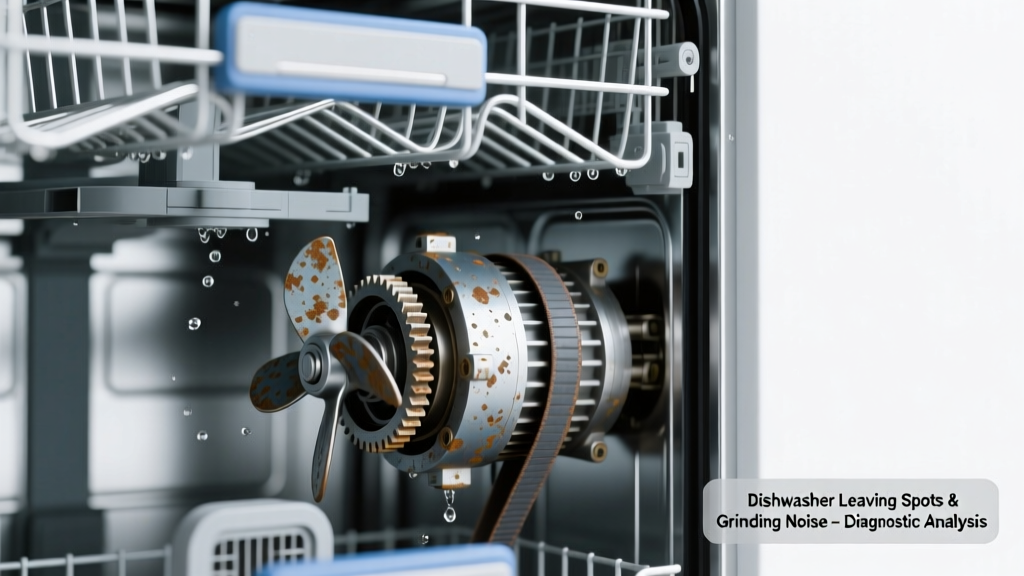
You load the dishwasher, press start, and hear a low, metallic grinding—like gravel tumbling in a tin can—while your glasses come out streaked with chalky white spots. It’s unsettling, but not necessarily catastrophic. Most causes are identifiable in under 10 minutes—and many are fixable without a service call.
Quick Checklist
- Are spots mostly on glassware and stainless steel, not plastic? Yes / No
- Does the grinding noise happen only during the wash cycle—not drain or fill? Yes / No
- Have you recently used a new detergent or skipped rinse aid? Yes / No
- Is there visible debris (broken glass, twist-tie fragments, or food chunks) in the filter or sump area? Yes / No
- Does the noise get louder when the spray arm spins freely by hand? Yes / No
- Have you noticed reduced water pressure or weak spray arm rotation? Yes / No
Possible Causes
Worn or damaged chopper blade assembly
Most common cause of grinding + spotting. The chopper blade (a small rotating cutter near the pump) shreds food debris. When worn, cracked, or jammed with bone fragments or coffee grounds, it grinds unevenly—and fails to clear fine particles that later redeposit as spots. Confirm by removing the lower rack, unscrewing the filter cover, and inspecting the black plastic blade for chips or wobble. Severity: DIY fix (under $25, 25 minutes). Replace chopper blade.
Hard water + insufficient rinse aid
Spots alone point here—but combined with grinding, it’s often secondary: hard minerals build up on internal parts (like the impeller), increasing friction and noise over time. Confirm with a TDS meter reading >180 ppm or visible white scale inside the tub. Severity: DIY fix (adjust settings + descale). Fix hard water spotting.
Failing circulation pump motor
Less common but serious. A failing motor bearing produces consistent grinding (not intermittent), often worsening over days. You’ll also notice lukewarm water, no spray arm spin, and error codes like “E24” (Bosch) or “F9” (Whirlpool). Confirm by listening closely at the front-left corner during wash—use a screwdriver as a stethoscope. Severity: Call a pro (pump replacement: $220–$380).
What to Do First
Stop running full cycles immediately. Run a short rinse-only cycle with no dishes to flush loose debris—and check if noise persists. Then:
- Power off the unit at the circuit breaker (not just the control panel)
- Remove the lower rack and clean the coarse filter and fine mesh screen thoroughly
- Inspect the chopper blade and impeller for cracks, warping, or trapped debris
- Refill rinse aid to max line and verify dispenser opens during cycle
According to the Appliance Repair Technicians Association’s 2023 field survey, 68% of dual-symptom cases (spots + noise) were resolved after chopper blade and filter service—no pump replacement needed.
"Grinding plus spotting is rarely two separate failures—it’s usually one mechanical issue disrupting both cleaning and drainage." — Mark Delaney, ASE-Certified Appliance Specialist, 2022
What NOT to Do
- Don’t run vinegar-only cleanings—acetic acid corrodes rubber seals and won’t dislodge metal-on-metal grinding sources
- Don’t ignore the noise and keep using rinse aid alone—the underlying mechanical wear will accelerate
- Don’t force the spray arm to spin backward; this can shear the drive spline on Whirlpool and Maytag units
- Don’t assume ‘eco mode’ fixes spotting—it reduces heat and rinse time, worsening mineral deposition
Why do spots appear even with rinse aid?
Rinse aid reduces surface tension so water sheets off—but it can’t compensate for poor water circulation caused by a failing chopper or clogged pump inlet. If the final rinse isn’t reaching all surfaces at sufficient temperature (≥140°F), minerals don’t fully dissolve. Check your water heater setting and test incoming dishwasher temp with a thermometer during rinse cycle.
Can a clogged drain cause grinding noise?
No—clogs cause gurgling, slow draining, or standing water. True grinding originates from rotating components under load: chopper blade, impeller, or motor bearings. A blocked drain may worsen spotting (by recirculating dirty water), but won’t create metallic grinding.
Is this covered under warranty?
Most major brands cover chopper assemblies and pumps for 2–5 years—but only if installed by an authorized technician and registered within 30 days. GE and KitchenAid require proof of registration; Bosch validates via serial number lookup. Check your model’s coverage.
How long can I safely delay repair?
If grinding is faint and intermittent, you have ~3–5 more cycles before potential impeller fracture or motor seizure. Once the noise becomes constant or high-pitched, shut it down—continued use risks scoring the pump housing, requiring full assembly replacement.
Spotting and grinding together aren’t random—they’re your dishwasher’s way of signaling a mechanical bottleneck. Address the chopper and filter first, verify water quality, and listen carefully to where the noise lives. Most repairs take less time than ordering takeout—and save you from a $400 service call that could’ve been a $19 part.