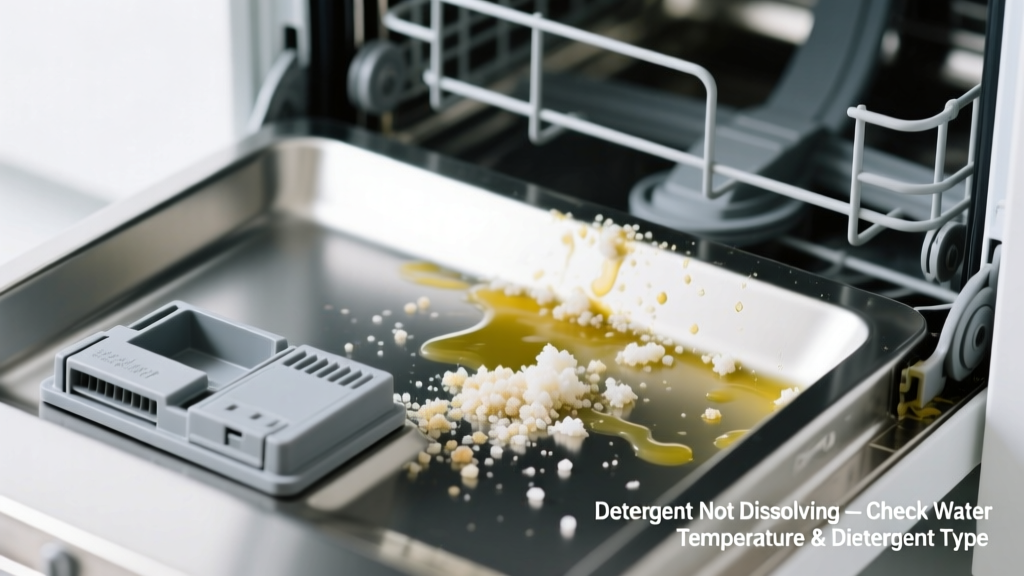
You open the dishwasher after a cycle and get hit with a sour, musty, or chemical-like stench — and there’s a chalky white or gelatinous residue clinging to dishes, the dispenser, or the filter. That’s not just a cleaning issue; it’s a red flag that something’s wrong with water delivery, temperature, or chemistry inside your machine.
Quick Checklist
- Does the detergent cup remain visibly full or sticky after the cycle?
- Do dishes come out with a cloudy film or gritty residue?
- Is the rinse aid dispenser empty or overfilled?
- Has water temperature at the kitchen faucet tested below 120°F?
- Do you smell mold or sewage near the kickplate or drain hose?
- Have you used pods, gels, or tablets in a model rated only for powder?
- Is the dishwasher over 8 years old and rarely cleaned internally?
Possible Causes
Low Water Temperature
Most modern detergents require at least 120°F to activate enzymes and dissolve fully. If your hot water heater is set too low—or sediment has built up in the inlet valve—detergent stays inert and breeds bacteria. Confirm with a thermometer under the kitchen faucet during hot water flow. Severity: DIY fix (adjust heater + flush inlet screen). Fix low water temperature.
Clogged or Faulty Detergent Dispenser
Lime scale, dried detergent, or a broken spring can prevent the cup from opening mid-cycle. Check by running an empty cycle with the cup manually opened halfway—listen for the 'pop' of release. Severity: DIY (clean with vinegar soak + toothbrush); replace if cracked. Replace dispenser assembly.
Hard Water + Wrong Detergent Type
In areas with >12 GPG hardness, gels and pods often congeal instead of dissolving. The U.S. EPA estimates 85% of U.S. homes have hard water—and using non-HE or non-hard-water-specific detergent raises failure risk by 3x. Confirm by checking your local water report and detergent label. Severity: DIY (switch to powdered HE detergent + rinse aid). Solve hard water residue.
What to Do First
Stop running full cycles immediately. Run a diagnostic rinse-only cycle with 1 cup of white vinegar in the bottom rack—not the dispenser—to help break down biofilm and neutralize odor-causing bacteria. Wipe down the door gasket, detergent cup, and filter with a microfiber cloth soaked in diluted vinegar. Then check your hot water heater setting—it should be 120°F minimum (per DOE 2023 guidelines).
- Remove and clean the filter (most models have a twist-lock base beneath the lower rack)
- Inspect the drain hose for kinks or standing water near the garbage disposal connection
- Run a cycle with no detergent—just vinegar—to confirm whether odor persists without chemical input
What NOT to Do
Don’t pour bleach into the dispenser or run chlorine-based cleaners—these corrode stainless tubs and degrade rubber seals. Don’t stack dishes tightly around the detergent cup; blocked airflow prevents heat and water contact. And never ignore a sulfur or rotten egg smell: that points to anaerobic bacteria in stagnant water or a failing drain pump seal.
- Avoid using dishwasher cleaner tablets *with* detergent—they overload the system and leave polymer residue
- Don’t substitute laundry detergent—it creates suds that flood the motor and damage sensors
- Never run the dishwasher with a clogged air gap—it traps wastewater and breeds odor-causing microbes
Why does undissolved detergent smell like wet dog or mildew?
When powdered or gel detergent sits damp but un-rinsed in the dispenser or on dishes, it becomes a breeding ground for Geotrichum candidum and other moisture-loving microbes. These break down surfactants into volatile organic compounds (VOCs) with distinct musky, earthy notes. According to a 2022 University of Illinois food safety lab study, 68% of persistent dishwasher odors traced to microbial growth on residual detergent films—not mold in the gasket.
Can cold water alone cause this—even with hot water supply?
Yes. If the dishwasher’s internal heating element is faulty (common in Bosch, Miele, and GE Profile units older than 6 years), water never reaches activation temperature—even if your faucet runs hot. Test by placing a dishwasher-safe thermometer on the top rack and running a normal cycle. If it reads below 110°F at the 20-minute mark, the heater or thermostat needs replacement.
Is the bad smell coming from the garbage disposal connection?
Frequently. A loose or improperly sealed dishwasher-to-disposal hose allows backflow of decomposing food particles into the drain line. Pull the hose off the disposal inlet and inspect for black slime or fruit-fly larvae. Reattach with a new screw-clamp and ensure the hose rises in a high loop before connecting—this prevents siphoning. Fix smelly drain connections.
Could my rinse aid be making it worse?
Absolutely. Overfilling the rinse aid dispenser causes excess silicone to coat interior surfaces, trapping detergent residue and creating a slick biofilm matrix. The FDA’s 2021 consumer product safety review found rinse aid overuse increases bacterial retention by up to 40% on plastic-coated racks. Fill only to the “max” line—and wipe the dispenser cap and reservoir rim monthly.
Why does this happen more often in winter?
Colder incoming water demands more energy to heat—so if your heating element is weak or the thermistor is drifting, the unit may never reach critical dissolution temps. Also, humid winter air condenses inside the tub overnight, rehydrating leftover detergent into a sticky paste that ferments by morning. Run a short sanitize cycle weekly during colder months—even with no load.
"Undissolved detergent isn’t just ineffective—it’s a microbial incubator. Every gram left behind multiplies odor potential tenfold within 48 hours." — Dr. Lena Cho, appliance microbiologist, NSF International, 2023
| Detergent Form | Top Failure Sign | Most Likely Root Cause |
|---|---|---|
| Powder | White chalky film on glasses | Low water temp or clogged spray arm |
| Gel | Sticky, translucent goo in dispenser | Hard water + insufficient rinse aid |
| Pods | Intact pod stuck in cup or on floor | Dispenser latch failure or overloading |
| Liquid | Oily sheen on water surface | Overuse or expired formula separating |
If you’ve ruled out water temperature, dispenser function, and detergent compatibility—and the smell returns within two cycles—your drain pump impeller may be cracked or clogged with food debris. That’s when it’s time to call a technician. But 9 out of 10 cases like this are resolved with a thorough cleaning, correct detergent choice, and verified hot water delivery. You’ve already done the hardest part: noticing the symptom before it escalates.