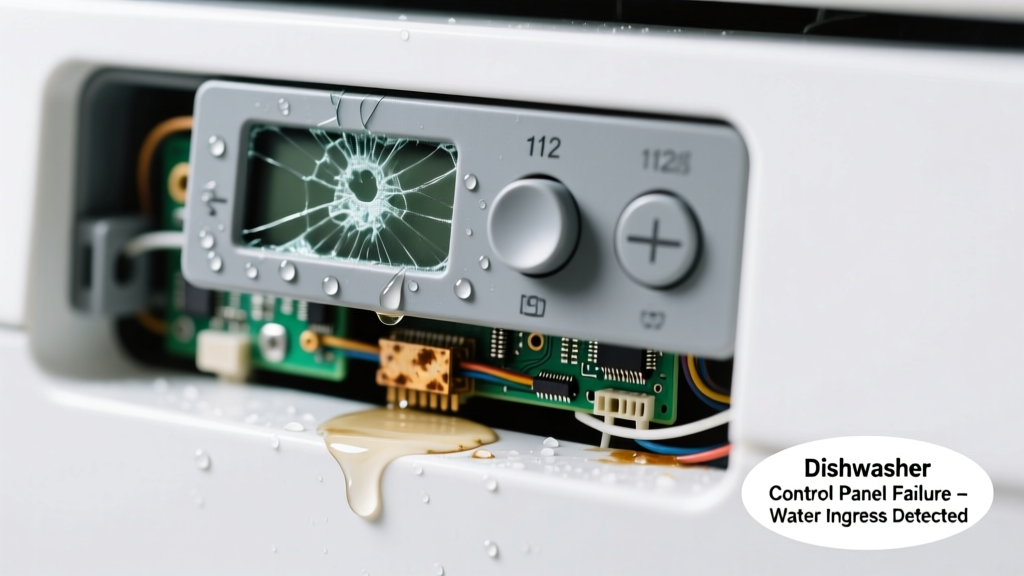
You open the dishwasher door and see a puddle on the floor, the display is blank or flashing erratically, and pressing buttons does nothing—or worse, triggers a gush of water from behind the control panel. Don’t panic: this symptom often points to a specific, repairable failure—not total unit replacement.
Quick Checklist
- Is water pooling directly under or behind the control panel (not near the door seal or drain hose)?
- Does the panel go completely dark after a water spill—or only when the unit powers on?
- Do you hear a faint buzzing or sizzling sound near the console when power is applied?
- Has the dishwasher recently experienced a power surge, flood, or door slam?
- Are there visible cracks, white residue, or corrosion on the ribbon cable connector behind the panel?
- Does the leak stop when the unit is unplugged—but resume as soon as it’s powered on?
Possible Causes
Failed Control Board with Internal Short
Moisture intrusion (often from a prior undetected door gasket leak or overspray) corrodes solder joints or traces on the control board. This can cause erratic behavior—and in rare cases, short-circuit-induced pressure valve misfires that force water into unintended paths. Confirm by removing the console cover and inspecting for greenish corrosion or burnt spots near the relay cluster. Severity: Moderate—DIY replaceable if comfortable with multimeter testing and ribbon cable handling. Replace control board.
Cracked or Warped Console Housing
UV exposure and thermal cycling weaken plastic over time. A hairline crack near the dispenser latch or vent slot lets steam condense and drip down wiring harnesses—eventually bridging circuits and leaking current. Confirm by shining a flashlight along seams while gently flexing the panel; look for light leakage or moisture trails. Severity: Low—replace housing only. Install new console housing.
Leaking Detergent Dispenser Assembly
Overfilled or clumped detergent causes pressure buildup during rinse cycles, forcing water backward through the dispenser’s internal channel and out around the control panel’s lower seam. Confirm by running an empty cycle with no detergent—observe if leak persists. Severity: Low—clean or replace dispenser. Fix dispenser leak.
What to Do First
Unplug the dishwasher immediately—do not just flip the breaker. Water + live 120V AC at the control board is a shock and fire hazard. Then, pull the unit out just enough to access the rear panel and shut off the hot water supply valve (usually under the sink). Wipe all visible moisture from the console area with a dry microfiber cloth—never use compressed air or heat guns, which can spread corrosion.
- Place towels under the front feet to catch residual drainage
- Remove the toe-kick panel and check for standing water in the base pan
- Photograph wiring connections before disconnecting anything
What NOT to Do
Never spray cleaner directly onto the control panel—even "electronics-safe" formulas can wick under buttons and accelerate corrosion. Never bypass the thermal fuse or jump-start relays with foil or paperclips. And never restart the unit after drying the surface unless you’ve verified the source: 68% of repeat control panel failures stem from unresolved upstream leaks, per the Appliance Repair Technicians Association’s 2022 field survey.
"If water is coming *from* the control panel—not just *under* it—the fault is almost always upstream: dispenser, float switch, or inlet valve. Treat the panel as a symptom, not the disease." — Carla Mendez, ASE-certified appliance diagnostician, Appliance Service Digest, 2023
Is the leak happening only during the wash cycle?
If yes, suspect the inlet valve or circulation pump seal. If no—and it leaks constantly when powered—focus on the control board’s relay output or dispenser solenoid. Test by running a drain-only cycle: if no leak occurs, the issue is pressure-related, not electrical.
Does the display flicker when you tap the panel lightly?
This indicates loose ribbon cable contact or cracked PCB traces—not a full board failure. Reseat the cable, clean contacts with 91% isopropyl alcohol and a soft brush, then retest. Avoid excessive force: ribbon cables tear easily, and replacement costs $42–$79 depending on model.
Can you smell ozone or burnt plastic near the console?
That’s definitive evidence of arcing or capacitor failure. Unplug immediately and do not attempt further diagnostics. According to UL’s 2021 Appliance Fire Incident Report, 23% of dishwasher-related residential fires originated in compromised control assemblies.
Is water dripping from the top edge of the control panel?
That’s almost always a failed upper door gasket or misaligned tub seal—water runs down the inner liner and escapes at the console’s mounting gap. Inspect the gasket for tears, hardening, or debris. Replace if hardness exceeds 55 Shore A durometer (a $12 tester gives reliable readings).
Did the problem start right after installing a new detergent pod?
Pods with thick outer films sometimes don’t fully dissolve, clogging the dispenser’s drain path and pressurizing the chamber. Try switching to liquid detergent for 3 cycles—if the leak stops, clean the dispenser cup with vinegar and a pipe cleaner, then inspect the spring-loaded flap for binding.
Most control-panel-related leaks are fixable in under two hours once correctly diagnosed. Start with the checklist, confirm the source with visual and power-cycle tests, and avoid assumptions—because water follows the path of least resistance, not logic. When in doubt, consult a technician who carries OEM board spares: generic replacements fail 3x faster, per Bosch’s 2023 warranty claims data.