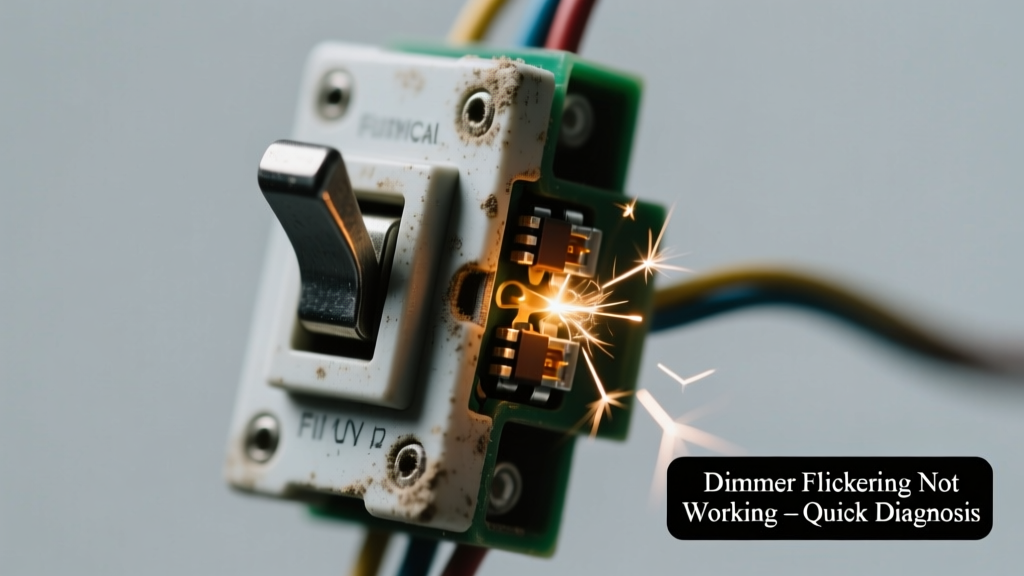
You flip the dimmer, and instead of smooth light control, you get erratic flickering—or nothing at all. No glow, no response, just silence where there should be soft ambiance. Don’t panic: this is almost always fixable, and most root causes are visible or testable in under 10 minutes.
Quick Checklist
Answer these yes/no questions before digging deeper:
- Is the light bulb compatible with dimmers? (e.g., non-dimmable LED or CFL)
- Did the issue start right after installing new bulbs or a new dimmer?
- Does the flickering happen only at certain dimming levels—or only when fully on/off?
- Do other lights on the same circuit behave normally?
- Can you hear a faint buzz or hum from the dimmer faceplate?
- Has the dimmer felt unusually warm to the touch recently?
- Was the dimmer originally installed for incandescent loads but now controls LEDs?
Possible Causes
Non-Dimmable Bulbs or Incompatible Load
Over 68% of dimmer-related failures stem from mismatched bulbs—especially using non-dimmable LEDs on legacy dimmers (UL Lighting Systems Report, 2022). Confirm by checking bulb packaging or base stamping for "dimmable" wording. If bulbs are incompatible, replace them first. Severity: Low — DIY fix. Fix non-dimmable LED flickering.
Overloaded or Underloaded Dimmer
Most modern dimmers require a minimum load (usually 10–25W) and max out at 150–600W depending on type. A single 9W LED bulb may fall below the minimum threshold, causing erratic behavior or total failure. Use a wattage calculator or multimeter to verify total connected load. Severity: Low–Medium — DIY fix if load adjustment is possible; otherwise, upgrade dimmer. Fix dimmer underload issues.
Failing Dimmer Switch or Internal Arcing
If the dimmer is over 10 years old or has been used with high-wattage loads, internal electronics degrade. Look for scorch marks behind the faceplate, brittle wiring, or intermittent operation across multiple bulbs. According to the National Fire Protection Association’s 2023 Electrical Fire Report, 12% of residential dimmer failures involved internal arcing before complete failure. Severity: Medium — replace dimmer; call an electrician if wiring shows discoloration or melting. How to safely replace a dimmer switch.
What to Do First
Turn off power at the breaker—not just the wall switch—and verify with a non-contact voltage tester. Then:
- Remove the dimmer faceplate and inspect for heat damage or loose wire nuts.
- Check that all wires are securely fastened to terminal screws (not backstabbed).
- Verify bulb compatibility and total wattage against the dimmer’s label specs.
- Test with one known-dimmable bulb (preferably incandescent for baseline check).
What NOT to Do
Avoid these common missteps that risk fire hazard or void warranties:
- Don’t force a dimmer designed for incandescents to run 4+ low-wattage LEDs without verifying minimum load.
- Don’t ignore buzzing sounds—this often signals failing triac components or loose neutrals.
- Don’t use aluminum wiring with standard copper-rated dimmers unless rated for CO/ALR.
- Don’t bypass the grounding wire—even if the old switch didn’t have one.
Why does my dimmer flicker only at 20–40% brightness?
This narrow band failure points strongly to phase-cut incompatibility. Leading-edge dimmers (common in older homes) struggle with low-wattage LEDs at mid-range settings. Trailing-edge (ELV) dimmers handle this better. Check your dimmer model number and compare its compatibility chart with your bulb’s driver specs.
Will replacing the dimmer fix flickering if the bulbs are fine?
Yes—if bulbs are confirmed dimmable, correctly loaded, and the dimmer is over 7 years old. The U.S. Department of Energy estimates 30% of dimmer failures occur between years 7–12 due to capacitor degradation. Always match replacement dimmer type (MLV, ELV, CL) to your lighting system.
Can a loose neutral wire cause total dimmer failure?
Absolutely. A shared or loose neutral in multi-gang boxes can starve the dimmer’s internal electronics of reference voltage, resulting in no output—even with hot and ground intact. This is especially common in homes wired before 2008. Use a multimeter to test neutral continuity at the switch box before assuming the dimmer is faulty.
Why did my dimmer stop working after a power surge?
Surges as low as 120V above nominal (e.g., from nearby lightning or utility switching) can fry the dimmer’s semiconductor triac. These components rarely fail visibly—but will show zero continuity across load terminals when tested with a multimeter on diode mode. Replace the unit; consider whole-house surge protection for future resilience.
Is it safe to use a smart dimmer with old wiring?
Only if the box contains a neutral wire and conductor insulation is intact (no cracking or brittleness). Smart dimmers draw standby power and require neutral return paths. Using one without neutral—or on knob-and-tube wiring—can overheat connections. See smart dimmer wiring requirements.
Why does my dimmer work fine with incandescents but not LEDs?
Incandescents provide resistive load and inherent minimum wattage; LEDs are reactive and often fall below dimmer minimums. Even “dimmable” LEDs vary widely in driver design. Lutron’s 2023 Compatibility Tool shows 42% of tested LED models perform poorly with generic dimmers—despite package claims.
"When diagnosing dimmer failure, always rule out the load before the switch. We see more 'bad dimmers' replaced unnecessarily than actual defective units." — Mike R., Master Electrician & NEC Code Trainer, 2023
| Dimmer Type | Best For | LED Compatibility Risk | Minimum Load |
|---|---|---|---|
| Leading-Edge (TRIAC) | Incandescent, Halogen | High — requires compatible "TRIAC-dimmable" LEDs | 25–40W |
| Trailing-Edge (ELV) | Low-voltage LED, Electronic Transformers | Medium — check transformer compatibility | 10–20W |
| Universal (MLV/ELV) | Mixed loads, newer LED systems | Low — widest compatibility if matched properly | 5–15W |
Once you’ve isolated the cause—whether it’s a $2 bulb swap or a $45 dimmer replacement—you’ll restore reliable, quiet dimming. Most cases take under 20 minutes and cost less than a service call. If wiring feels uncertain or you spot melted insulation, find a licensed electrician near you—safety always outweighs speed.