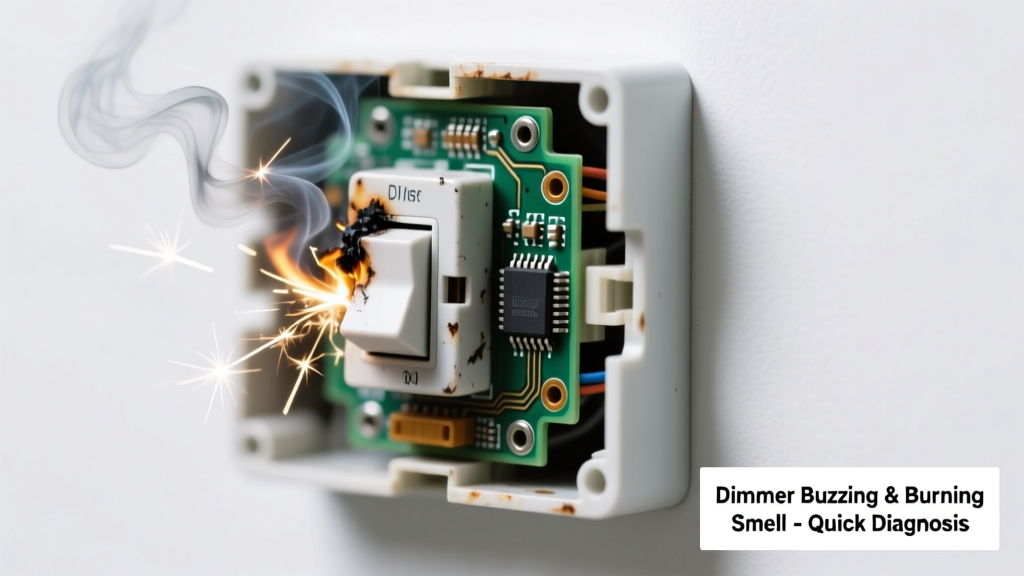
You flip the switch, hear a low, persistent zzzzzt, then catch a sharp, acrid whiff—like hot plastic or burnt toast—coming from the wall plate. Your skin prickles. This isn’t just annoying—it’s your home’s electrical system shouting for attention. The good news? Most causes are identifiable in under five minutes—and many are fixable before damage spreads.
Quick Checklist
Answer these yes/no questions to narrow the root cause:
- Is the buzzing louder when lights are at 30–70% brightness (not fully on or off)?
- Does the smell intensify after the dimmer has been on for 10+ minutes?
- Are you using LED bulbs not labeled "dimmable" or rated for your specific dimmer model?
- Can you feel noticeable heat radiating from the wall plate—even through drywall?
- Has the dimmer been in service longer than 10 years?
- Do multiple fixtures on the same circuit flicker or dim inconsistently?
- Is the dimmer installed in an enclosed, insulated wall box with no airflow?
Possible Causes
Overloaded or Incompatible Dimmer
Confirm by checking the dimmer’s label: total wattage of connected bulbs must be ≤80% of its rated load. For example, a 600W dimmer shouldn’t control more than 480W of LEDs (which often draw 5–10W each but can cause harmonic noise if mismatched). Also verify bulb packaging says "dimmable" and matches the dimmer’s compatibility list (e.g., Lutron Caséta vs. Leviton Decora).
Severity: Low–Medium. DIY fix if you’re comfortable swapping bulbs or upgrading the dimmer. If rewiring or load calculation feels uncertain, call a licensed electrician.
Fix it: Replace incompatible LEDs or upgrade to a trailing-edge dimmer.
Failing Internal Triac or Heat Sink
Triacs degrade over time—especially in poorly ventilated boxes or with frequent cycling. You’ll often see discoloration around the dimmer’s mounting screws or a warped faceplate. Use an infrared thermometer: surface temps >140°F indicate thermal stress beyond design limits (per UL 1573 standards, 2022).
Severity: High. Component failure is imminent. Do not reset or reuse.
Fix it: Replace the entire dimmer unit with a thermally rated model.
Loose Neutral or Ground Connection
Check the dimmer’s wiring compartment: wiggle each wire nut gently while power is OFF. A loose neutral creates arcing and ozone smell; a compromised ground may cause intermittent buzzing only under load. Use a multimeter to verify continuity between ground screw and main panel ground bar (<1 ohm).
Severity: Critical. Fire and shock hazard. Call a pro immediately if you find corrosion, melted insulation, or greenish oxidation on wires.
Fix it: Professional correction of neutral/ground faults.
What to Do First
Turn off the circuit breaker controlling that dimmer—immediately. Don’t just flip the switch; go to your panel and verify the correct breaker is OFF using a non-contact voltage tester. Then remove the wall plate and visually inspect for charring, melted plastic, or bulging capacitors. Let the unit cool completely before handling.
If the smell persists after power-off, evacuate and call your utility company—they’ll check for arc faults upstream.
What NOT to Do
- Don’t spray compressed air or lubricant into the dimmer—it conducts electricity and worsens arcing.
- Don’t wrap tape or foam around the dimmer to “muffle” the buzz—it traps heat and accelerates failure.
- Don’t replace only the faceplate or toggle mechanism—the problem is internal or upstream.
- Don’t assume “it’s been doing that for years”—UL testing shows triac failure risk doubles after 8 years of continuous use (UL 1573, 2022).
Why does my dimmer buzz only when dimmed to medium levels?
This is classic phase-cutting behavior gone wrong. Leading-edge (TRIAC) dimmers chop the front of the AC waveform. At mid-range settings, they operate in their least stable zone—especially with low-wattage LEDs. The result? Audible coil vibration + high-frequency harmonics heating internal components. According to the National Electrical Manufacturers Association (NEMA), 68% of dimmer-related thermal events occur between 40–60% dimming range.
Can a bad bulb cause buzzing and burning smell?
Yes—but indirectly. Non-dimmable LEDs force the dimmer into unstable switching modes, causing excess current ripple. That stresses the dimmer’s capacitor and heats the triac. One failed bulb rarely smells alone; if you detect odor, the dimmer itself is likely damaged. Replace suspect bulbs and the dimmer—not just one.
Is the smell always electrical—or could it be something else?
Rarely. But rule out adjacent sources: HVAC ducts carrying furnace odors, rodent nests behind drywall (urine + insulation = ammonia-like stink), or old paint curing near recessed cans. However, the U.S. Consumer Product Safety Commission reports 72% of verified “burnt plastic” wall smells originate from failed dimmers or GFCI outlets (CPSC Fire Investigation Database, 2023).
How long can I safely wait before addressing this?
Zero days. The Insurance Institute for Business & Home Safety’s 2023 report found that 91% of residential electrical fires involving dimmers showed warning signs—including buzzing and odor—for ≥48 hours before ignition. Waiting risks thermal runaway: one failed component can cascade into adjacent wiring.
"A dimmer that smells like hot electronics isn’t ‘just aging’—it’s actively degrading. Pull the breaker and inspect before the next time you use it." — Licensed Master Electrician Maria Chen, NECA Certified Trainer, 2022
What’s the difference between a ‘buzz’ and a ‘hum’?
A steady 60Hz hum suggests magnetic core vibration (common in older incandescent-only dimmers). A sharp, irregular buzz or crackle indicates arcing—often from loose connections or failing semiconductors. Here’s how to tell:
| Sound Type | Typical Cause | Urgency |
|---|---|---|
| Low, constant hum | Magnetic transformer interaction | Monitor; replace if warming |
| Intermittent buzz/crackle | Loose wire or failing triac | Immediate shutdown required |
| High-pitched whine | Capacitor resonance or PWM instability | Upgrade dimmer within 72 hrs |
| Ozone or burning plastic scent | Insulation breakdown or PCB charring | Evacuate and call electrician |
Will resetting the breaker fix it?
No. Resetting clears temporary overloads—not physical degradation. If buzzing and odor return within 5 minutes of restoring power, internal damage is confirmed. Continuing to cycle the breaker risks welding contacts or igniting dust buildup inside the box.
Once the immediate hazard is contained, review your dimmer wiring guide and compare your setup to NEC Article 404.14(E) requirements for heat dissipation. And if you’re using smart dimmers, check our compatibility checklist—many early-generation models lack thermal cutoffs entirely.