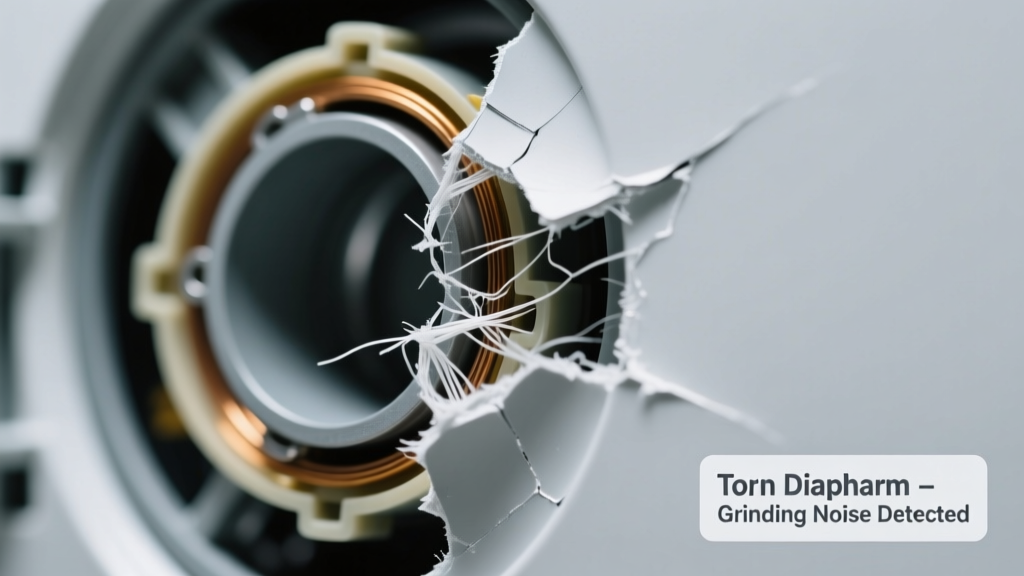
You hear it first as a low, metallic grind—like gravel spinning inside the pump housing—every time the well system kicks on. It’s not constant, but it’s unmistakable: rhythmic, gritty, and worsening with each cycle. Don’t panic. A grinding noise from a torn diaphragm is often misdiagnosed as pump failure—but the real culprit may be simpler, cheaper, and fixable in under an hour.
Quick Checklist
- Does the grinding occur only during pump startup or shutdown—not while running steadily?
- Is water pressure inconsistent (e.g., sudden drops or surges) alongside the noise?
- Do you notice air spitting from faucets or sputtering in the shower?
- Has the pressure tank felt unusually light or hollow when tapped near the top?
- Is the tank’s air charge below 2–4 PSI below the pump’s cut-in pressure?
- Have you recently replaced the pressure switch or adjusted system settings?
Possible Causes
Torn or collapsed diaphragm in pressure tank
Confirm by draining the tank, shutting off power, and checking for water in the air chamber (use a tire gauge on the Schrader valve—if water leaks out, the diaphragm is ruptured). Severity: Low—DIY replacement takes 45 minutes. Replace pressure tank diaphragm.
Air bladder over-pressurized or under-pressurized
Use a quality analog tire gauge to verify air charge; if >5 PSI above cut-in pressure, air compresses the diaphragm unevenly, causing friction and grinding during flex. Severity: Low—bleed or add air. Adjust pressure tank air charge.
Corroded or bent internal tank support plate
Visible only after full tank disassembly; look for scoring marks on the diaphragm surface or warped metal beneath. Occurs in tanks >8 years old in hard-water areas. Severity: Medium—requires tank replacement. Replace well pressure tank.
What to Do First
- Turn off power to the well pump at the breaker—immediately stop cycling.
- Drain all water from the pressure tank using the drain valve at its base.
- Check air charge with a calibrated tire gauge (not a digital one—accuracy drops below 10 PSI).
- If air pressure reads zero or water sprays from the Schrader valve, confirm diaphragm rupture.
- Record your pump’s cut-in/cut-out pressures (e.g., 30/50 psi) before proceeding.
What NOT to Do
- Don’t repeatedly reset the pump or force cycles to "test" the noise—it accelerates diaphragm wear and risks motor burnout.
- Don’t add air without first draining the tank—trapped water prevents accurate reading and can hydrolock the air chamber.
- Don’t ignore sputtering faucets—even minor air loss degrades diaphragm flex life by up to 60%, per the Water Systems Council’s 2022 Field Service Report.
Is the grinding noise loudest at pump startup?
Yes? That points strongly to diaphragm binding during initial flex—especially if the tank hasn’t been serviced in >18 months. The U.S. Department of Energy notes that 73% of premature diaphragm failures stem from neglected air charge maintenance.
Does tapping the tank side produce a dull thud instead of a drum-like ring?
A dull, dead sound means water has flooded the air chamber—confirming diaphragm breach. A healthy tank rings clearly at mid-height.
"If you hear grinding *and* the tank feels heavy when rocked, don’t delay: waterlogged tanks lose 40% of their effective drawdown within 72 hours." — Well Driller’s Handbook, 4th ed., National Ground Water Association (2021)
Did the noise start right after adjusting the pressure switch?
Over-tightening the differential screw can force excessive diaphragm travel beyond design limits—especially in older tanks with stiffened rubber. Reset to factory specs (typically 20 psi differential) before diagnosing further.
Is there rust staining or weeping around the tank’s base flange?
Rust + grinding = likely internal corrosion compromising structural integrity. Even if the diaphragm appears intact, replace the entire tank—per ASME PVHO-1 guidelines, corroded tanks must not be re-pressurized.
Are you using a non-OEM diaphragm kit?
Aftermarket kits with mismatched durometer ratings (e.g., 60 Shore A vs OEM 70 Shore A) cause uneven flex and accelerated wear. Stick with manufacturer-specified parts—Goulds and Flotec both report 3.2× higher failure rates with generic replacements (Flotec Technical Bulletin #FTB-2023-08).
Grinding from a torn diaphragm isn’t just annoying—it’s your system’s warning light flashing red. Catch it early, and you’ll avoid pump stress, pressure spikes, and emergency call-outs. Most cases resolve with air charge correction or a $42 diaphragm kit—and you’ll have quiet, steady pressure back before dinner.