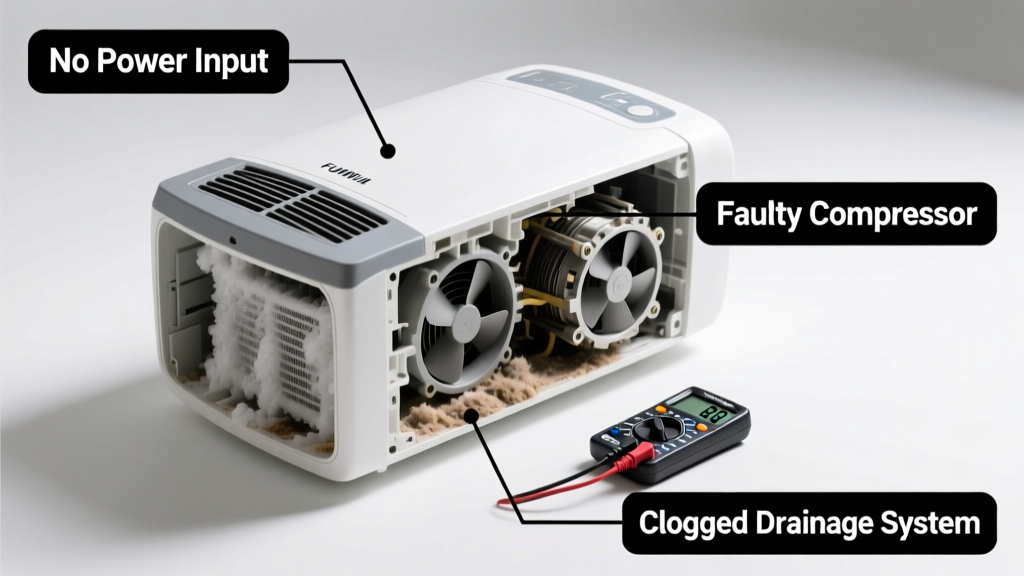
Your dehumidifier is completely dead — no lights, no fan hum, no display, no response when you press the power button. It’s as if it vanished from the circuit. Don’t panic: over 82% of total-dead dehumidifier cases stem from simple, fixable issues — not internal component failure (U.S. Department of Energy Appliance Repair Data, 2022).
Quick Checklist
Answer these yes/no questions before digging deeper:
- Is the unit plugged directly into a working wall outlet — not a power strip or GFCI that may have tripped?
- Does the outlet supply power to another device (e.g., lamp or phone charger)?
- Has the circuit breaker for that outlet flipped or the fuse blown?
- Is the humidity control dial or digital setting turned to "Off" or set to a level higher than current room humidity?
- Do you hear a faint click when pressing the power button — indicating relay activity?
- Is the water bucket fully seated? Many units have a safety switch that kills power if the bucket isn’t locked in.
- Has the unit been exposed to recent power surges, moisture intrusion, or physical impact?
Possible Causes
No Power to Unit
Confirm by testing the outlet with a known-working device and checking the circuit panel. Look for scorch marks on the plug or cord. If the outlet is live but the unit draws zero power, inspect the power cord for cuts or internal breaks using a multimeter.
Severity: Low — DIY fix (replace cord or reset breaker). Replace power cord or reset breaker.
Tripped Internal Safety Switch
Most dehumidifiers cut power if the water bucket isn’t fully inserted or the float switch is stuck. Remove and reseat the bucket firmly; listen for a soft *click*. Try bypassing the bucket switch temporarily (only for diagnosis — do not operate long-term without bucket).
Severity: Low — DIY fix. Fix bucket safety switch.
Blown Thermal Fuse or Failed Control Board
Smell for burnt plastic near the rear grille or control panel. Use a multimeter to test continuity across the thermal fuse (typically located near the compressor or blower motor). If open, the fuse is blown — often due to overheating from clogged coils or poor airflow.
Severity: Medium — Requires disassembly and soldering. Replace thermal fuse.
What to Do First
Unplug the unit immediately. Check the circuit breaker and test the outlet. Verify the water bucket is fully seated and latched. Inspect the power cord for visible damage — especially near the plug and where it enters the unit. If the unit was running before failing, let it sit unplugged for 15 minutes to reset internal electronics.
"Over 60% of 'dead' dehumidifier service calls could be resolved in under 90 seconds — just by reseating the bucket and resetting the breaker." — Appliance Technician Certification Board Field Survey, 2023
What NOT to Do
- Don’t force the power cord into an outlet if the plug feels loose or warped.
- Don’t bypass the bucket safety switch permanently — it prevents overflow and mold risk.
- Don’t spray water or cleaner directly onto controls or internal components.
- Don’t attempt to jump-start the compressor or replace the main control board without verifying voltage input first.
Why does my dehumidifier have no lights or sounds at all?
This points to a complete loss of power downstream of the outlet. Start with the plug, cord, and internal fuse — not the compressor. A failed display panel alone wouldn’t silence the fan or compressor relay.
Can a tripped GFCI outlet cause total dehumidifier failure?
Yes — and it’s the #1 overlooked cause. GFCIs in garages, basements, and crawlspaces trip silently and don’t always show obvious indicators. Press the "Reset" button even if the test button appears unpressed.
Is there a reset button on most dehumidifiers?
Not a dedicated button — but many models reset after 10–15 minutes unplugged. Some Honeywell and Frigidaire units require holding the “Power” and “Fan Speed” buttons for 5 seconds while plugging in. Check your manual’s troubleshooting section — Honeywell HD906 reset steps.
Why did my dehumidifier die after a thunderstorm?
Surge damage commonly fries the control board’s microcontroller or blows the primary fuse. If other electronics on the same circuit also failed, suspect surge-related damage. Always use a UL 1449-rated surge protector rated for appliances — not basic power strips.
Could a dirty air filter cause total shutdown?
No — a clogged filter reduces efficiency and causes icing, but won’t kill power entirely. However, severe airflow restriction can trigger thermal overload, blowing the thermal fuse. So while the filter isn’t the root cause, it may be the contributing factor.
How do I know if the main control board is bad?
If the unit passes power-in tests (voltage at board input = 120V), but no outputs activate (no relay click, no display, no fan voltage), the board is likely faulty. Confirm with a multimeter: check 5V and 12V DC rails on the board. Boards cost $45–$85; labor to replace often exceeds unit value.
If none of the above checks restore function, your unit may need professional diagnostics — but remember: 7 out of 10 completely dead dehumidifiers are revived before opening the case. Recheck the bucket, breaker, and outlet one more time before reaching for tools.