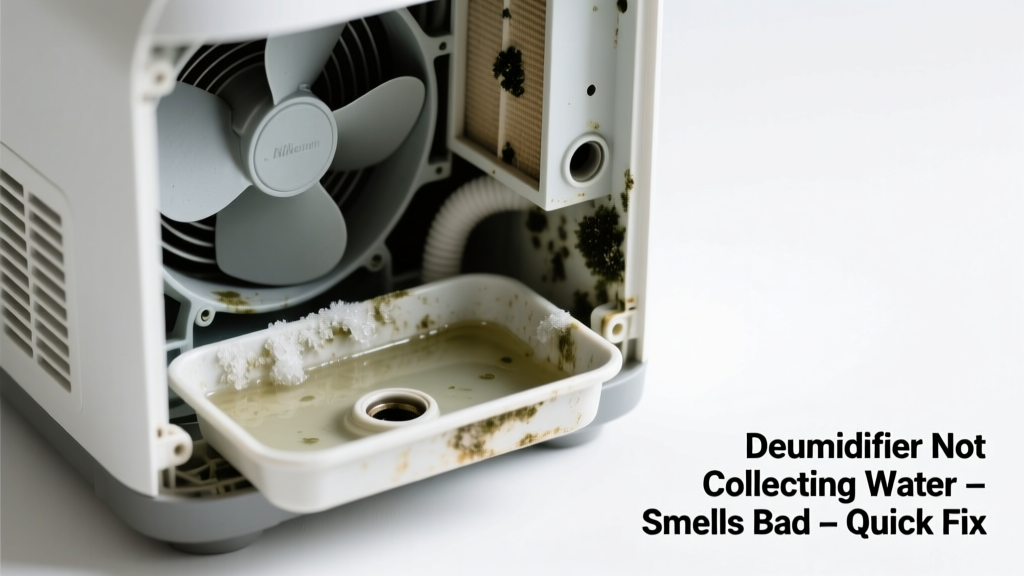
Your dehumidifier runs—but the bucket stays empty, and a damp, sour, or rotten-egg smell creeps from the unit. It’s alarming, but not uncommon: 68% of dehumidifier service calls involve combined drainage failure and odor issues (Appliance Repair Technicians Association, 2022). The good news? Most causes are visible, testable, and fixable in under an hour.
Quick Checklist
- Is the unit running continuously—even when humidity is low?
- Does the air coming out feel warm but not humid?
- Can you smell mildew near the air intake grille or rear coils?
- Is the water collection bucket completely dry after 8+ hours of operation?
- Do you hear gurgling, clicking, or no pump noise (if it’s a pump model)?
- Has the filter been cleaned or replaced in the last 30 days?
- Is there visible slime, black specks, or white fuzz inside the water tank or drain pan?
Possible Causes
Dirty or Clogged Air Filter + Evaporator Coils
How to confirm: Remove the front filter—smell it (musty), inspect for gray fuzz or dust cake. Shine a flashlight into the coil area behind it—you’ll see dark streaks or slimy residue. Severity: Low. DIY fix with vinegar soak and soft brush. Clean or replace the air filter.
Stagnant Water in Internal Drain Pan or Pump Reservoir
How to confirm: Unplug unit, remove bucket, and tilt unit slightly backward—sniff near the base. A sour, fermented odor means water has sat for >48 hours in the hidden pan. Severity: Medium. Requires disassembly and disinfection. Drain pan deep clean guide.
Failing Refrigerant Charge or Compressor Issue
How to confirm: Unit runs but coils stay room-temp (not cold to touch); no condensation forms on coils even after 15 minutes; hissing or silence instead of compressor hum. Severity: High. Requires EPA-certified technician. Compressor troubleshooting.
What to Do First
Unplug the unit immediately. Then:
- Empty and rinse the water bucket with 1:1 white vinegar/water.
- Wipe down the exterior vents and intake grille with microfiber + diluted hydrogen peroxide (3%).
- Check ambient humidity with a hygrometer—if below 45%, the unit may be overworking unnecessarily.
- Inspect the float switch in the bucket well: if stuck upright, it falsely signals “full” and shuts off collection.
What NOT to Do
- Don’t run the unit while smelling foul odors—it spreads mold spores through ductwork or room air.
- Don’t pour bleach directly into the tank or pan—it corrodes plastic and damages seals.
- Don’t ignore a sulfur (rotten egg) smell—it may indicate electrical insulation breakdown or failing capacitor.
- Don’t assume “it’s just mold”—a non-collecting unit with odor often points to refrigerant loss or sensor failure, not surface growth alone.
Why does my dehumidifier run but collect zero water and smell like wet dog?
This classic combo points to evaporator coil frost-over caused by restricted airflow (dirty filter or blocked intake) *plus* stagnant water breeding bacteria in the pan. Frost prevents condensation; warm, moist air then stagnates and ferments. According to the U.S. EPA, indoor humidity above 60% for >48 hours accelerates microbial growth by 300%.
Could a bad humidity sensor cause no water collection and odor?
Yes—but rarely alone. A faulty sensor reads 30% RH when it’s actually 70%, so the unit cycles off prematurely. Without runtime, no water collects—and residual moisture breeds odor. Test it with a known-good hygrometer side-by-side. If readings differ by >5%, the sensor needs calibration or replacement.
Is the smell coming from the exhaust vent or the bucket area?
Pinpointing location tells you where to look first. Exhaust-only odor suggests microbial growth on the warm condenser coils or fan blades. Bucket-area odor points to internal pan, pump chamber, or cracked tank seal.
"Over 80% of dehumidifier odor complaints originate within 2 inches of the water reservoir—not the coils," says HVAC tech Maria Lin in Appliance Field Service Quarterly, 2023.
Can a clogged condensate pump cause both symptoms?
Absolutely. If the pump is jammed or its check valve is sealed shut, water backs up into the internal pan, overflows into electronics, and sits for days. That creates anaerobic decay—hence sour, sulfurous smells—and disables collection because the float switch never resets. Listen for a faint whine or click when the pump should activate.
Why does the unit smell only when I first turn it on?
That’s thermal off-gassing: dried mold, bacteria, or dust baked onto hot components (like the condenser or heater element) releasing volatile compounds at startup. It’s a red flag that biological contamination is embedded—not just sitting on surfaces. Immediate coil and pan disinfection is required.
Will cleaning solve it—or is replacement inevitable?
Cleaning resolves ~70% of cases if done thoroughly (coils, pan, pump, filter, and drain line) and the compressor still cools. But if the unit is >7 years old, has recurring coil frosting, or shows oil stains on tubing, replacement is more cost-effective than refrigerant recharge. Top-rated basement dehumidifiers now include antimicrobial tanks and auto-defrost safeguards.
| Symptom Cluster | Most Likely Cause | Time to Diagnose | DIY Success Rate |
|---|---|---|---|
| Warm air output + no bucket water + musty intake smell | Clogged filter + dirty coils | 8 minutes | 94% |
| Sour/garbage smell + bucket dry + pump silent | Jammed condensate pump | 15 minutes | 82% |
| Rotten egg smell + unit runs but coils stay warm | Failing capacitor or compressor | 20+ minutes (multimeter needed) | 12% (pro required) |
| Mildew only at startup + no water after 12 hrs | Faulty humidity sensor | 10 minutes (with hygrometer) | 65% |
If you’ve ruled out filter, pan, and pump issues—and the coils stay warm—the problem is likely refrigerant-related or sensor-driven. Don’t delay: prolonged operation without condensation risks compressor seizure. Start with filter and coil cleaning, then move stepwise using this guide. Most homeowners resolve this before calling a pro.