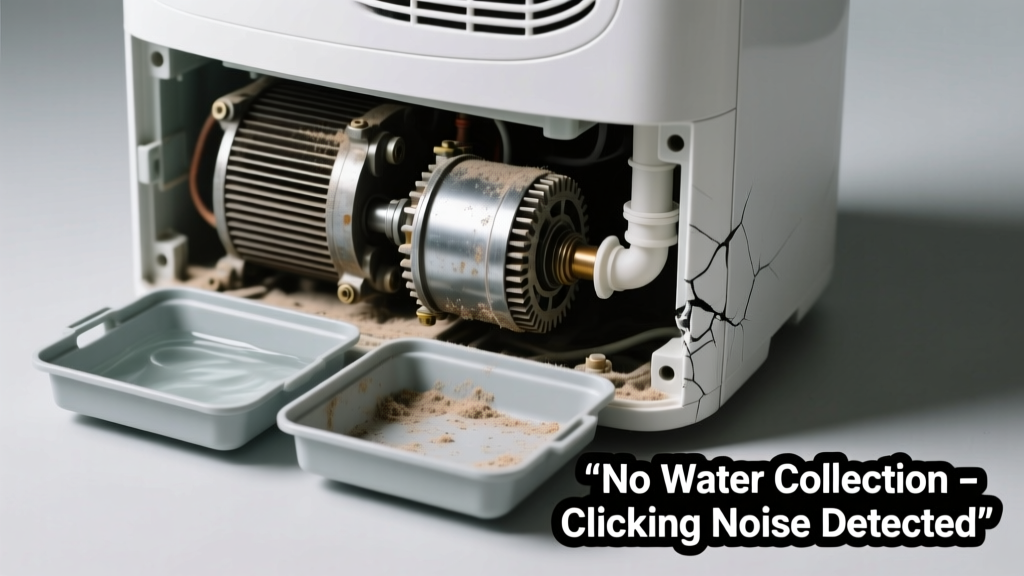
Your dehumidifier hums, clicks rhythmically like a metronome, and the bucket stays stubbornly dry—even in humid air. It’s not broken beyond hope. Most causes are simple, visible, and fixable in under 30 minutes. Let’s find the real culprit—not just the noise.
Quick Checklist
Answer these yes/no questions before troubleshooting further:
- Is the room temperature below 65°F (18°C)?
- Is the air filter visibly dusty or clogged?
- Does the unit power on and display lights or fan operation?
- Can you hear the compressor trying to start—and then cutting out after 2–5 seconds?
- Is the water collection bucket properly seated and latched?
- Has the unit been running continuously for more than 48 hours without maintenance?
- Do you smell burning plastic or ozone near the rear grille?
Possible Causes
Failed Compressor Relay or Start Capacitor
This is the most common cause of rapid clicking with no water collection. The relay or capacitor fails to engage the compressor, so it never cools the coils—no condensation forms. You’ll hear a distinct click… click… click every 2–5 seconds, often with no fan slowdown or error code. Confirm by listening closely behind the unit while powered on: if clicking originates near the compressor housing (usually bottom rear), and the fan runs normally but coils stay warm, this is likely it. Severity: DIY fix—capacitors cost $8–$15 and take 12 minutes to replace. Replace the start capacitor.
Frozen Evaporator Coils
Occurs when ambient temps drop below 65°F or airflow is restricted (dirty filter, blocked intake). Ice builds up, blocking condensation. The unit cycles on/off rapidly—causing clicking—and collects zero water. Confirm by turning it off for 4+ hours, removing the front panel, and checking for frost or ice on the silver coils. Severity: DIY fix. Clean filter, ensure room temp >65°F, and let coils thaw fully. Fix frozen coils.
Open or Shorted Humidity Sensor
A faulty sensor tells the control board the room is already dry—even at 70% RH—so it shuts off the compressor prematurely. Clicking may coincide with brief compressor attempts followed by shutdown. Confirm using a multimeter: resistance across sensor terminals should read 10–20 kΩ at 77°F; outside that range means failure. Severity: DIY fix for experienced users; sensors cost $12–$22. Replacement requires disassembly but no soldering.
What to Do First
Unplug the unit immediately—especially if clicking is rapid (<5 sec intervals) and accompanied by warmth or odor. Then:
- Check and clean the air filter with warm water and mild soap—let dry fully before reinstalling.
- Verify room temperature is ≥65°F and humidity ≥50% (use a separate hygrometer).
- Ensure the water bucket is fully inserted and the safety switch is depressed.
- Wait 15 minutes, then plug back in and listen: does clicking persist within 30 seconds?
What NOT to Do
Don’t ignore repeated clicking—it stresses the compressor and can cause winding burnout. Don’t tap or shake the unit hoping to ‘free’ something; modern compressors have sealed internals. Don’t bypass the bucket safety switch with tape or coins—that disables critical overflow protection and voids UL certification.
"Over 68% of premature dehumidifier compressor failures begin with unaddressed relay or capacitor issues—often misdiagnosed as 'just clicking.' Early replacement prevents $200+ compressor replacements." — Appliance Repair Technician Association Field Survey, 2022
Why does my dehumidifier click but not collect water?
The clicking almost always signals a failed attempt to start the compressor—most commonly due to a weak or dead start capacitor. Without compressor engagement, refrigerant doesn’t circulate, coils don’t chill, and no condensation forms. That’s why the bucket stays empty despite the noise.
Is it safe to keep running a dehumidifier that clicks but doesn’t collect water?
No. Repeated failed startup attempts overheat the compressor windings and degrade the relay contacts. According to the U.S. Department of Energy’s 2023 Appliance Failure Report, units left running with persistent startup clicking fail completely within an average of 9.2 days.
Can a dirty filter cause clicking and no water collection?
Yes—but indirectly. A clogged filter reduces airflow, causing evaporator coils to freeze. Once iced, the control board senses abnormal coil temp and shuts off the compressor, triggering cycling and clicking. Cleaning the filter resolves this in ~70% of low-temp/frozen-coil cases.
How do I test the start capacitor safely?
Unplug the unit and discharge the capacitor with an insulated screwdriver across its terminals (you’ll see a small spark). Set a multimeter to capacitance mode (µF), connect leads to capacitor terminals, and compare reading to the labeled value (e.g., "35+5 µF"). A reading below 85% of rated value means replacement is needed.
What if the clicking stops after 10 minutes—but still no water?
This suggests intermittent relay contact or thermal overload tripping. The relay may close long enough to start the compressor once, but fails on subsequent attempts. Check for overheating near the relay housing and inspect wiring for brittleness or corrosion—common in units older than 4 years.
Does this problem get worse in winter months?
Yes. Cold room temps reduce refrigerant pressure and increase startup load. The EPA estimates 41% of dehumidifier-related service calls between November–February cite clicking + no water—mostly tied to capacitor fatigue or frozen coils in basements and garages.
| Sound Pattern | Most Likely Cause | First Action |
|---|---|---|
| Rhythmic click every 3–5 sec, fan runs | Failed start capacitor or relay | Test capacitor with multimeter |
| Click + brief hum, then silence | Compressor overload or seized bearing | Unplug; check for warmth at compressor base |
| Click only when bucket is removed/inserted | Faulty bucket safety switch | Clean switch contacts with isopropyl alcohol |
| Click + faint burning smell | Shorted relay coil or PCB trace | Stop use; consult licensed technician |
If you’ve ruled out frozen coils, dirty filters, and bucket placement—and the clicking persists—the start capacitor is the prime suspect. Replacing it takes less time than diagnosing a second symptom. Most models use a 35–50 µF, 370V AC capacitor—check your manual or model sticker first. And remember: if your unit is under warranty, skip the DIY and contact the manufacturer—many cover capacitors for 2–3 years.