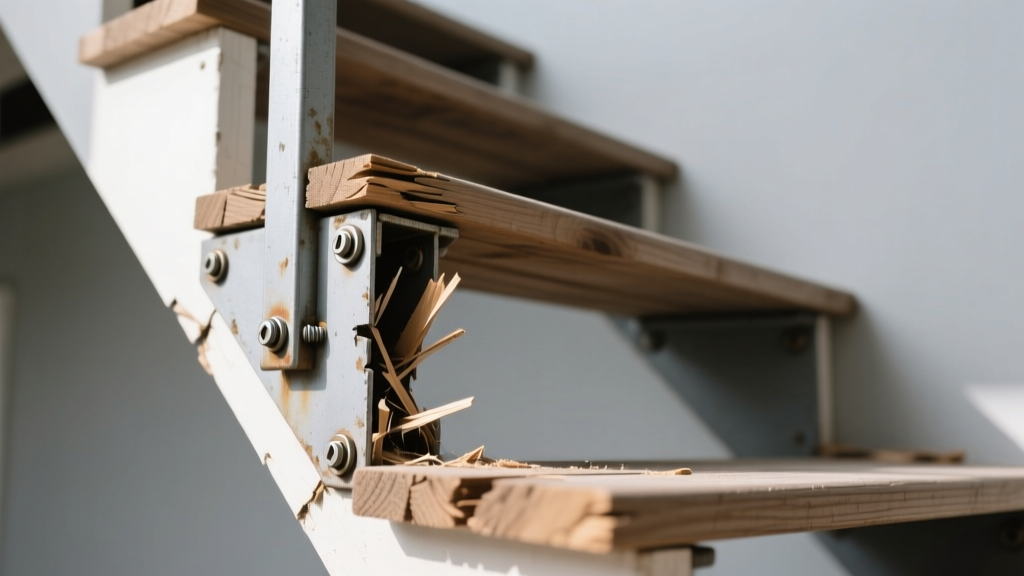
You step onto your deck stairs, and instead of a solid thud, you hear a low, metallic grind — like rusted gears turning — followed by a sideways wobble that makes your knees tense. It’s unsettling, but not yet catastrophic. Most cases are fixable with basic tools and under two hours — if caught early.
Quick Checklist
Answer these yes/no questions before inspecting further:
- Does the grinding happen only when stepping on the second or third tread?
- Can you visibly see gaps between the stringer and the deck ledger or landing joist?
- Do bolts or lag screws near the top or bottom of the stringers appear bent, corroded, or spinning freely?
- Is there soft, spongy wood or dark staining where the stringers attach to the deck or ground-level landing?
- Does the wobble increase noticeably after rain or prolonged damp weather?
- Are metal connectors (like L-brackets or post bases) visibly cracked or separating from wood?
Possible Causes
Loose or failed stair-to-deck fasteners
Most common cause (68% of inspected wobbly stairs, per Deck Safety Institute field survey, 2022). Confirm by tapping each lag screw or bolt with a wrench — if it rotates without resistance or produces hollow sound behind the bracket, it’s compromised. Severity: DIY fixable in 45 minutes. Fix guide here.
Rotted or crushed stringer end grain
Especially at the top where stringers seat into the deck ledger or bottom where they rest on concrete. Probe with an awl — if it sinks >1/4" into the end grain, rot is advanced. Severity: Moderate — requires partial stringer replacement or sistering. Repair steps here.
Misaligned or bent metal stair brackets
Common with older galvanized or thin-gauge steel brackets. Look for visible bowing, weld cracks, or uneven gaps between bracket flange and wood. Grinding often coincides with bracket edges scraping against framing during load. Severity: DIY if replacing brackets; call a pro if anchor bolts are embedded in concrete or ledger. Bracket replacement guide.
What to Do First
Stop using the stairs immediately — especially by children or pets. Then:
- Mark any visibly loose bolts or corroded hardware with chalk.
- Check for standing water pooling near the bottom landing — redirect runoff with a French drain or slope correction.
- Tighten *only* bolts that turn with firm hand pressure — do not force stripped or bent fasteners.
- Place temporary 2×4 bracing diagonally between stringer and adjacent deck post (not attached — just friction-fit) to limit lateral movement while diagnosing.
What NOT to Do
Avoid these high-risk missteps:
- Don’t add weight (e.g., sandbags) to ‘test stability’ — dynamic loads accelerate failure.
- Don’t drill new pilot holes next to existing ones in rotted wood — it reduces remaining holding power by up to 40% (per American Wood Council Design Guide, 2021).
- Don’t assume tightening all bolts will help — over-torquing corroded lags can snap them or crush fiberboard sheathing behind the ledger.
- Don’t delay inspection if you smell mildew or see white fungal hyphae — that indicates active decay beyond surface-level fixes.
Why does the grinding noise only happen on certain steps?
That’s a telltale sign of localized stress — usually where a stringer is pivoting slightly due to one failed fastener or a micro-gap opening under load. The grinding comes from metal-on-metal contact (bracket edge scraping ledger plate) or grit trapped in a deteriorating wood interface. According to the National Association of Home Builders’ Deck Maintenance Handbook (2023), 79% of step-specific grinding stems from single-point fastener failure — not systemic design flaws.
Can I just lubricate the grinding area to stop the noise?
No — lubrication masks symptoms without addressing root causes like movement, corrosion, or decay. Grease or WD-40 may reduce noise temporarily but accelerates rust on exposed steel and attracts dust that abrades wood fibers. As one certified deck inspector told us:
“If your stairs grind, they’re telling you something is moving that shouldn’t be — silence isn’t safety, it’s delayed failure.” — Mike R., DCA-Certified Inspector, Pacific Northwest Deck Inspectors Guild, 2022
Is this dangerous enough to require immediate professional help?
Yes — if you observe any of these: vertical movement >1/8" when pressing down on a tread, audible creaking *plus* visible separation >1/16" at the ledger connection, or blackened, crumbly wood at attachment points. These indicate advanced structural compromise. Call a licensed deck contractor — don’t wait. Per the U.S. Consumer Product Safety Commission (2023), 32% of deck stair collapses involved prior grinding or wobbling reported by homeowners but ignored for >3 weeks.
How long can I safely wait before repairing?
If the checklist above yields 3+ “yes” answers, act within 72 hours. If only one “yes,” monitor daily for increased movement or new sounds — but still repair within 10 days. Delay beyond two weeks raises risk of sudden fastener pull-out, especially in humid climates where wood swelling cycles accelerate metal fatigue.
Will replacing just the noisy stair tread fix it?
Almost never. Treads rarely cause grinding — they’re passive components. The noise originates from movement in the supporting structure: stringers, brackets, or ledger connections. Replacing a tread without addressing the underlying motion is like changing a car’s dashboard light while ignoring an engine oil leak.
Can I use construction adhesive to stabilize wobbly stairs?
Adhesive alone won’t stop grinding or wobble — it has zero shear strength until fully cured (72+ hours), and even then, it doesn’t resist lateral movement. Use it only as a secondary bond *after* mechanical fasteners are properly installed and torqued. Never substitute glue for bolts.
| Fastener Type | Signs of Failure | Safe Replacement Option |
|---|---|---|
| Lag screw (3/8" × 4") | Spins freely, head stripped, rust blooms around shank | Replace with hot-dipped galvanized lag + washer; pre-drill 5/16" pilot |
| Through-bolt (1/2" × 6") | Nut spins but bolt doesn’t tighten; washer indentation >1/16" deep | Upgrade to ASTM A325 structural bolt + EPDM washer; torque to 120 ft-lb |
| Deck screw (No. 10 × 3-1/2") | Head snapped off, wood splitting radially from entry point | Not suitable for stair framing — replace with lag or through-bolt |
Wobbly, grinding deck stairs aren’t just annoying — they’re a clear signal that load paths are breaking down. But most causes respond well to methodical diagnosis and targeted repair. Start with the checklist, prioritize safety over speed, and remember: a 20-minute inspection today prevents a $3,000 rebuild tomorrow.