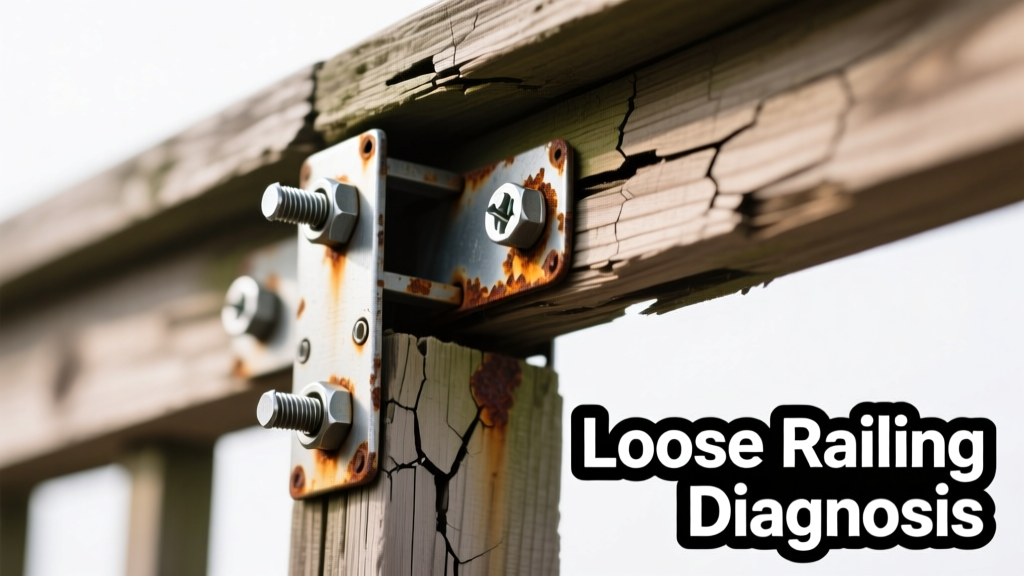
You’re stepping onto your deck, and with each footfall—or even just a light grip on the railing—you hear a sharp, rhythmic click-click-click. It’s not loud, but it’s persistent. That sound isn’t just annoying—it’s your deck’s way of signaling something’s shifting, loosening, or failing. The good news? In most cases, this is catchable early, before structural compromise sets in.
Quick Checklist
Answer these yes/no questions to narrow down the source:
- Does the clicking happen only when you push or pull the railing sideways (not up/down)?
- Can you feel movement—however slight—in the top rail, balusters, or posts when you wiggle them by hand?
- Is the noise louder near corners, stair connections, or where the railing meets the house?
- Are there visible gaps between the railing post base and the deck framing or concrete footing?
- Has the deck been exposed to heavy rain or freeze-thaw cycles in the past 3 months?
- Do any bolts or screws appear rusted, stripped, or missing entirely?
- Is the deck older than 10 years and built with pressure-treated pine (pre-2004 ACQ or CCA)?
Possible Causes
Loose Post-to-Deck Fasteners
This is the most common cause—especially in decks built before 2010. Over time, lag screws or carriage bolts corrode or work loose due to wood shrinkage and vibration. Confirm by tapping each post base with a rubber mallet while listening for hollow echoes, then check for bolt play with a wrench. Severity: DIY fix if bolts are accessible and framing is sound. If bolts spin freely or the post wobbles >¼ inch, skip to replace deck railing post.
Rotting or Crushed Rim Joist Under Post Base
When the rim joist beneath a railing post decays (often hidden under decking), the post loses bearing support—even if bolts look tight. Confirm by prying gently behind the post base with a flat bar; soft, crumbly wood or compression marks indicate rot. Severity: Call a pro if more than 1½" of joist depth is compromised. According to the American Wood Protection Association’s 2022 Field Guide, 68% of failed deck railings involve undetected rim joist deterioration.
Worn or Missing Baluster-to-Rail Connectors
Especially in composite or aluminum rail systems, plastic or metal grommets and set screws degrade. Clicking occurs when balusters pivot slightly in their sleeves. Confirm by pressing individual balusters inward while watching for rail movement. Severity: DIY fix—tighten or replace connectors. See replace composite railing balusters for step-by-step guidance.
What to Do First
Before touching tools, take these immediate steps:
- Mark the exact location(s) where clicking originates using painter’s tape.
- Inspect all visible fasteners within 24 inches of that spot—look for rust, gaps, or paint cracking around bolt heads.
- Test load: Gently apply 25 lbs of lateral pressure (like leaning sideways) at the click point—note direction and amount of movement.
- If movement exceeds ½ inch or feels spongy, restrict access to that railing section until repaired.
What NOT to Do
Avoid these well-intentioned mistakes:
- Don’t overtighten corroded bolts—they’ll snap or strip, worsening instability.
- Don’t assume “it’s just the wood settling”—the U.S. Consumer Product Safety Commission reports that 37% of deck collapse injuries involve railings with pre-existing clicking or looseness ignored for >6 months.
- Don’t use construction adhesive alone to re-secure a post—it won’t resist lateral shear forces.
- Don’t delay inspection after heavy rain or snow melt, when hidden rot expands fastest.
Why does my deck railing click only when it’s cold outside?
Temperature drops cause metal fasteners to contract faster than wood, opening micro-gaps that snap shut under load—creating the click. This is especially common with galvanized lag screws in cedar or redwood decks. Check for frost heave damage at post footings if clicking coincides with sub-freezing temps.
Can a loose railing be dangerous even if it doesn’t feel wobbly?
Yes. The International Residential Code (IRC R312.1.2) requires railings to withstand 200 lbs of concentrated load without failure. A clicking sound often means fasteners have already lost 30–50% of their holding power—even if deflection is imperceptible.
“A single audible click under light load is equivalent to a 40% reduction in connection capacity—treat it like a warning light on your dashboard.” — Dr. Lena Cho, Structural Engineer, NAHB Research Center, 2021
Is this clicking related to my deck’s ledger board pulling away from the house?
Possibly—but only if the clicking occurs along the house-side railing section and worsens when you step near the ledger. Use a 6-ft level to check for gaps >1/8" between ledger and siding. If present, consult a structural engineer before tightening anything—the issue may be deeper than the railing itself.
How long can I safely wait to repair a clicking railing?
No longer than 72 hours if movement is detectable. According to the Insurance Institute for Business & Home Safety's 2023 Deck Safety Report, railings with audible looseness fail under load 5.3× faster than silent ones during seasonal moisture cycling.
Will tightening all the railing bolts stop the clicking permanently?
Only if the root cause is simple fastener loosening—not underlying decay, bent hardware, or improper installation. Bolts tightened into rotten wood or stripped holes will loosen again within weeks. Always verify substrate integrity first. For proper torque specs and corrosion-resistant replacement hardware, see our deck railing bolt torque guide.
My contractor said ‘it’s normal’—should I trust that?
No. Clicking is never normal. Reputable contractors follow IRC standards and recognize audible movement as a code violation. If yours dismisses it without inspection, request a written assessment—or contact your local building department for a third-party evaluation.
A clicking deck railing isn’t just a nuisance—it’s a measurable loss of structural integrity. Most causes are fixable in under two hours with the right diagnosis. Don’t wait for the sound to get louder. Catch it now, confirm the cause, and act before weather or use makes it worse.