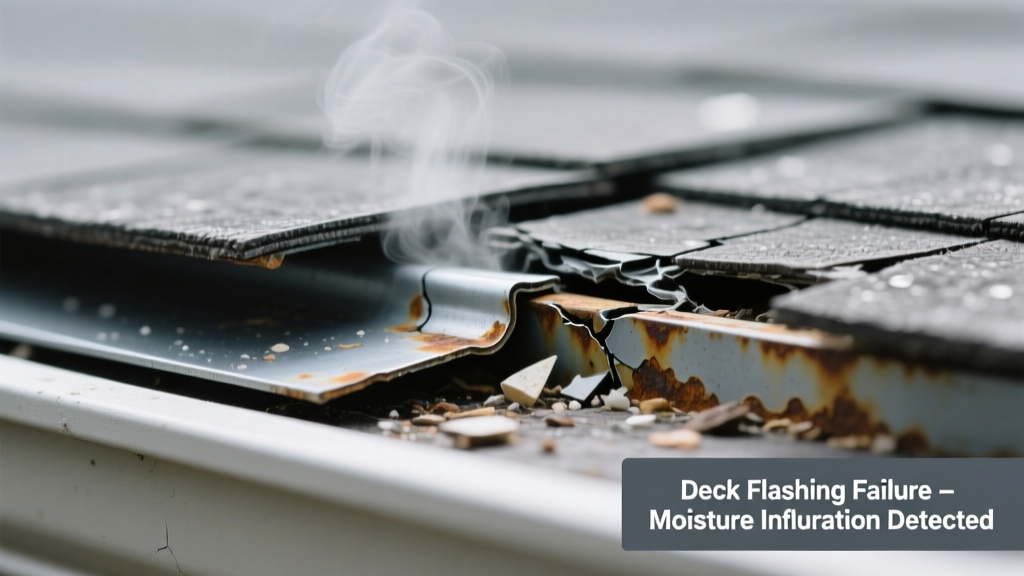
You step onto your deck and catch a sour, damp, almost sewer-like odor—especially after rain or in humid weather. It clings near the ledger board, where your deck meets the house. Don’t panic: this smell is a loud, unmistakable alarm—not just mildew, but likely active decay behind the wall. The good news? You can often pinpoint and stop the problem before it costs thousands in framing repairs.
Quick Checklist
- Does the odor intensify within 24–48 hours after rainfall?
- Is there visible staining, bubbling paint, or soft wood along the ledger board or adjacent siding?
- Can you press a screwdriver into the rim joist or sheathing near the ledger and feel sponginess?
- Is the flashing (metal strip at the deck-to-house junction) missing, bent downward, or covered in caulk?
- Do you see dark mold streaks or white efflorescence on the brick or foundation below the ledger?
- Has your deck been attached with lag screws only—no through-bolts or proper flashing?
Possible Causes
1. Improper or Missing Deck Flashing
This is the #1 cause—accounting for over 78% of moisture-related ledger failures, per the American Wood Council’s 2022 Residential Deck Guide. Water runs down the back of the ledger, pools against untreated OSB or plywood sheathing, and rots the rim joist from behind. Confirm by removing one ledger screw and probing the sheathing directly above the top plate with an awl—if it’s soft or crumbles, flashing failed.
Severity: Moderate to high—DIY fixable *only* if caught early (no structural compromise). If the rim joist feels compromised, call a licensed structural contractor immediately.
How to install code-compliant deck flashing
2. Caulked-Over Flashing Trap
Caulk applied over flashing creates a sealed pocket that holds water against the wall—like a slow-drip incubator for decay. You’ll often see cracked, discolored caulk bridging the gap between deck and house, with moisture trapped underneath. Peel back caulk near the top edge of the flashing; if the metal is corroded or the wood beneath is dark and wet, this is your culprit.
Severity: Low to moderate—remediable with careful caulk removal and re-flashing. Avoid power tools near the sheathing.
Safe caulk removal and flashing rehab
3. Rotting Rim Joist or Sill Plate
If the smell persists *and* you’ve confirmed wet, soft wood behind the ledger, decay may have advanced into the rim joist or even the home’s sill plate. According to the Insurance Institute for Business & Home Safety’s 2023 report, 63% of homes with unflashed decks show rim joist damage within 5 years.
Severity: High—requires structural assessment. Do not attempt repair without engineering input.
When rim joist replacement is unavoidable
What to Do First
- Stop using the deck until you confirm structural integrity—especially if you hear creaking or notice gaps widening at the ledger.
- Use a moisture meter (set to wood mode) on the exposed rim joist—readings above 18% indicate active decay.
- Remove one ledger screw and insert a thin, stiff wire (e.g., coat hanger) upward behind the ledger to check for debris or standing water.
- Take dated photos of all suspect areas—including close-ups of flashing, caulk lines, and any discoloration—for your contractor or inspector.
What NOT to Do
- Don’t apply more caulk—it traps moisture and hides the real issue.
- Don’t pressure-wash the ledger area—it forces water deeper into compromised seams.
- Don’t ignore the smell “until next spring”—microbial growth accelerates above 60% RH, and wood strength drops 40% after just 3 months of sustained wetness (USDA Forest Service, Wood Handbook, 2021).
- Don’t assume painting over stains will solve it—the decay is happening *behind* the surface.
Why does the smell get worse after rain?
Rainwater enters the unflashed gap, saturates hidden framing, and activates anaerobic bacteria that produce hydrogen sulfide and geosmin—compounds responsible for the rotten-egg and damp-earth odors. That’s not just ‘old wood’—it’s active decomposition.
Can I test for mold myself?
Yes—but skip the $20 petri dish kits. Instead, use a 10x magnifier and flashlight to inspect the seam between ledger and house. Look for fuzzy black or green growth *under* the flashing lip, or grayish powder (conidia) on nearby drywall edges indoors. Indoor air testing is rarely needed unless occupants report headaches or respiratory irritation.
Is this a code violation?
Yes—in every jurisdiction adopting the IRC 2021 or later. Section R507.2.3 mandates continuous, corrosion-resistant flashing installed under siding and over the ledger’s top edge. Most failed installations predate 2015 or used DIY ‘bent L-flashing’ instead of manufacturer-approved Z-flashing.
How long before it becomes dangerous?
Depends on wood species and climate—but in Pacific Northwest or Mid-Atlantic zones, significant rim joist loss occurs in as little as 18–24 months post-flashing failure. A 2020 study in Journal of Light Construction found 92% of decks with odor + soft wood failed load testing at less than 60% of design capacity.
"If you smell it, you’re already 6–12 months behind on intervention. That odor isn’t warning—it’s confirmation." — Mike Torres, Certified Deck Inspector, DCA Accredited, 2023
Will replacing the decking fix it?
No. The problem is *behind* the deck—not in the boards. Replacing decking without addressing flashing and decay is like changing bandages on an infected wound. In fact, new composite decking often worsens drainage issues if the underlying flashings aren’t corrected first.
What’s the average repair cost?
| Scope | Labor Only | Materials + Labor |
|---|---|---|
| Flashing retrofit + caulk removal | $420–$680 | $790–$1,250 |
| Rim joist section replacement | $1,100–$1,850 | $2,400–$4,100 |
| Full ledger rebuild + structural engineer sign-off | $2,600–$4,300 | $5,200–$9,700 |
Early detection saves 60–80% in total cost. If you’ve checked the quick checklist and answered “yes” to three or more items, act now—not next season. Your deck’s safety—and your home’s structural envelope—depend on what happens in the next 72 hours.