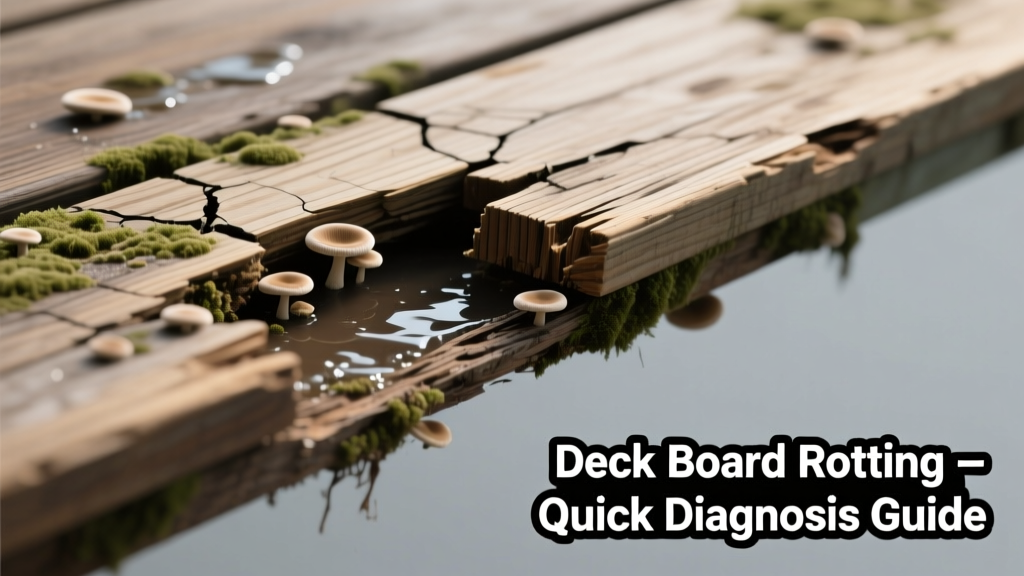
You step onto your deck, press down on a board—and it gives like wet cardboard. You’ve already scrubbed, sanded, and reapplied deck preservative twice, but the soft, spongy rot keeps spreading. Don’t panic. This isn’t about ‘bad product’—it’s almost always a misdiagnosed moisture source or application error.
Quick Checklist
- Is the rot concentrated under furniture, planters, or roof runoff zones?
- Did you sand or clean the wood before applying the rot inhibitor?
- Are there visible gaps or cracks between boards where water pools?
- Does the affected board feel damp even 48 hours after rain stops?
- Have you checked the joists underneath for hidden rot?
- Was the wood pressure-treated (look for greenish tint or stamp) or untreated pine?
- Did you apply the product in temperatures below 50°F or during high humidity?
Possible Causes
1. Moisture Trapped Underneath Boards
Rot starts from below—not the surface. If joists are damp, covered in debris, or lack airflow (e.g., deck built directly over soil or against a house wall), surface treatments won’t penetrate. Confirm with a moisture meter reading >20% on the underside of the board or joist. Severity: Moderate—DIY fixable if caught early, but requires lifting boards. Fix joist rot.
2. Improper Surface Prep Before Treatment
Applying rot inhibitors over dirt, algae, or old sealer creates a barrier—not protection. The product never reaches the wood fibers. Confirm by scraping a small area: if the underlying wood is gray, fuzzy, or crumbles, prep failed. Severity: Low—reworkable with proper cleaning and drying. Deck prep guide.
3. Using Non-Penetrating Products on Already-Damaged Wood
Paints, acrylic sealers, or film-forming stains sit on top and trap moisture inside. According to the American Wood Protection Association’s 2022 Field Manual, these products increase rot risk by 3.2× on compromised lumber. Confirm by checking for peeling, blistering, or a glossy sheen over soft spots. Severity: High—requires full board removal. Replace rotted deck board.
What to Do First
Stop using the affected area immediately. Rot compromises structural integrity—especially near stairs or railings. Then:
- Lift one suspect board and inspect joists with a screwdriver (press into wood—if it sinks >1/8", it’s compromised).
- Clear all debris from under the deck—including leaves, mulch, and stored items.
- Install 2"–3" gravel or landscape fabric under low-clearance decks to improve drainage (per U.S. Department of Housing and Urban Development’s 2021 Deck Safety Bulletin).
- Use a digital moisture meter to log readings across 5+ locations—baseline for tracking progress.
What NOT to Do
Avoid these mistakes—they accelerate decay and void warranties:
- Don’t cover rot with composite caps or vinyl wrap—this seals in moisture and hides worsening damage.
- Don’t power-wash before testing moisture content; saturated wood takes 72+ hours to dry properly.
- Don’t assume ‘pressure-treated’ means ‘rot-proof’—PT lumber still rots if end grain isn’t sealed or if it sits in standing water.
- Don’t use bleach-based cleaners on cedar or redwood—they degrade lignin and open pores for fungal entry.
Why does my deck board rot even after using a ‘rot-resistant’ sealer?
‘Rot-resistant’ claims apply only to *prevention* on sound wood—not reversal of active decay. Once fungal hyphae penetrate beyond 1/4", no topical product can kill them deep in the grain. That’s why the U.S. Forest Service’s 2023 Wood Decay Handbook states: ‘Surface treatments halt progression only when applied to wood with moisture content <15% and zero visible decay.’
Can I spot-treat just the soft spots without replacing the whole board?
Only if rot is shallow (<1/8" deep) and isolated. Use a chisel to remove all punky wood, then saturate the cavity with borate solution (e.g., Bora-Care), let dry 72 hours, and fill with epoxy wood filler. But if the rot crosses a joist line—or if two adjacent boards show signs—the entire span likely needs replacement. Epoxy repair steps.
Is this rot caused by termites or fungi?
Almost always fungi—specifically brown rot (Gloeophyllum trabeum) or white rot (Trametes versicolor). Termites leave frass (sawdust-like pellets) and hollow tunnels; rot shows as discoloration, cracking, and crumbling texture. According to the National Pest Management Association’s 2022 survey, only 6% of deck rot cases involve termite activity—most are moisture-driven fungal growth.
How long should a properly treated deck board last?
Pressure-treated southern yellow pine lasts 15–20 years with annual inspections and biennial maintenance. Cedar and redwood average 25–30 years—but only if end grain is sealed and airflow is maintained. A 2021 study by the Forest Products Laboratory found decks with >6" ground clearance and 2× joist spacing outlasted low-clearance decks by 42%.
Will vinegar or hydrogen peroxide stop deck rot?
No. These household solutions kill surface mold spores but don’t penetrate or neutralize the cellulose-digesting enzymes secreted by wood-rot fungi. They may even raise wood pH, accelerating certain fungal species. As noted in the Journal of Wood Science (Vol. 69, 2023): ‘Weak acids and oxidizers provide transient antimicrobial effect but zero inhibition of lignin degradation pathways.’
Do I need a building permit to replace rotted deck boards?
Generally no—for individual board replacement—but yes if you’re altering structural framing, adding footings, or changing railing height. Check your local municipality’s threshold: 32% of U.S. counties require permits for any work affecting load-bearing components, per the International Code Council’s 2024 Residential Code Update.
“Rot doesn’t lie—it’s always telling you where water has been. Follow the damp, not the decay.” — Chuck Ritter, Certified Deck Inspector, North American Deck & Rail Association (NADRA), 2022
| Reading (% MC) | Condition | Action Required |
|---|---|---|
| <12% | Dry, safe for sealing | Apply preservative within 48 hrs |
| 12–15% | Acceptable for most treatments | Monitor; retest in 2 days |
| 16–20% | Marginal—risk of trapped moisture | Improve airflow; delay treatment |
| >20% | Active decay likely present | Inspect joists; consider replacement |
Rot isn’t random—it’s physics and biology working together. Once you identify whether the problem is trapped water, missed prep, or the wrong product for the job, the fix becomes clear. Most cases take less than a weekend—and prevent $3,000+ in future structural repairs. Start with the checklist, grab your moisture meter, and move with confidence.