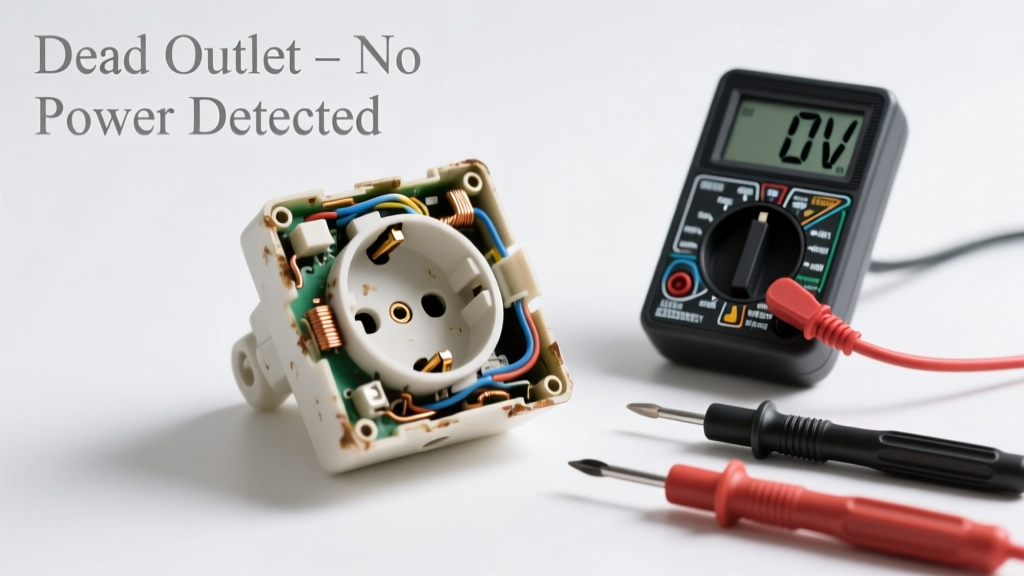
You flip the switch, plug in a lamp, and… nothing. No click, no buzz, no indicator light — just total silence. That dead outlet isn’t just inconvenient; it’s a clue. Most of the time, the fix is fast, safe, and within reach of a careful homeowner.
Quick Checklist
Answer these before grabbing tools or calling for help:
- Is the outlet controlled by a wall switch? (Check nearby switches — especially in bedrooms or living rooms)
- Has a GFCI outlet upstream tripped? (Look in bathrooms, kitchens, garages, basements, or outdoor outlets)
- Did any other outlets or lights go out at the same time?
- Does the circuit breaker for this outlet feel loose or appear slightly popped (not fully ON or OFF)?
- Is there visible damage — scorch marks, melted plastic, or a burning smell near the outlet or panel?
- Was there a recent power surge, storm, or appliance failure on that circuit?
Possible Causes
Tripped or Failed GFCI Outlet
Over 68% of single-outlet failures in kitchens and bathrooms stem from an upstream GFCI trip — not the outlet itself (National Electrical Manufacturers Association, 2022). Test every GFCI within 30 feet using its TEST/RESET buttons. If resetting restores power, the issue is resolved.
Severity: DIY-safe. How to reset a tripped GFCI outlet
Tripped or Faulty Circuit Breaker
Breakers can trip silently — appearing “on” but not conducting. Use a non-contact voltage tester at the outlet first. Then double-check the panel: toggle the suspected breaker fully OFF, then back ON. If it trips again immediately, stop and call a pro.
Severity: DIY-safe *unless* it trips repeatedly. How to reset a tripped circuit breaker
Loose or Disconnected Wire Behind the Outlet
Vibration, age, or improper installation can loosen terminal screws or push-in connections. This causes intermittent or total failure — often with no visible signs. Only inspect after confirming power is OFF at the breaker and verifying with a tester.
Severity: Intermediate DIY — requires safety discipline. How to tighten loose outlet wires
What to Do First
Before touching anything: turn OFF the circuit breaker supplying the dead outlet. Verify it’s off using a non-contact voltage tester at the outlet faceplate screws and slots. Then check GFCIs and breakers as outlined above. Document which breaker controls the outlet — label it if unmarked. According to the U.S. Consumer Product Safety Commission, 12% of home electrical injuries occur during troubleshooting without verified lockout.
"Never assume a breaker is off just because it looks centered — always test. A ‘phantom’ live circuit is the top cause of DIY shock incidents." — Licensed Master Electrician Maria Lin, NEC Code Trainer, 2023
What NOT to Do
- Don’t replace the outlet without verifying power is truly OFF — even if the breaker is flipped.
- Don’t use outlet testers alone — they can give false negatives on open neutrals or shared neutrals.
- Don’t daisy-chain power strips or extension cords to bypass the dead outlet — this overloads circuits and hides real problems.
- Don’t ignore scorch marks or buzzing sounds — these indicate arcing, a leading cause of residential fires (NFPA Electrical Fire Report, 2021).
Is the outlet controlled by a hidden wall switch?
Many builders wire switched outlets — especially in living rooms or bedrooms — to control lamps or TVs. Look for blank wall plates, unusual switch placements (e.g., near doorways), or switches that seem to do nothing. Flip each one while testing the outlet with a known-working device like a phone charger.
Could this be a shared neutral or multi-wire branch circuit issue?
If only one outlet is dead but others on the same breaker work fine, suspect a broken neutral connection — especially if the outlet shows 120V between hot and ground but 0V between hot and neutral. This requires metering and is best handled by a licensed electrician. The National Fire Protection Association notes shared-neutral faults account for 9% of unexplained outlet failures in homes built 1980–2005.
Why does the outlet test as live with a non-contact tester but still not power devices?
A non-contact tester detects voltage presence — not load capacity. A broken neutral or high-resistance connection (e.g., corroded wire nut) can let voltage “leak” to the hot side while preventing current flow. Confirm with a multimeter: measure voltage hot-to-neutral (should be 110–125V) and hot-to-ground (same range). A mismatch >5V signals a neutral fault.
Is this outlet part of an AFCI-protected circuit?
Since 2014, AFCI breakers are required in bedrooms, living areas, and hallways (NEC 210.12). These detect dangerous arcing — and may trip without obvious cause. Check your panel for breakers labeled “AFCI” or with a TEST button. Press TEST, then RESET. If it won’t hold, the circuit has an arc fault — often in damaged cordage or backstabbed outlets.
When should I call a licensed electrician instead of DIY?
Call immediately if you find: burn marks, melted insulation, repeated breaker trips, aluminum wiring (common in homes built 1965–1973), or if the outlet serves critical loads (refrigerator, sump pump, medical equipment). Also call if voltage readings are inconsistent across hot/neutral/ground terminals — that points to panel-level issues or utility-side faults. The Insurance Institute for Business & Home Safety estimates 32% of electrical insurance claims involve DIY attempts without proper verification steps.
Most dead outlets aren’t emergencies — but they’re rarely random. With methodical checking, you’ll either restore power in minutes or gather precise information for a pro. Either way, you’ve eliminated guesswork and protected your home’s safety baseline.
| Clue | Most Likely Cause | Next Step |
|---|---|---|
| No power to multiple outlets in same room | Tripped GFCI or AFCI breaker | Reset all GFCIs + test AFCI breaker |
| Single outlet dead, others on same breaker work | Loose wire or failed outlet | Power off → inspect terminals → test continuity |
| Outlet works briefly, then dies | Failing internal contacts or overheating | Replace outlet — don’t reuse old one |
| Burning smell or discoloration | Overheated connection or arc fault | Turn OFF breaker → call electrician immediately |