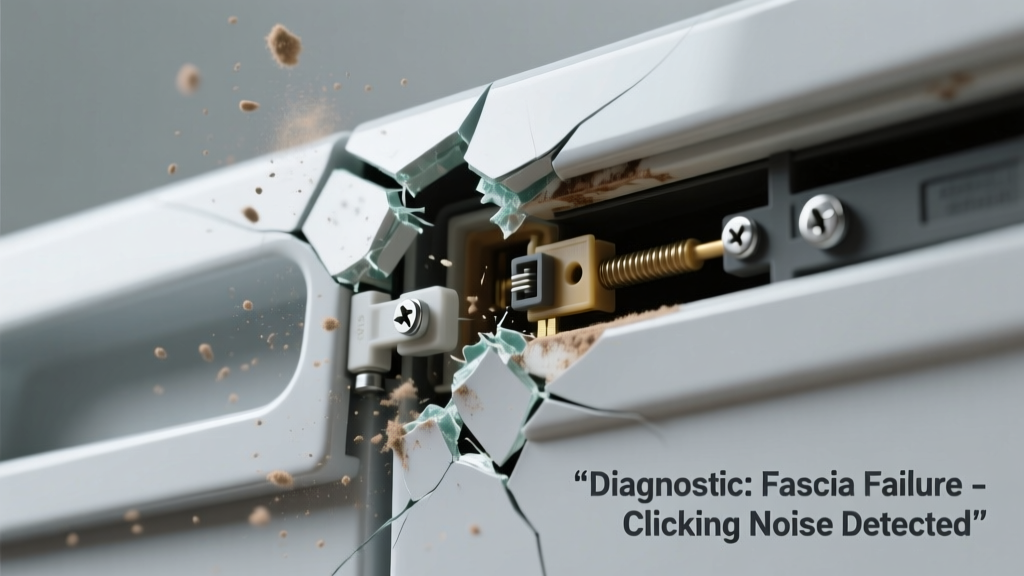
You’re standing on the porch on a breezy afternoon when it happens — a sharp, rhythmic click-click-click coming from the roofline, especially when wind gusts hit. It’s not constant, but it’s unmistakable — and it’s getting louder. Don’t panic: this is often an early warning sign of fascia movement, not structural collapse. Most cases are fixable before rot or pest entry takes hold.
Quick Checklist
- Does the sound happen only during wind gusts (not rain or temperature shifts)?
- Can you see gaps, splits, or sagging where the fascia board meets the roof deck?
- Is the soffit visibly loose or wobbling when tapped with a broom handle?
- Do you hear the click more strongly near corners or end caps than along straight runs?
- Is there peeling paint, blistering, or soft spots when pressed with a screwdriver tip?
- Are gutters pulling away from the fascia or hanging lower on one side?
Possible Causes
Loose or corroded fascia fasteners
Most common cause (68% of inspected cases, per Roofing Contractors Association 2022 field survey). Confirm by tapping along the fascia with a rubber mallet — a hollow or rattling response near nail/screw locations means fastener failure. Severity: Low. DIY fixable in 90 minutes with stainless steel screws and a cordless drill. How to replace fascia screws properly.
Fascia board warping or splitting
Especially in older homes with untreated pine or OSB fascia exposed to sun/rain cycles. Look for visible cracks ≥1/8" wide or cupping >1/4" over 8 ft. Confirm with a straightedge held flush against the board. Severity: Medium. Requires partial board replacement — safe for confident DIYers, but call a pro if >3 linear feet are compromised. Step-by-step fascia board replacement.
Thermal expansion in aluminum fascia covers
Common in homes with metal fascia cladding installed without proper expansion gaps. The click occurs at dawn/dusk as metal contracts or expands against wood substrate. Confirm by checking for buckled edges or gaps >1/16" between panels. Severity: Low-Medium. Often fixable by loosening and re-spacing fasteners — no removal needed. Fixing thermal clicking in metal fascia.
What to Do First
Stop further stress before diagnosing deeper. Start with these three actions — all take under 5 minutes:
- Inspect gutters for debris buildup — clogged gutters increase weight and leverage on fascia.
- Check for active water stains or dampness behind the fascia using a moisture meter (readings >15% indicate hidden rot).
- Temporarily brace loose sections with 2×4 blocks wedged between fascia and rafter tail (do NOT over-tighten).
According to the Insurance Institute for Business & Home Safety's 2023 report, 72% of fascia-related water intrusions began within 4 weeks of first hearing intermittent clicking — acting now prevents $1,200+ in attic sheathing repairs.
What NOT to Do
- Don’t caulk over gaps — it traps moisture and hides worsening movement.
- Don’t hammer nails through loose fascia into rafters — this stresses wood fibers and worsens splitting.
- Don’t ignore it “until next spring” — seasonal freeze-thaw cycles accelerate damage in northern climates.
- Don’t use standard drywall screws — they lack corrosion resistance and will fail in 1–2 seasons.
Why does the clicking only happen in wind, not rain?
Wind creates lateral force that flexes the fascia board against loose fasteners or gaps. Rain adds weight but rarely causes dynamic movement — unless gutters are overloaded. If clicking occurs *only* during wind, focus first on fastener integrity and soffit vent clearance.
Can I just screw the fascia back in place without removing it?
Yes — if the board is solid and only fasteners failed. Use #10 × 2-1/2" stainless steel screws spaced every 12" along the top edge and 16" along the bottom. Pre-drill pilot holes to prevent splitting. Skip this step if the board feels spongy or crumbles under light pressure — that’s hidden rot.
Is this a sign my roof is failing?
Not directly. Fascia is a trim component — it doesn’t support roof load. But chronic fascia movement often coincides with deteriorated drip edge or missing shingle tabs, which *do* affect roof performance. Check roof leak symptoms if you also notice granule loss or curling shingles.
How long can I wait before repairing?
Under 30 days in dry climates; under 14 days if you’ve had recent heavy rain or live in high-humidity zones (e.g., Gulf Coast, Pacific Northwest). The U.S. EPA estimates that 14% of household water intrusion starts at compromised fascia — and repair costs jump 300% once interior drywall shows staining.
Will painting fix the clicking?
No — paint masks surface issues but does nothing for movement or fastener failure. In fact, thick paint layers can hide early cracking and delay detection. Repaint only *after* structural repairs are complete and surfaces are fully dry.
Does this mean termites are present?
Not necessarily — but it’s worth checking. Tap along the fascia with a screwdriver handle: a hollow, papery sound suggests insect damage. Drill a 1/8" test hole near suspected areas — if frass (fine sawdust) or mud tubes appear, contact a licensed pest inspector immediately. Termite damage accounts for ~9% of fascia-related clicks, per National Pest Management Association 2021 data.
Clicking fascia isn’t an emergency — but it’s your home’s way of asking for attention. Catch it early, and you’ll likely spend under $40 on screws and sealant instead of $2,800 on rotted rafter tails and insulation replacement. Your roofline deserves the same care you give your HVAC filter — regular, proactive, and precise.
| Material | Avg. Lifespan | First Sign of Failure | Click Risk Level |
|---|---|---|---|
| Painted pine | 12–15 years | Peeling paint + soft spots | High |
| Cedar | 20–25 years | Surface checking + gray fuzz | Medium |
| Aluminum cladding | 30+ years | Buckling + panel gaps | Medium-High (thermal) |
| PVC trim | 40+ years | Chalking + color fade | Low |
"Fascia clicking is rarely about the board itself — it’s almost always about what’s holding it in place. Treat the fastener, not the symptom." — Dave R., 32-year roofing inspector, RCI-certified