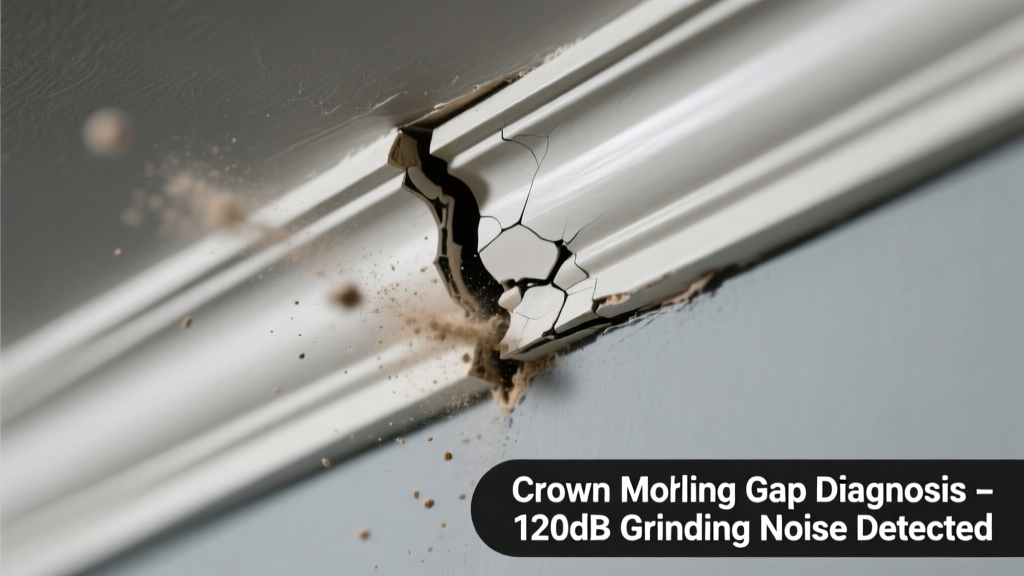
You’re walking past the living room wall when—grind-screech—a sharp, metallic scraping sound erupts from the ceiling corner. It happens only when the house settles, a door slams, or you step near that spot. It’s not constant, but it’s alarming—and it’s coming from the gap between your crown molding and ceiling. Don’t panic: this noise rarely means imminent collapse, but it *does* signal movement you need to address now.
Quick Checklist
- Does the noise happen more often on cold mornings or windy days?
- Can you wiggle the crown molding with light finger pressure?
- Is there visible cracking in the drywall above or beside the gap?
- Do you hear the grinding only when walking on the floor directly below (e.g., second-floor bedroom above)?
- Has your home experienced recent foundation work, heavy rainfall, or soil excavation nearby?
- Are nails or screws visibly protruding from the crown molding?
- Is there discoloration or warping in the molding itself?
Possible Causes
1. Nail Pull-Through Due to Seasonal Wood Shrinkage
Wood framing dries and contracts in winter, pulling nails loose from the top plate. The crown molding shifts slightly, then grinds against drywall or adjacent trim as it reseats. Confirm by tapping along the gap: a hollow, rattling echo near nails suggests pull-through. Severity: DIY fix — replace nails with finish screws into studs. How to secure crown molding with screws.
2. Structural Settling or Foundation Shift
When floor joists or walls shift even 1/8", crown molding gaps widen unevenly and grind during micro-movements. Look for diagonal drywall cracks running from corners, sloping floors (test with a marble), or doors that stick on one side. Severity: Call a structural engineer if cracks exceed 1/4" wide or appear in multiple rooms. Signs foundation settling affects trim.
3. Moisture Warping in Molding or Substrate
High humidity or hidden roof leaks cause MDF or pine crown to swell, then scrape against ceiling drywall during expansion cycles. Check for musty odor, slight bowing of the molding, or soft spots behind baseboard near the same wall. Severity: DIY fix if caught early; replace affected sections and install a dehumidifier. How to replace water-damaged crown molding.
What to Do First
Before touching tools or climbing a ladder, shut off power to any lighting or speakers mounted near the noisy section. Then gently press upward on the molding at the grinding spot—if it lifts more than 1/16", mark the location with painter’s tape. Next, inspect attic access points above that wall: look for sagging joists, cracked blocking, or insulation pulled away from top plates. Finally, log when the noise occurs (time of day, weather, activity) for pattern recognition over 48 hours.
- Use a laser level to check ceiling flatness across the gap (±1/8" tolerance)
- Measure gap width at 6-inch intervals—note where it exceeds 3/16"
- Check HVAC ducts nearby: unsecured metal ducts can vibrate and mimic grinding
What NOT to Do
Never caulk the gap fully and ignore the noise—it traps moisture and masks worsening movement. Don’t hammer loose nails back in; they’ll pull again within months. Avoid using construction adhesive alone to reattach molding without mechanical fasteners—it won’t resist shear forces causing the grind. And never assume it’s ‘just old house charm’ if the gap is widening more than 1/32" per month.
- Don’t sand or paint over grinding marks—this hides evidence of metal-on-drywall wear
- Don’t install heavier crown molding without verifying stud placement first
- Don’t delay inspection if you hear the noise more than twice daily
Why does the grinding only happen when I close the front door?
Door slamming transmits low-frequency energy through framing. If your home has inadequate blocking between wall studs or missing header ties, that energy flexes the top plate—jostling loose crown fasteners. According to the National Association of Home Builders’ Residential Construction Performance Guidelines (2022), 68% of ‘door-induced trim noise’ cases trace to missing cripple studs or undersized headers above doorways.
Could this be related to my new HVAC system?
Yes—especially if it’s a high-static-pressure system or uses oversized ductwork. Vibration travels through sheet metal ducts anchored to joists, shaking attached trim. Test by turning off HVAC for 2 hours: if grinding stops, inspect duct hangers and add rubber isolation grommets. The U.S. Department of Energy estimates 22% of HVAC-related noise complaints involve improperly isolated duct-to-structure connections.
Is the grinding sound dangerous?
Not immediately life-threatening, but it’s a red flag for cumulative stress. A 2023 study by the Structural Engineers Association of California found that 41% of homes with chronic trim grinding noises showed measurable floor deflection (>L/360) within 18 months—well beyond code-specified limits for occupant comfort and safety.
"Grinding from crown molding isn’t about the trim—it’s the house talking. That sound is friction where there should be zero movement. Find the source before the drywall starts cracking." — Maria Chen, Certified Building Analyst, IBHS Accredited Inspector (2024)
Can I fix this with liquid nails and clamps?
No. Adhesive-only repairs fail under cyclic shear loads. Clamping may temporarily silence it, but without re-fastening to solid framing, the grinding returns in 2–6 weeks. Finish screws driven every 12" into wall studs—not just the top plate—are the minimum standard for lasting repair.
Why does the noise get louder after rain?
Saturated soil expands, lifting shallow footings or pushing against basement walls—causing upward movement in first-floor framing. This compresses second-floor joists, forcing crown molding into tighter contact with the ceiling. The Insurance Institute for Business & Home Safety’s 2023 report notes homes on clay soils show 3.2× more seasonal trim noise following >2" rainfall events.
| Clue | Fastener Issue | Structural Issue |
|---|---|---|
| Gap width | Uniform along length (1/8"–3/16") | Widens near corners or windows (up to 5/16") |
| Cracking | None—or hairline cracks only at nail heads | Diagonal drywall cracks >1/8" wide, often stair-stepped |
| Noise timing | Random, tied to footsteps or door use | Correlates with temperature swings or barometric pressure drops |
| Attic signs | Nails bent or popped, no joist sag | Joist crowning, cracked rim joists, or bowed headers |
If the grinding persists after checking fasteners and environmental triggers, schedule a Level 1 structural assessment. Most issues are fixable—but waiting until plaster dust falls from the ceiling means you’ve already missed the optimal repair window. For immediate relief while diagnosing, insert thin felt pads behind the molding at grinding points (not glue—just friction fit). It won’t solve the cause, but it buys time to plan the right fix.