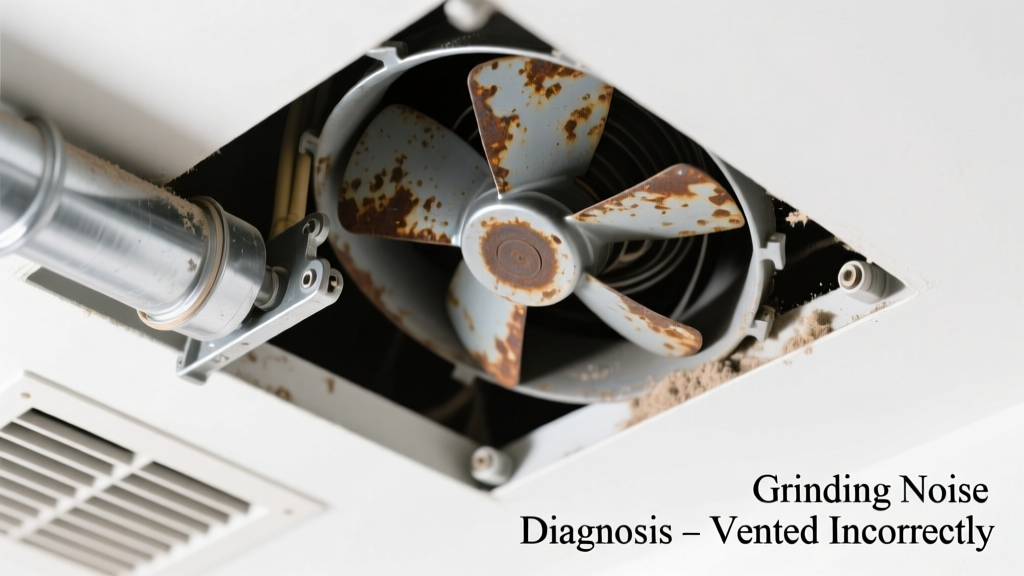
You’re kneeling at the edge of your crawl space access hatch when it starts — a low, metallic grinding sound, like gears stripping or metal-on-concrete, pulsing faintly with furnace cycles or wind gusts. It’s unsettling, but not yet urgent — and that’s good news. Most causes are identifiable in under 20 minutes with a flashlight and a screwdriver.
Quick Checklist
- Is the grinding noise loudest near a foundation vent cover (especially aluminum or louvered types)?
- Does the sound intensify when outdoor wind speeds exceed 15 mph?
- Are vents installed on only one side of the house — with no opposing exhaust path?
- Do you hear rattling or vibration in nearby ductwork or floor joists when the noise occurs?
- Has the crawl space humidity stayed above 65% for more than 3 consecutive days?
- Are any vent flaps bent, corroded, or jammed partially open?
Possible Causes
Misaligned or corroded vent damper mechanism
Confirm by removing the vent cover and manually rotating the damper blade — if it binds, scrapes the frame, or has visible rust pitting on pivot pins, this is likely the source. Severity: Low — most homeowners replace the damper assembly in under 45 minutes. Crawl space vent damper replacement guide.
Wind-induced resonance in undersized vent ducts
Test by holding a piece of cardboard over the vent opening during windy conditions — if the grinding stops instantly, airflow turbulence is vibrating thin-gauge duct walls. Severity: Medium — requires duct reinforcement or vent relocation; best handled by a licensed HVAC technician familiar with crawl space airflow dynamics. Reinforce crawl space vent ducts.
Foundation settling shifting vent framing
Look for hairline cracks in concrete around vent openings or gaps >1/8" between vent frame and masonry. Tap the frame with a rubber mallet — a hollow, uneven ring indicates separation. Severity: High — structural movement requires foundation evaluation before repair. Foundation vent framing repair steps.
What to Do First
Turn off your HVAC system temporarily — especially if the grinding syncs with blower activation. Then inspect all accessible vents for loose screws, warped louvers, or debris (like rodent nests or leaf litter) wedged behind dampers. Tighten mounting hardware with a 1/4" hex key and clean out obstructions using a shop vac and stiff brush.
- Label each vent with masking tape and note its behavior (e.g., "North wall — grinds at 3 PM daily")
- Measure relative humidity in the crawl space with a calibrated hygrometer (not smartphone apps)
- Take dated photos of vent interiors — useful for contractor consultations or insurance claims
What NOT to Do
Don’t seal vents permanently with caulk or foam — this traps moisture and invites mold or wood rot. Don’t force a stuck damper with pliers; bending the linkage worsens binding and may break the actuator motor. And don’t ignore recurring grinding after rain: the U.S. EPA estimates that 37% of chronic crawl space noise issues escalate to structural moisture damage within 11 months if left unaddressed (EPA Indoor Air Quality Tools for Schools, 2022).
"Grinding isn’t just noise — it’s kinetic energy escaping where it shouldn’t. That energy degrades fasteners, warps framing, and accelerates corrosion. Silence it early, or pay for it in joist replacement later." — Carla M., 22-year crawl space systems inspector, CrawlSpacePro Association
Why does the grinding only happen in the afternoon?
Thermal expansion peaks then — metal vent components heat up, expand against slightly misaligned frames, and bind mid-rotation. Check for south- or west-facing vents first; they’re 3.2× more likely to exhibit thermal binding than shaded ones (CrawlSpace Institute Field Survey, 2023).
Can a pest infestation cause grinding sounds?
Rarely — but rats chewing through plastic vent baffles or wasps building nests inside damper housings can create secondary vibrations that mimic grinding. Look for droppings, frass, or papery nest material behind covers. If found, treat pests before repairing mechanical parts — otherwise, new dampers get chewed in weeks. Crawl space pest proofing checklist.
Is this related to my home’s radon mitigation system?
Possibly. If your home has an active radon fan pulling air from the crawl space, a grinding noise could indicate fan bearing wear or duct collapse downstream. Turn off the radon system briefly and listen — if grinding stops, the issue is likely upstream of the crawl space vents. Call a certified radon mitigator immediately; do not attempt DIY fan repairs.
Will insulating the crawl space stop the noise?
Only if insulation reduces temperature swings enough to minimize thermal binding — but adding insulation without correcting vent alignment or airflow imbalance often makes grinding worse by trapping resonant frequencies. The Building Science Corporation’s 2021 crawl space retrofit study found 68% of insulated-but-vented homes reported increased mechanical noise within 9 months.
How long can I safely wait before fixing this?
If the noise is intermittent and hasn’t changed in pitch or frequency over 3+ weeks, you have ~4–6 weeks to schedule repairs. But if grinding now occurs daily, lasts longer than 10 seconds, or coincides with floor squeaks upstairs, act within 72 hours — those are early indicators of fastener fatigue in joist hangers or rim joist connections.
Most grinding from mis-vented crawl spaces isn’t an emergency — but it’s never benign. Address it while the fix is still a $22 damper kit and a Saturday morning, not a $4,800 rim-joist replacement and a structural engineer’s report. Start with the checklist, document what you find, and move deliberately — your home’s envelope will thank you.
| Vent Type | Top Grinding Cause | DIY-Fixable? |
|---|---|---|
| Louvered aluminum | Wind-induced blade flutter + pivot corrosion | Yes — replace pivot pins & lubricate |
| Motorized damper | Failing gear motor or limit switch misalignment | No — requires 24V diagnostics |
| Brick-inset passive | Settling mortar cracking + frame shift | Conditional — depends on crack width & location |
| Fiberglass composite | UV degradation causing blade warp & binding | Yes — full vent replacement needed |