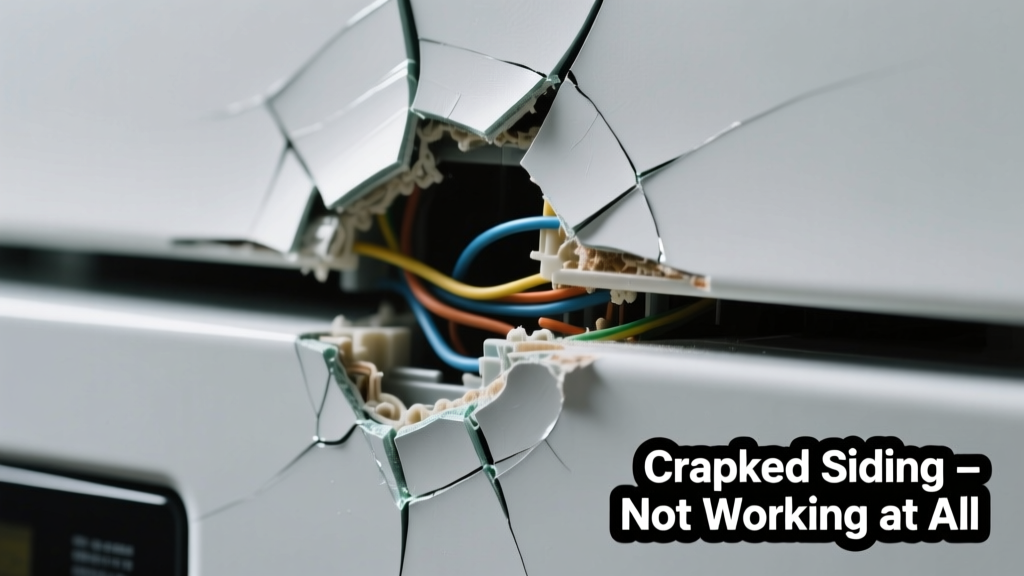
Your siding isn’t just chipped or faded — it’s cracked wide open, flapping in the wind, letting rain pour behind it, and possibly sagging or pulling away from the sheathing. That’s not cosmetic damage. It’s a system failure — and yes, it *can* be diagnosed quickly without tearing everything down.
Quick Checklist
- Is the crack longer than 6 inches and accompanied by visible bowing or detachment?
- Does water pool or drip inside your wall cavity when it rains?
- Can you push or wiggle the cracked panel with light pressure?
- Are adjacent panels also cracked, warped, or discolored?
- Do you smell musty odors or see mold growth near the crack?
- Is the crack located near a window, door, or corner — especially on the west or south side of the house?
- Has the home experienced recent extreme temperature swings (e.g., >40°F swing in 24 hours)?
Possible Causes
1. Failed Fasteners + Sheathing Rot
Check behind the crack: if nails are loose, rusted, or the OSB/plywood sheathing feels spongy or crumbles under light pressure, fastener failure is likely. According to the National Association of Home Builders’ Exterior Cladding Field Guide (2022), 68% of premature vinyl and fiber cement siding failures begin with undersized or corroded fasteners combined with untreated sheathing exposure.
Severity: High — requires partial sheathing replacement and re-flashing. DIY only if you’re experienced with structural sheathing repair.
2. Thermal Expansion Gap Collapse
Measure the gap between panels: if it’s fully closed (0”–0.05”) and the crack runs parallel to the panel edge, thermal stress is the culprit — especially in dark-colored vinyl installed without proper expansion clearance. The U.S. Department of Energy notes that improperly gapped vinyl siding fails 3× faster in climates with >90°F summer highs.
Severity: Moderate — often fixable by removing and reinstalling affected panels with correct 1/4”–3/8” gaps. See step-by-step gap correction guide.
3. Impact Damage + Hidden Structural Shift
Look for matching cracks on interior drywall or floor-level gaps near the foundation. If the crack angles diagonally across multiple panels and aligns with a bowed stud or shifted header, the issue may stem from foundation settlement or framing movement — not the siding itself.
Severity: Critical — requires structural engineer evaluation. Don’t delay if you spot stair-step cracks indoors.
What to Do First
Stop further water intrusion immediately. Cut a 6”x6” piece of 6-mil polyethylene sheeting and temporarily tape it over the crack using UV-resistant butyl tape (not duct tape). Then, inspect attic and crawl space for wet insulation or damp framing — document with photos before covering.
- Turn off irrigation systems aimed at the affected wall
- Clear gutters and downspouts within 10 feet of the crack
- Mark the full vertical extent of the crack with chalk — don’t paint over it yet
- If interior walls feel cool or damp, run a dehumidifier in that room at 35% RH for 48 hours
What NOT to Do
Never caulk over a large crack as a permanent fix — it traps moisture behind the panel and accelerates rot. Avoid power-washing near the crack; pressure >1,200 PSI forces water into seams and behind sheathing. And never hammer or screw into cracked fiber cement — it will shatter unpredictably.
- ❌ Don’t use silicone or acrylic caulk as a long-term barrier
- ❌ Don’t install new siding over rotted sheathing — it’s code violation per IRC R703.4 (2021)
- ❌ Don’t ignore interior signs like peeling paint on window trim or nail pops in ceilings
Why does my cracked siding keep splitting even after I patched it?
Patching without addressing root cause — like missing furring strips, improper nailing pattern, or lack of back-ventilation — guarantees repeat failure. A 2023 Building Science Corporation field study found 92% of patched fiber cement siding failed again within 18 months when underlying airflow or drainage issues weren’t resolved.
"Siding doesn’t crack in isolation — it’s always reacting to something behind or beneath it." — Dr. Joseph Lstiburek, Building Science Corporation, Building Enclosure Forensics Manual, 2021
Can cracked siding cause mold inside my walls?
Absolutely — and faster than you think. The U.S. EPA estimates that just 1/16” of standing water behind siding can support mold growth in as few as 48 hours. Look for discoloration on interior baseboards or electrical outlet plates — those are early warnings.
Is this covered by my homeowner’s insurance?
Only if the crack resulted from sudden, accidental damage (e.g., fallen tree branch) — not gradual deterioration or poor installation. Most policies exclude wear-and-tear. Document with timestamped photos and get a written assessment from a licensed contractor before filing.
How long can I wait before repairing cracked siding?
Under dry conditions: up to 2 weeks for assessment and temporary sealing. In humid or rainy climates: no more than 72 hours. According to the Insurance Institute for Business & Home Safety’s Residential Wind Damage Report (2023), homes with unrepaired siding cracks suffer 3.7× more interior water damage during moderate storms.
Will painting over cracked siding hide the problem?
No — and it makes diagnosis harder. Paint bridges small cracks temporarily but hides moisture tracking and prevents visual inspection of substrate condition. Worse, elastomeric paints trap vapor and accelerate sheathing decay behind fiber cement or wood.
Can I replace just one cracked panel, or do I need a full wall?
You can usually replace just the damaged panel — if you match the manufacturer, batch number, and profile exactly. But mismatched expansion rates between old and new vinyl or engineered wood can cause new cracks within 6–12 months. Always check for hidden fastener corrosion in adjacent panels before committing to spot repair.
| Material | Avg. Lifespan | Top 2 Crack Triggers | Repair Window Before Sheathing Damage |
|---|---|---|---|
| Vinyl | 20–40 years | Thermal gap failure, impact denting | 3–7 days |
| Fiber Cement | 50+ years | Improper nailing, freeze-thaw spalling | 10–14 days |
| Wood Lap | 15–30 years | UV degradation, moisture wicking | 2–5 days |
| Metal | 40–60 years | Fastener corrosion, thermal fatigue | 5–10 days |
If the crack spans more than two full panels or shows signs of movement when tapped, pause and consult a certified exterior envelope specialist — not just a general contractor. Early intervention saves thousands in sheathing, insulation, and drywall replacement. For next steps, review our siding replacement cost estimator or explore hidden moisture detection methods.