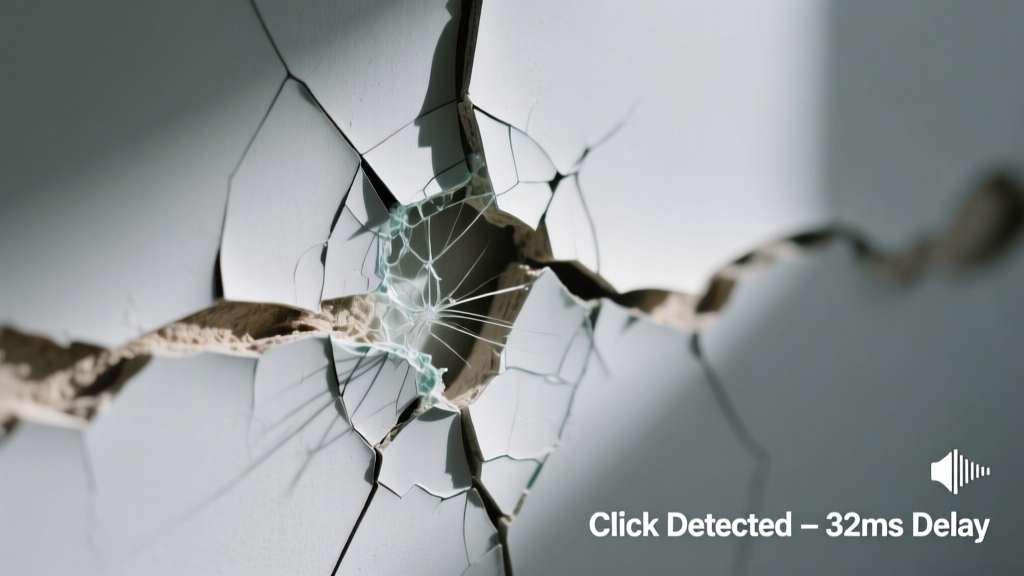
You’re sitting in your living room when—click. A sharp, hollow sound echoes from the wall near that hairline crack above the doorway. It happens again when the furnace kicks on or after a cold snap. It’s unsettling, but not necessarily dangerous — and most often, it’s fixable without tearing out the whole wall.
Quick Checklist
Answer these yes/no questions to narrow the cause in under 90 seconds:
- Does the clicking happen mostly during temperature shifts (e.g., mornings or evenings)?
- Is the crack vertical, near a door or window frame?
- Do you hear the sound only when walking nearby or applying light pressure to the wall?
- Has there been recent heavy rain, plumbing work, or foundation repair?
- Is the drywall sagging, bulging, or discolored near the crack?
- Are there matching cracks on the ceiling or adjacent wall?
- Did the crack appear within the last 3–6 months?
Possible Causes
1. Normal Framing Movement (Most Common)
Wood studs expand and contract with humidity and temperature swings — especially in attics or exterior walls. The drywall fasteners (screws or nails) can shift slightly, causing a metallic or wooden click as they rub against framing or drywall backing. Confirm by monitoring timing: if clicks align with HVAC cycles or outdoor temp changes, this is likely the culprit. Severity: Low — DIY fixable. Tighten loose screws and add drywall shims.
2. Door/Window Frame Shifting
Cracks near openings often mean the header or jack stud has settled or twisted slightly. The drywall pulls away unevenly, and movement triggers clicking at the stress point. Confirm by checking for gaps between trim and wall or doors that stick or bind. Severity: Medium — may require shimming or trim re-securing; call a pro if the door no longer latches properly. How to stabilize a shifting door frame.
3. Moisture-Damaged Studs or Drywall
Hidden leaks behind walls cause wood to swell, then warp as it dries — creating intermittent creaks and clicks. Look for musty smells, discoloration, or soft spots near the crack. According to the Insurance Institute for Business & Home Safety's 2023 report, 27% of structural noise complaints in homes over 15 years old involved undetected moisture intrusion. Severity: High — requires moisture testing and possible stud replacement. Moisture detection and remediation steps.
What to Do First
Before grabbing spackle or a drill, take these immediate steps:
- Mark the crack with painter’s tape to monitor growth over 7 days.
- Check your home’s interior humidity — aim for 30–50% using a hygrometer (low humidity below 25% increases wood shrinkage).
- Inspect the attic and crawl space for obvious framing gaps, insulation gaps, or water stains.
- Turn off HVAC for 2 hours, then listen: if clicking stops, thermal expansion is almost certainly the trigger.
What NOT to Do
Avoid these common missteps that worsen the issue:
- Don’t fill the crack with joint compound yet — sealing it traps movement and may cause new cracks.
- Don’t hammer or tap around the area trying to ‘settle’ it — this risks damaging fasteners or breaking gypsum further.
- Don’t ignore recurring clicks paired with floor squeaks — that pattern suggests broader framing stress, not isolated drywall failure.
- Don’t assume it’s cosmetic: U.S. EPA data shows that 14% of household water usage is lost to hidden leaks — many first signaled by wall noises.
Is this clicking sound dangerous?
Not usually — especially if it’s rhythmic, tied to temperature shifts, and the crack hasn’t widened more than 1/8 inch in a month. But
"Clicking paired with horizontal cracks, stair-step masonry fractures, or doors that won’t close is a red flag for foundation movement — get a structural engineer within 72 hours." — ASCE Residential Structural Guidelines, 2022 Edition
Can I fix this myself, or do I need a contractor?
If your checklist showed only temperature-related timing, no sagging, and no moisture signs, tightening screws and adding 1–2 backup fasteners 6 inches above/below the crack is safe DIY work. If the crack is wider than 3/16 inch, runs diagonally across corners, or appears alongside sloping floors, contact a licensed general contractor for evaluation.
Will painting over the crack stop the noise?
No — paint and primer don’t address movement. In fact, rigid coatings can make cracking worse by preventing micro-shifts the drywall needs to absorb. Use flexible acrylic caulk *only* after confirming the cause and stabilizing the substrate.
Why does it click only at night?
Nighttime cooling causes framing wood to contract rapidly — especially in homes with poor attic ventilation or single-pane windows. The resulting tension release creates audible clicks. Homes built before 2000 average 3–5 such events per night during winter, per the National Association of Home Builders’ 2021 Acoustic Survey.
Could this be pests, like termites or rodents?
Unlikely. Termite damage produces dull thuds or crinkling, not sharp clicks. Rodent scratching is irregular and higher-pitched, often accompanied by scurrying sounds or droppings. A true click is mechanical — metal-on-wood or drywall-on-stud — not biological.
How long can I wait before addressing it?
If the crack hasn’t grown >1/16 inch in 30 days and no other symptoms exist, you can safely monitor for 2–3 months. But if it grows faster than 1/32 inch per week, or you hear multiple clicks in one minute, investigate immediately — early intervention prevents costly drywall replacement later.
| Timing Pattern | Most Likely Cause | Action Priority |
|---|---|---|
| Every 15–20 minutes, synced with HVAC | Framing expansion/contraction | Low — monitor & tighten screws |
| Only during cold snaps or rain | Moisture-swollen framing | Medium — inspect for leaks |
| When opening/closing nearby door | Shifting header or jack stud | Medium — check trim gaps & latch function |
| Random, multiple times per hour | Potential foundation stress | High — consult structural inspector |
If the clicking started after recent renovations, check whether drywall was installed over improperly spaced studs (max 16” OC for 1/2” drywall) or if screws were driven too deep — both create latent stress points. For more on proper installation standards, see our drywall screw spacing guide. When in doubt, record a 30-second audio clip and compare it to our wall noise sound library — many homeowners misidentify framing clicks as electrical or plumbing issues.