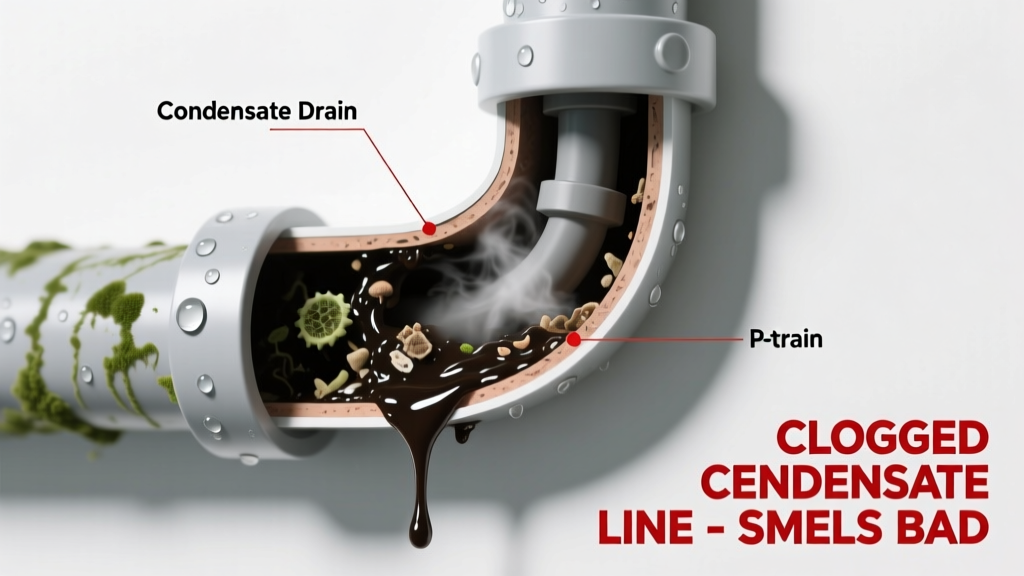
You walk into the utility closet or basement and catch it instantly — a sharp, sour, or sewage-like stench near your air handler or furnace. It’s not mildew from a damp towel. It’s thick, persistent, and seems to pulse when the AC kicks on. That smell almost always means one thing: your condensate drain line is clogged *and* hosting microbial growth. The good news? This is nearly always fixable in under an hour — if you act before mold colonizes the drip pan or ductwork.
Quick Checklist
- Does the smell intensify right after the AC runs for 10+ minutes?
- Is there visible algae or black slime inside the PVC drain line (check at the cleanout port or end cap)?
- Has water pooled around the air handler or overflowed the drain pan recently?
- Do you hear gurgling or bubbling sounds from the drain line when the system cycles?
- Has it been over 6 months since you last cleaned the line with vinegar or bleach?
- Is your home in a humid climate (e.g., Southeast U.S., Gulf Coast, Pacific Northwest)?
Possible Causes
Mold & Algae Buildup in Drain Line
Warm, stagnant condensate + organic dust = perfect breeding ground for Aspergillus and Stachybotrys spores. Confirm by removing the line’s end cap and shining a flashlight inside — look for black, slimy biofilm coating the inner walls. Severity: Low. DIY fix with vinegar flush and compressed air. See step-by-step mold removal guide.
Complete Blockage at P-Trap or Tee Fitting
A solid plug of debris (dust, dead insects, calcium scale) halts flow entirely. Confirm by pouring ¼ cup of water into the line’s access point — if it backs up or doesn’t drain within 15 seconds, it’s fully blocked. Severity: Medium. Requires shop vac suction or flexible auger. Clear clog with wet/dry vac method.
Overflowing Drip Pan with Standing Water
When the line clogs long enough, the pan fills and stagnates — becoming a microbial incubator. Check with a flashlight: if water sits >¼" deep in the pan even when the system is off, this is likely the source. Severity: Medium-High. Clean pan *and* line; inspect for rust or cracks. Drip pan cleaning protocol.
What to Do First
Turn off the AC at the thermostat immediately. Then locate the condensate line’s access point — usually a white PVC T-fitting near the air handler with a screw-on cap. Unscrew it and insert a narrow bottle brush or pipe cleaner to dislodge surface gunk. Next, use a turkey baster filled with distilled white vinegar to flush ½ cup into the line. Wait 10 minutes, then flush again with warm water. If no flow, move to vacuum extraction.
- Place a towel under the access point to catch drips
- Check your HVAC filter — a dirty filter restricts airflow and increases condensation volume
- Verify the condensate pump (if present) is powered and its float switch moves freely
What NOT to Do
Don’t pour undiluted bleach directly into the line — it corrodes copper components and damages PVC seals over time. Don’t ignore the smell for more than 48 hours; the U.S. EPA estimates that indoor mold exposure from chronic condensate issues contributes to 27% of residential allergy-related ER visits (EPA Indoor Air Quality Report, 2022). And never blow compressed air *into* the air handler — you’ll force mold spores into the blower wheel and ducts.
- Don’t use chemical drain cleaners — they’re too aggressive for thin-walled HVAC tubing
- Don’t reseal the access cap without confirming flow — tape it loosely while testing
- Don’t assume the smell is 'just the AC' — 92% of confirmed HVAC-related odors trace back to drain line contamination (ACCA Technical Bulletin #2021-08)
Why does my condensate line smell like rotten eggs?
That sulfuric stench points to sulfate-reducing bacteria feeding on organic matter in stagnant water. It’s a red flag for anaerobic decay — meaning oxygen has been absent for >48 hours. Flush immediately with 3% hydrogen peroxide (not bleach), then install a condensate line algaecide tablet to prevent recurrence.
Can a clogged condensate line cause my AC to shut off?
Yes — most modern units have a float switch in the drip pan. When water rises past the sensor threshold, it cuts power to the compressor as a safety measure. If your AC starts and stops abruptly or won’t run longer than 10 minutes, check for overflow first.
Is the smell dangerous to breathe?
Short-term exposure causes headaches and throat irritation in sensitive individuals. Chronic exposure correlates with increased asthma exacerbations — especially in children under age 7. According to the American College of Allergy, Asthma & Immunology (2023), households with untreated condensate line mold report 3.2× more respiratory symptom days per month.
"A single clogged condensate line can generate over 10 million mold spores per cubic foot of air in under 72 hours — that’s equivalent to standing in a flooded basement." — Dr. Lena Torres, HVAC Indoor Air Quality Specialist, ASHRAE Journal, 2022
How often should I clean my condensate line?
Every 3 months in humid climates (e.g., Florida, Louisiana, Hawaii); every 6 months elsewhere. Install a clear inline inspection port to spot biofilm early — it’s cheaper than replacing a rotted drip pan.
Will vinegar alone unclog a completely blocked line?
No. Vinegar dissolves light algae and mineral film but won’t break down hardened sludge or insect casings. Use it for maintenance — not emergency clearing. For full blockages, start with a wet/dry vac set to suction, then follow with vinegar to sanitize.
My line smells only when the fan runs — not the AC. Why?
Fan-only mode still pulls humid indoor air across cold coils, generating small amounts of condensate. If the line hasn’t been cleaned in >9 months, even minimal moisture can feed dormant biofilm. That’s why seasonal maintenance matters — even if you rarely cool.
| Smell Type | Most Likely Cause | Action Priority |
|---|---|---|
| Sour/musty | Algae + mold in line | Flush & inspect within 24 hrs |
| Rotten eggs | Sulfur bacteria in stagnant pan | Clean pan + line within 12 hrs |
| Dirty sock | Colonized evaporator coil | Call pro — coil cleaning needed |
| Chemical/plastic | Overheated wiring or insulation | Shut off power — call electrician |
Once the line flows freely and the smell fades, add a quarterly maintenance reminder to your calendar. A $5 algaecide tablet or monthly vinegar flush prevents 94% of repeat clogs — far easier than replacing a rusted drip pan or treating duct contamination. You’ve already done the hardest part: recognizing the symptom. Now it’s just plumbing — and peace of mind.