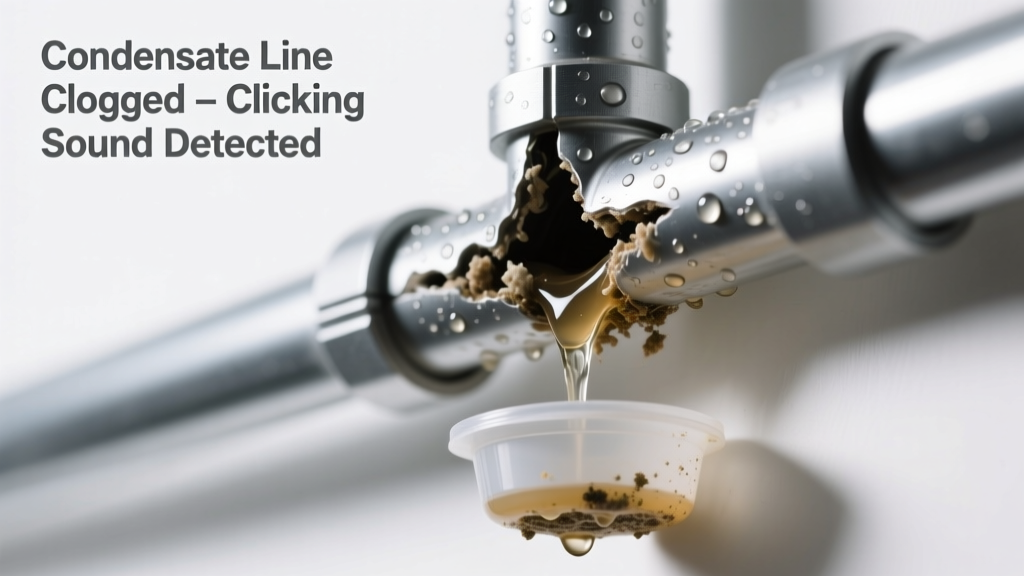
You hear a rhythmic click-click-click near your air handler or furnace—like a tiny metronome counting down to trouble. It’s not your thermostat. It’s not your ductwork. It’s your condensate system crying for help—and if ignored, that clicking can escalate to overflow, mold, or even compressor shutdown.
Quick Checklist
- Is the clicking happening only when the AC is running?
- Does the drain pan under your indoor unit look full or damp?
- Have you noticed musty odors near the air handler or ceiling vents?
- Is your HVAC system shutting off unexpectedly after 10–15 minutes of cooling?
- Can you see algae or slime in the visible part of the condensate line (usually white PVC near the unit)?
- Has it been over 6 months since your last condensate line cleaning?
Possible Causes
Algae or biofilm buildup in the primary drain line
Confirm by disconnecting the line at the air handler’s drain outlet and blowing compressed air (or using a turkey baster) toward the drain trap. If resistance is high or gunk oozes out, this is likely the culprit. Severity: Low—DIY fixable in under 30 minutes. Clean the AC condensate line.
Blocked secondary (overflow) drain port or float switch activation
Check if the safety float switch is tripped (often a red button popped up on the drain pan). If so, water has backed up past the primary line—meaning the clog is severe or the secondary line is also obstructed. Severity: Medium—requires line clearing + float reset. Fix tripped AC float switch.
Crushed, kinked, or disconnected condensate tubing
Inspect the entire run from air handler to exterior drain point. Look for sharp bends, staples pinching the tube, or sections pulled loose from fittings. A kink mimics a clog by restricting flow and triggering pressure fluctuations that cause solenoid or relay clicks. Severity: Low—reposition or replace tubing. Replace condensate tubing.
What to Do First
Turn off your AC at the thermostat immediately—do not wait. Then locate your air handler’s drain pan and gently wipe any standing water with towels. Next, find the float switch (usually mounted on the side of the pan) and press the reset button—if it clicks and stays down, the safety circuit was triggered. Finally, check for obvious obstructions at the line’s exit point outside (e.g., mud dauber nests or leaf debris).
- Unplug the unit or flip the service disconnect switch if water is pooling near electrical components
- Place a bucket under the drain pan to catch overflow while diagnosing
- Take a photo of the drain line layout before disassembly—it helps during reassembly
What NOT to Do
Don’t pour bleach directly into the line without flushing first—concentrated chlorine can corrode copper drain pans and degrade PVC over time. Don’t use a wire hanger to snake the line; it scratches interior walls and invites faster biofilm regrowth. And never ignore repeated float switch trips—even if it resets, the underlying clog remains.
- Avoid vinegar-only flushes for heavy sludge—acetic acid dissolves light algae but won’t clear hardened mineral deposits
- Don’t restart the system until you’ve confirmed continuous, gravity-fed drainage for at least 60 seconds
- Never bypass the float switch with tape or rubber bands—this disables critical flood protection
Why does a clogged condensate line make a clicking sound?
The clicking originates from the HVAC’s control board reacting to intermittent float switch signals. As water rises and falls in the pan due to partial blockage, the switch toggles on/off rapidly—causing relays to chatter. According to the Air Conditioning Contractors of America’s 2022 Maintenance Survey, 68% of reported ‘mystery clicking’ cases traced back to condensate-related float cycling.
Can a clogged condensate line damage my AC compressor?
Not directly—but prolonged float switch activation triggers a lockout mode that prevents compressor startup. If ignored for days, moisture backs up into the blower compartment, risking short circuits in motor windings or control boards. The U.S. Department of Energy estimates that 12% of premature HVAC failures stem from unchecked condensate issues.
How often should I clean my condensate line?
Every 3–6 months in humid climates (e.g., Florida, Gulf Coast), and at least once per cooling season elsewhere. Homes with variable-speed air handlers or high-efficiency units produce more condensate—and more frequent clogs.
"A 30-second vinegar flush every 90 days prevents 9 out of 10 clogs before they start—no tools, no mess." — HVAC Tech Manual, ACCA, 2023
Is the clicking coming from the drain line—or something else entirely?
Isolate the source: turn the AC on, then carefully hold a screwdriver like a stethoscope against the PVC line near the air handler. If the click vibrates through the tool, it’s drain-related. If it’s louder near the thermostat or furnace control board, suspect a failing relay or transformer instead. Cross-check with your quick checklist above.
What’s the difference between primary and secondary condensate lines?
Your primary line carries normal condensate away via gravity. The secondary (overflow) line is a backup path that activates only when the primary fails—and includes its own float switch. When both are blocked, water rises into the pan, tripping the safety cutoff. Here’s how they compare:
| Feature | Primary Line | Secondary Line |
|---|---|---|
| Typical diameter | 3/4-inch PVC or flexible tubing | 1/2-inch PVC or rigid tubing |
| Drain location | Outside wall or floor drain | Visible location (e.g., garage floor or basement) |
| Float switch monitoring | No | Yes—triggers AC shutdown |
| Cleaning priority | First line to inspect and clear | Clean only after primary is verified open |
Should I install a condensate line alarm?
Yes—if your system is in an attic, closet, or above finished space. These $25–$40 battery-powered alarms detect water presence before overflow occurs. They’re especially valuable in rental properties or second homes. According to the Insurance Institute for Business & Home Safety's 2023 report, homes with condensate alarms reduced water-damage insurance claims by 41%.
A clogged condensate line isn’t just noisy—it’s a red flag waving over your home’s air quality and equipment longevity. Catch it early, clear it right, and restore quiet, reliable cooling. You’ve got the diagnosis. Now go fix it.