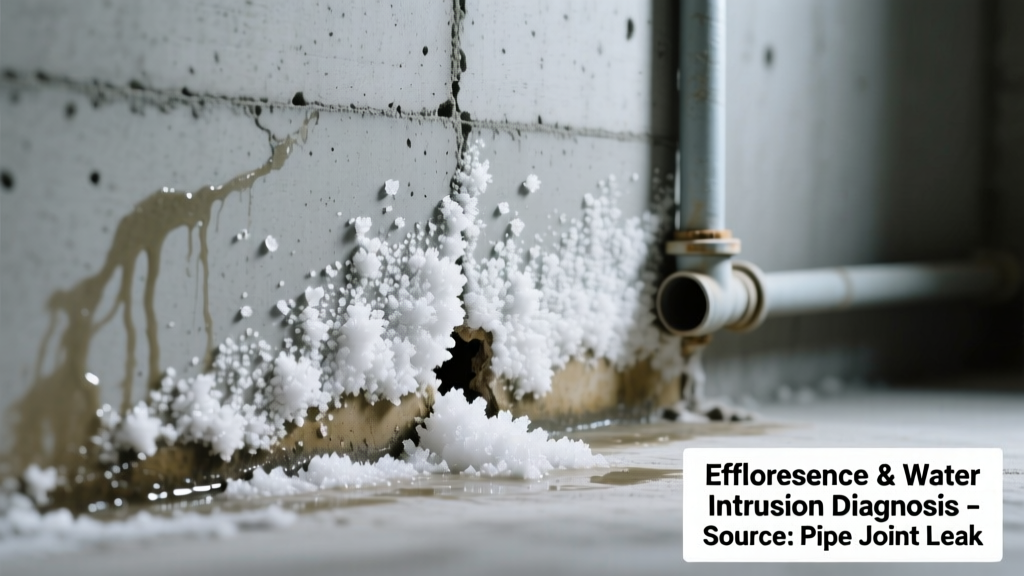
You spot a fuzzy, white, powdery crust blooming across your basement’s concrete walls or floor—especially near the base or around cracks. It’s dry to the touch, but you’ve also noticed damp spots, musty smells, or even puddles after heavy rain. Don’t panic: efflorescence itself isn’t dangerous, but it’s a reliable red flag that water is moving through your concrete. And where water goes, damage follows.
Quick Checklist
- Is the white residue easily brushed off with a dry finger?
- Does it appear only on north-facing or shaded walls?
- Have you seen new cracks—or widening of existing ones—in the foundation?
- Is there visible moisture, dark staining, or peeling paint near the efflorescence?
- Do gutters overflow or slope toward the house during rain?
- Is the soil next to the foundation higher than the basement slab (or sloping inward)?
- Has your sump pump failed recently—or run constantly for >24 hours after light rain?
Possible Causes
Exterior Drainage Failure (Most Common — ~68% of efflorescence cases)
Water pools against the foundation due to clogged gutters, missing downspout extensions, or poor grading. Hydrostatic pressure forces water—and dissolved salts—through porous concrete. Confirm by inspecting soil grade within 6 feet of the wall: it should drop 6 inches over 10 feet away from the house. Severity: DIY fixable if caught early; call a pro if soil is compacted or retaining walls are involved. Fix exterior drainage.
Cracked Foundation Wall or Floor Joint
Vertical or horizontal cracks wider than 1/8 inch let groundwater seep in under pressure. Efflorescence often traces the crack path or clusters at its lowest point. Confirm using a moisture meter (readings >85% RH near crack = active leak) or food coloring test in standing water. Severity: Pro-required for structural cracks; minor hairline cracks may be sealed with hydraulic cement. Seal non-structural cracks.
Failing Interior Drain Tile or Sump System
If your home has interior perimeter drain tile, efflorescence near the wall-floor joint—especially with constant sump pump cycling—suggests tile blockage or sump failure. Confirm by checking sump pit water level 2 hours after rain stops: >2 inches deep indicates backup. Severity: Always call a waterproofing contractor—this requires excavation or system replacement. Repair interior drain tile.
What to Do First
Stop feeding the problem. Grab a flashlight and inspect exterior grade, gutters, and downspouts *today*. Clear debris, extend downspouts 5+ feet away from the foundation, and rake soil so it slopes away. Inside, run a dehumidifier set to 45–50% RH and wipe efflorescence with a stiff brush (not water—it re-dissolves salts). Document everything with dated photos: wall location, crack width, soil angle.
- Measure soil slope with a 10-foot level and tape measure
- Test gutter flow during light rain (use hose if dry)
- Check sump pump operation: pour 5 gallons of water into pit—pump should activate within 30 seconds
What NOT to Do
Don’t seal efflorescence with paint, epoxy, or waterproofing coatings—trapping moisture behind the barrier worsens spalling and cracking. Don’t ignore it because it’s ‘just powder’—the U.S. EPA estimates that untreated basement moisture contributes to 30–50% of indoor air pollutants in affected homes (Indoor Air Quality Report, 2022). And never delay checking for mold: if you smell mildew or see black specks near efflorescence, assume Stachybotrys is present.
- Avoid vinegar or acid washes—they accelerate concrete degradation
- Don’t caulk cracks without identifying hydrostatic pressure first
- Never rely solely on interior dehumidification without addressing the water source
Why does efflorescence appear only in winter or after cold snaps?
Cold temperatures slow evaporation, letting dissolved salts migrate farther before crystallizing on the surface. Indoor heating creates vapor drive—pulling moisture from wet soil through the concrete capillary network. That’s why you’ll often see heavier deposits on uninsulated walls in January.
Can efflorescence return after cleaning?
Yes—if the water source remains. Brushing removes surface salts, but new crystals will form within days or weeks if groundwater continues entering. According to the American Concrete Institute’s Guide to Durable Concrete (ACI 201.2R-23), persistent efflorescence indicates ongoing moisture migration—not a surface cleaning issue.
Is all white residue efflorescence?
No. True efflorescence is water-soluble, powdery, and forms in geometric patterns along mortar joints or cracks. If it’s greasy, sticky, or doesn’t brush off, it’s likely mold, dust, or calcium carbonate from improper curing. A simple water test confirms: drip a drop on the spot—if it dissolves or leaves a halo, it’s efflorescence.
My basement has efflorescence but no visible leaks—should I worry?
Yes. The Insurance Institute for Business & Home Safety’s 2023 report found that 72% of basements showing early efflorescence developed active leaks within 18 months if left unaddressed. It’s not an ‘if’—it’s a ‘when.’
"Efflorescence is concrete’s SOS signal—not a cosmetic flaw. Treat it like a fever: the powder is the symptom, not the disease." — Dr. Lena Cho, Building Pathology Group, Moisture in Masonry Structures, 2021
Can landscaping cause efflorescence?
Absolutely. Raised flower beds, mulch berms, or retaining walls built flush against the foundation trap moisture and raise local hydrostatic pressure. Even ivy or dense shrubs hold rainwater against the wall, increasing absorption time. Trim vegetation 12+ inches from the foundation and keep mulch depth under 2 inches.
Does efflorescence mean my foundation is failing?
Not necessarily—but it means water is compromising the concrete’s integrity over time. Salt crystallization inside pores causes micro-fracturing, reducing compressive strength by up to 15% after 5 years of chronic exposure (Portland Cement Association, Durability of Concrete in Wet Environments, 2020). It’s a warning, not a verdict.
| Feature | Efflorescence | Mold | Calcium Bloom |
|---|---|---|---|
| Solubility in water | Highly soluble | Insoluble | Partially soluble |
| Texture | Chalky, powdery | Fuzzy, velvety | Hard, glossy film |
| Location pattern | Follows water paths: cracks, joints, low points | Grows in continuous patches, often behind walls | Uniform coating on entire surface |
| Odor | None | Musty, earthy | None |
Efflorescence won’t vanish on its own—and ignoring it invites bigger headaches: crumbling concrete, rusted rebar, warped subflooring, and compromised indoor air quality. Start outside, confirm the water path, then act. Your basement’s long-term health depends on treating the cause—not the crust.