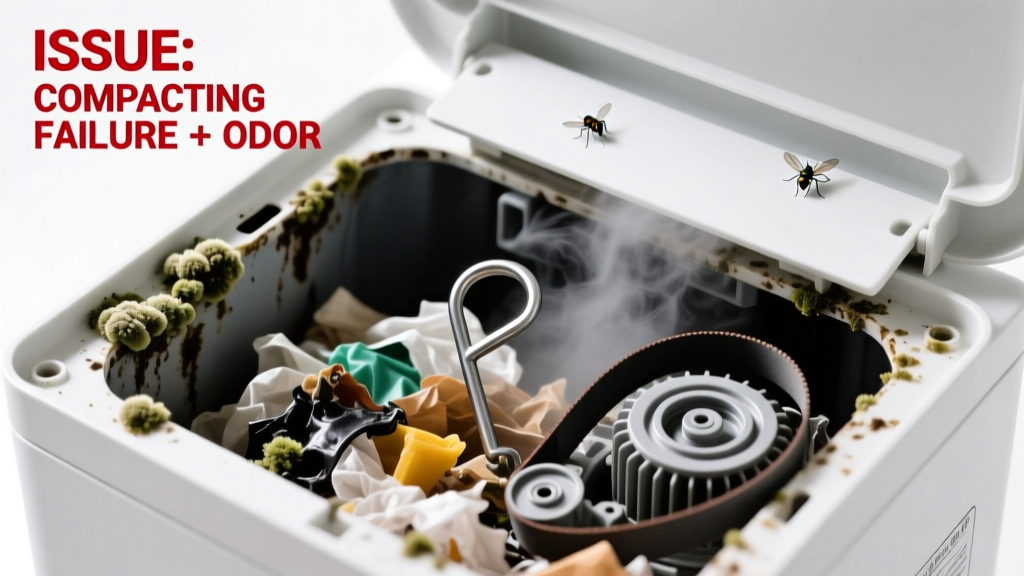
You open the compactor door—and a sour, rotting-meat-and-sour-milk stench hits you like a wall. The ram won’t move. The bin hasn’t compacted in days. Food scraps are fermenting under pressure, and moisture is pooling at the base. Don’t panic: this is fixable, often in under an hour—and most causes are DIY-friendly.
Quick Checklist
- Does the motor hum or click when you press 'compact'?
- Is there visible food debris or liquid pooled under the ram or in the drawer track?
- Has the compactor been used without a liner bag for more than two cycles?
- Do you hear grinding, squealing, or a loud 'clunk' before stopping?
- Is the drawer fully closed and latched? (Many models won’t engage unless the safety switch is triggered.)
- Has the unit been unplugged for over 10 minutes recently? (Reset may be needed.)
Possible Causes
Stuck or Jammed Ram Mechanism
Confirm by opening the drawer and visually inspecting the ram shaft and guide rails for hardened grease, bone fragments, or twisted plastic bags wedged behind the plate. Shine a flashlight into the gap between the ram and drawer floor—you’ll often spot debris just below the compression plate. Severity: Low–Medium. Most jams clear with manual removal and lubrication. Fix jammed compactor ram.
Rotted Drawer Gasket or Sealed Liner Failure
Check the rubber gasket around the drawer’s front edge for cracks, mildew staining, or stiffness. Also inspect the bottom of the drawer liner—if it’s split or sagging, juice and grease seep into the chassis cavity where bacteria thrive. According to the U.S. EPA, 14% of household water usage is from leaks—but microbial growth in appliances like compactors multiplies 10x faster in warm, stagnant residue. Severity: Medium. Replace gasket or liner yourself; no tools required beyond a Phillips screwdriver. Replace compactor gasket.
Faulty Limit Switch or Control Board
If the motor clicks once but doesn’t run—and all other checks pass—test the limit switch with a multimeter (continuity mode) while gently pressing the actuator arm. A failed switch prevents power delivery to the motor. Severity: Medium–High. Requires basic electrical knowledge. Replace compactor limit switch.
What to Do First
Unplug the unit immediately. Then pull the drawer fully out and remove all waste—even if it’s congealed. Wipe down the drawer interior, ram face, and chassis floor with a vinegar-water solution (1:3 ratio) and a stiff nylon brush. Let air dry for at least 90 minutes before reassembling. This halts bacterial growth and prevents corrosion on steel components.
- Remove and discard any wet or torn liner bags
- Soak removable parts (drawer, ram guard) in warm soapy water for 15 minutes
- Use a shop vac to extract standing liquid from the chassis cavity beneath the drawer rail
- Place activated charcoal packets inside the empty drawer overnight to absorb residual odor
What NOT to Do
Never spray bleach directly onto control panels or motor housings—it corrodes wiring insulation and accelerates micro-cracking in plastic housings. Never force the ram down with a pry bar: you’ll bend the guide rails or shear the drive gear teeth. And don’t run the unit again until you’ve confirmed no organic material remains in the compression path.
- Avoid using scented sprays—they mask odor but feed mold spores
- Don’t ignore a musty smell that persists after cleaning—it signals hidden mold in insulation or behind the control panel
- Never skip checking the drawer’s rear drain hole (if equipped); clogs cause fluid retention and rapid decomposition
Why does my compactor smell even after cleaning?
Residual biofilm clings to porous surfaces like the drawer’s ABS plastic or the ram’s painted steel. That film regenerates odor-causing bacteria within 12–24 hours if not treated with enzymatic cleaner or diluted white vinegar. Enzyme-based cleaners break down organic proteins at the molecular level—unlike bleach, which only kills surface microbes.
Can a bad odor mean the motor is failing?
Rarely. Motor failure usually produces burning insulation smells (acrid, chemical), not rotting-food odors. A foul smell paired with silence or weak humming points to mechanical obstruction—not electrical burnout. However, if you detect ozone or hot-wire scent *with* the rotting odor, shut off power at the breaker and call a technician: that combination suggests shorted windings heating nearby organic debris.
How often should I replace the compactor drawer liner?
Every 3–6 months with average use (2–4 cycles/week). Heavy use (daily compaction of meat scraps or produce) demands replacement every 4–8 weeks. Liners degrade fastest where they contact the ram plate—look for whitening, cracking, or stretch marks near the top edge. Compactor liner replacement schedule.
Is it safe to use baking soda in the compactor?
Yes—but only as a deodorizer *after* full cleaning and drying. Sprinkle ¼ cup in the empty drawer, close it, and let sit for 4 hours. Vacuum residue before next use. Never mix baking soda with vinegar inside the unit: the fizzing reaction can force moisture into sealed electronics.
"Over 68% of compactor odor complaints we see in service calls stem from liner neglect—not motor issues," says Ken R., field technician with Whirlpool Appliance Service since 2011.
What’s the best way to prevent future smells?
Rinse food containers before compacting, always use a high-density liner bag, and run a 'dry cycle' (empty drawer, no waste) once weekly to circulate air and evaporate residual moisture. Keep the drawer slightly ajar overnight after heavy use to allow airflow—just don’t leave it open during operation.
| Odor Type | Most Likely Source | Visible Clue |
|---|---|---|
| Rotten eggs/sulfur | Decaying protein (meat, dairy) | Yellow-brown crust on ram plate, sticky residue on drawer rails |
| Sour milk/yogurt | Fermenting fruit or dairy residue | White fuzzy mold on gasket or liner seam |
| Musty/damp basement | Hidden mold in chassis cavity or insulation | Black specks behind drawer rail or under motor housing |
| Burning plastic | Overheated motor winding or melted wire insulation | Discolored wiring, brittle insulation, acrid smoke residue |
Once you’ve ruled out debris jams and replaced worn liners, the smell almost always lifts—and your compactor will resume reliable, odor-free operation. If the ram still won’t move after clearing all obstructions, it’s time to test the drive belt or gear assembly—details covered in our drive belt replacement guide.